Study Scientific Computing
This study course has been discontinued. Application for the first semester no longer possible.
Mathematics is more than just calculating with pen and paper. Complex problems can be solved through modeling and simulation on powerful computers: How do I optimize a fuel cell? What flooding can I expect after a dam bursts? How do diseases spread?
Application Information (Higher Semester)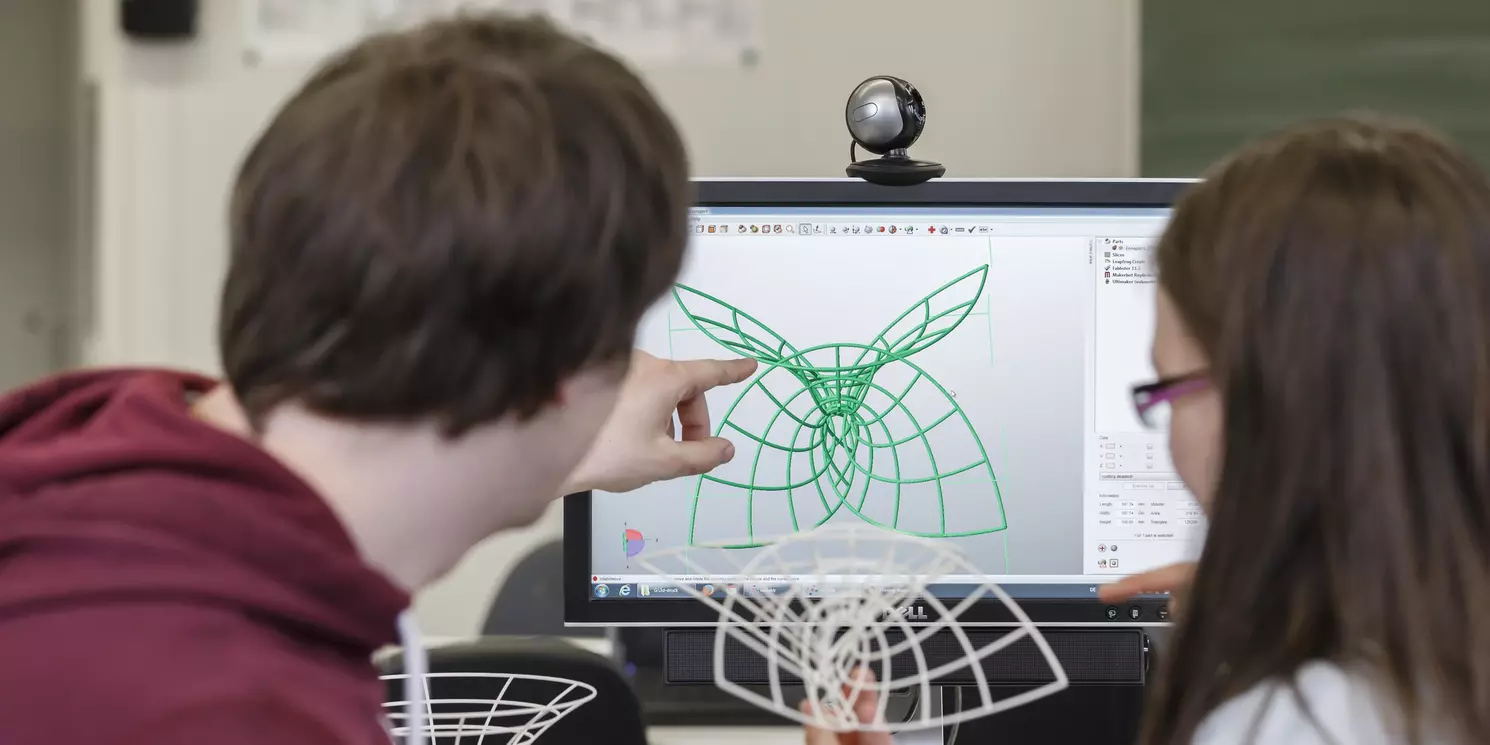
Learning content
What is the Scientific Computing (SC) degree program about?
You will receive a sound education in mathematics and computer science with a high degree of practical and application relevance. The course covers the following areas, among others:
- Fundamentals of mathematics: “Learning mathematics”, analysis and linear algebra, probability theory and statistics
- Fundamentals of modelling and simulation: numerics and differential equations, optimization and simulation, modelling projects, simulation projects
- Fundamentals of computer science: programming, machine learning and data science
- Advanced lectures: e.g. numerics of partial differential equations, optimization, operations research, signal processing
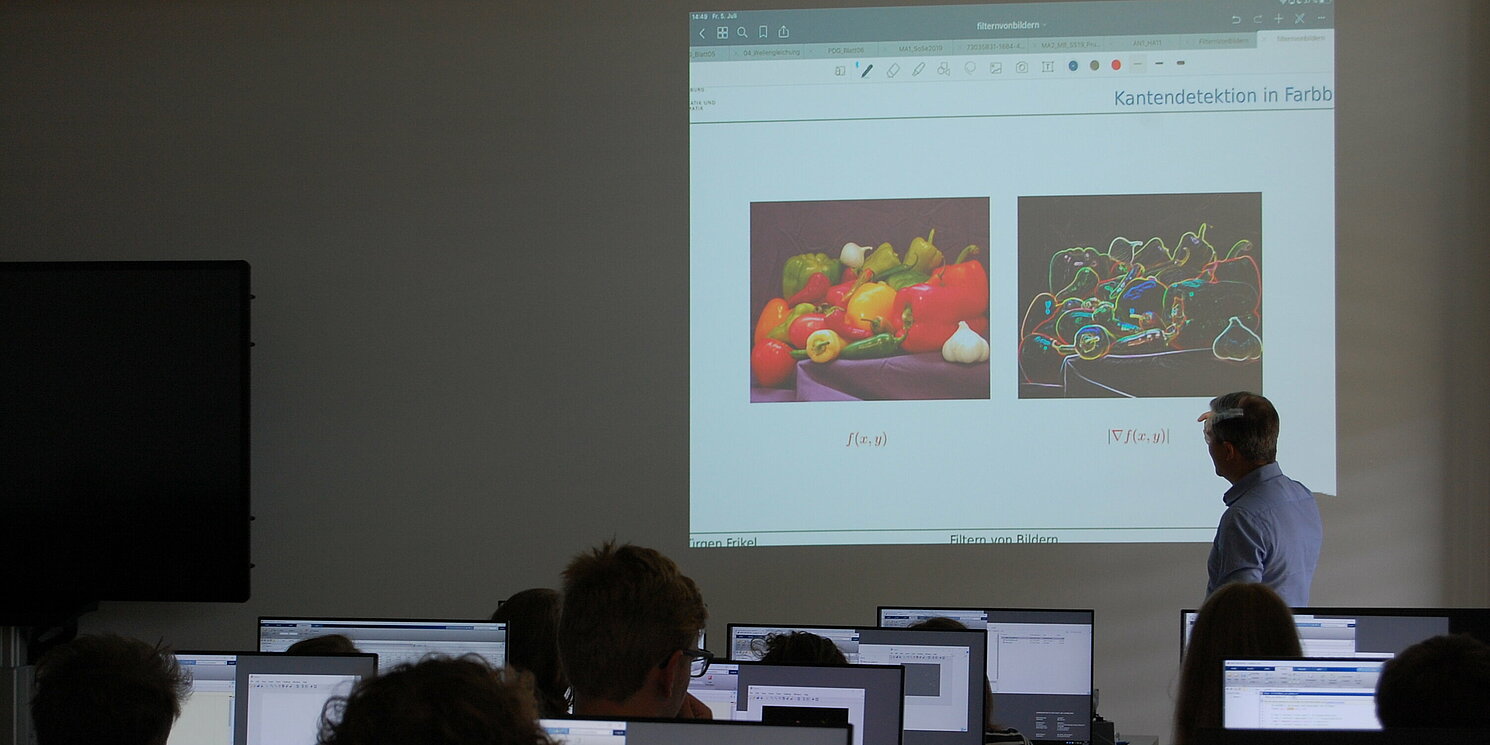
- Application lectures: e.g. image processing, robotics, parallel and distributed processes, simulation tools, etc.
- Practical semester: internship lasting several months
Career opportunities
Top career prospects
Do you want to hit the ground running in your professional life, do a Master's degree first or even aim for a doctorate?
Information on various follow-up options is summarized here:
Structure and modules
How is the course structured?
The Bachelor's degree course in Scientific Computing is a full-time course with a standard period of study of seven semesters. It consists of six theoretical semesters and one practical semester. You can also study Scientific Computing in cooperation with a company.
In the first and second semesters, basic skills and practice-oriented knowledge are taught.
These include
- Mathematical foundations: courses in analysis, linear algebra, probability theory and statistics
- Computer science basics: courses in programming and mathematical software
- Modeling projects and the module “Learning mathematics”
- Communication and social skills
In the 3rd and 4th semesters, mathematical topics are deepened (numerical mathematics, ordinary differential equations, optimization and simulation) and computer science concepts are developed (basics of computer science, machine learning, data science, databases). This is supplemented by a simulation project and AW subjects.
The 5th semester is the practical semester. It comprises 18 weeks of practical experience in a company and offers the opportunity to put what you have learned into practice in a well-known company or an exciting start-up in Germany or abroad. You can gain your first professional experience and make valuable contacts for your future career.
In the 6th and 7th semesters, you choose two modules from module groups A and B and take five application modules from three specializations. This is supplemented by four project assignments, two of which accompany the internship.
You will complete your Bachelor's thesis in the 7th semester. The Bachelor's thesis is accompanied by the Bachelor's seminar. Module groups
- Algebra / Analysis / Geometry (module group A), e.g. approximation theory, discrete mathematics, Fourier analysis, ...
- Numerics / Optimization / Statistics (module group B), e.g. numerics of ordinary differential equations, numerics of partial differential equations, linear optimization, combinatorial optimization, ... Application modules
- Modeling and simulation (e.g. discrete-event simulation, Markov processes, optimal control, digital control, multiphysics simulation, ...)
- Tools, machines, algorithms and industrial applications (e.g. simulation tools, algorithms and data structures, cryptography, robotics, operations research, image processing, signal processing, semiconductors and logistics, ...)
- Machine learning (e.g. neural networks, multivariate statistics, reinforcement learning, speech recognition, ...)
When writing the Bachelor's thesis, the knowledge and skills acquired during the course are applied independently to a complex task. You develop a written paper and prepare a presentation. Bachelor's theses can be written internally or in cooperation with companies.
All modules and subjects of the degree program are described in detail in the module handbook. You will find the following information in the module handbook:
- Course content
- Learning objectives: Identified as professional competencies and personal competencies
- Form of teaching
- Semester assignment
- Teaching scope in semester hours per week (SWS)
- Teaching language
You can find the link to the module handbook and further information on the range of courses in the study and examination regulations in the download area.

Specialization - Which focus areas can I choose?
The Scientific Computing degree program at OTH Regensburg offers you three areas of specialization:
- Modeling and Simulation
- Tools, machines, algorithms and industrial applications
- Machine learning
Closer to practice - dual study program
You can also study the Bachelor's degree course in Scientific Computing as a dual course with in-depth practical experience according to the dual university model. This requires a contractual relationship between you and a company or institution contractually approved by the university. Coordination between the university and the cooperating company takes place in particular during the internship and in the area of final theses.
Questions about the dual study program?
General Student Advisory Service, Kathrin Köpf M.A.
Galgenbergstr. 30, D 109, 93053 Regensburg
Phone +49 941 943-9711
studienberatung(at)oth-regensburg.de
Questions about the dual study program at the faculty - your contact persons at the faculty:
- For all content-related questions: Prof. Dr. Georg Illies, Practice Officer, georg.illies(at)oth-regensburg.de
- For organizational questions: Gillian Schimming, Faculty Officer, gillian.schimming(at)oth-regensburg.de
Further information can be found here: Dual study program at the OTH Regensburg
Was ist der Unterschied zwischen den Studiengängen Mathematik und Scientific Computing?
Beide Bachelorstudiengänge sind Mathematikstudiengänge mit unterschiedlichen Ausprägungen der Schwerpunkte.
Im Studiengang Mathematik werden tiefere theoretische Kenntnisse der reinen Mathematik vermittelt (z.B. Zahlentheorie und Wahrscheinlichkeitstheorie). Versicherungsmathematik ist als Schwerpunkt wählbar.
Die Inhalte im Studiengang Scientific Computing sind stärker durch Anwendungsprobleme und deren praktischen Lösung getrieben (mit zusätzliche Modellierungs- und Simulationsprojekten, Numerik, Optimierung und Simulation) und es werden mehr informatische Themenbereiche abgedeckt (z.B. Machine Learning und Data Science).
Studies and organizational matters
So that everything runs smoothly
Answers to further questions about studying Scientific Computing can be found here.
This study course has been discontinued. Application is only possible for a higher semester. This requires creditable achievements from a relevant programme of study.
Application period for winter semesters in a higher semesters: 1 May - 15 June
Application period for summer semesters in a higher semesters: 15 November - 15 January
1. Please register in the application portal of OTH Regensburg. To apply for a higher semester of study, you do not need additional registration on Hochschulstart.
2. You can now select the programme you want to apply for. Please go through the steps of the application, read the information carefully and upload the required documents when prompted. The most important documents are your university entrance qualification (for details please also check the tab „International“), certificates of language proficiency, official transcripts of records showing the courses you already completed, as well as a completed and signed application for credit recognition. Additional documents will be pointed out in the application portal.
3. Once your application has been received, it will be reviewed for completeness and to ensure that all formal requirements are met. Please check the OTH Regensburg application portal regularly for updates on your status or missing documents. If necessary, you can upload any missing documents before the application deadline. It is not possible to submit your application or provide additional documents after the application deadline has passed!
4. The examination committee decides on crediting of academic achievements and whether a placement in a higher semester is possible after the application deadline has passed. This placement is based on the creditable achievements and not on the semesters completed. Please note that there may also be admission restrictions in the admission procedure for higher semesters. Once the examination committee has completed its review and evaluation of the documents, you will receive a notice of admission or rejection.
5. So, what comes next? You can find all the information you need in the section under "Admissions and enrolment".
IMPORTANT INFORMATION
Application during the first semester
You should only apply for a higher semester if you have already completed at least one semester in a similar university degree in terms of academic level (bachelor’s or master’s degree) and field of study. If you are currently enrolled in your first semester at university, you should not apply for a higher semester because you will most likely not receive your exam results before our application deadline (we do not accept any documents after the deadline).
Application for credit recognition
To assess whether you have already completed creditable work, you should first read the study and examination regulations of the programme you wish to study, in particular which courses and modules are included in the curriculum. You must prepare your proposal for recognition of credits for the examination board yourself, enter the modules into the application form, and submit sufficient supporting documentation (graded transcripts and module descriptions for the coursework already completed).
Module description
Instead of uploading the complete module handbooks, you should only upload the module descriptions of the courses you have completed. If the courses were taken at OTH Regensburg, module descriptions are not required.
Preliminary assessments
The content-related evaluation by the examination committee will take place after the application deadline. It is not possible to provide any information regarding potential placement before or during the application process.
Additional application for the first semester
Please note that an unsuccessful application for a higher semester does not automatically result in an offer of admission for the first semester of the same degree programme. If you are interested in studying the programme in the first semester as well, please submit a separate application for the first semester (different deadlines or requirements may apply!).
For their application at the OTH Regensburg, international applicants need
- a university entrance qualification
- an adequate knowledge of German
UNIVERSITY ENTRANCE QUALIFICATION
For an application for a Bachelor’s degree programme at the OTH Regensburg (university of applied sciences) international certificates, transcripts of your educational records and diplomas must first be recognized by uni-assist. Please request a so-called “preliminary review documentation” (in German "Vorprüfungsdokumentation", abbr. VPD). The processing time is 4-6 weeks, often longer. The VPD must be submitted by the deadline (see ‘Deadlines’ / ‘Deadline for late submission of certificates’). The application for the VPD is not sufficient!
Exceptions are applications from the PR China and Vietnam. The recognition lies in the responsibility of the particular Academic Evaluation Center. However, if the APS certificate does not show a grade, a VPD is also required. Applicants from India normally need a certificate of the Academic Evaluation Center of India in order to request the VPD from uni-assist.
If you have completed a preparatory college (Studienkolleg), please submit your certificate of Feststellungsprüfung (FSP), as well as a certificate of recognition for your international academic credentials, e.g. VPD from Uni Assist. The final grade will be calculated as the average of the FSP grade and the grade of the previous qualifications.
If you have an IB Diploma, you do not need to apply for a VPD from uni-assist. You can just upload the diploma or have your final grades released for us in the IB portal, and we will check whether your results qualify you to study the programme(s) you have applied for. The basis for the recognition of the IB Diploma as qualification for admission to a higher education institution in Germany is the Resolution of the Conference of the Ministers of Education and Cultural Affairs (KMK) as of 10 March 1986, as amended.
GERMAN LANGUAGE SKILLS
German language skills on level DSH 1 are required. You have to upload your German language certificate either when applying or when enrolling via the online portal.
If you are attending a preparatory German language course at the University of Regensburg, please upload your enrolment certificate with your application and submit your DSH certificate later.
If you are taking the DSH or another German language exam at the University of Regensburg in March or September (without prior course), please upload your exam registration when you enrol.
These certificates are accepted as an alternative to the DSH 1 certificate:
- TestDaF: TDN 3 in all sections of the exam
- Studienkolleg: Feststellungsprüfung „Deutsch“
- DSD: Level II with B2 in all sections of the exam
- Goethe: C1
- telc: telc Deutsch C1, telc Deutsch C1 Hochschule
- ÖSD: C1
- UNIcert® Deutsch III
IMPORTANT INFORMATION
We do not work with commercial recruitment agencies. Guarantees of enrolment given by such agencies are not to be trusted.
Please read on this website all texts and, if available, linked documents directly under Application Info! We have put together a step-by-step-guide to help you navigate the application portal.
If you need a visa to study in Germany, you should look into the visa procedure and (if necessary) register on the waitlist as soon as possible. Depending on your country, receiving a visa appointment can take a long time. On the other hand, our admission letters are only valid for one semester and admission cannot be deferred.
You can find more information for prospective international students (e.g. details about the recognition of certificates and visas) on the web pages of the International Office.