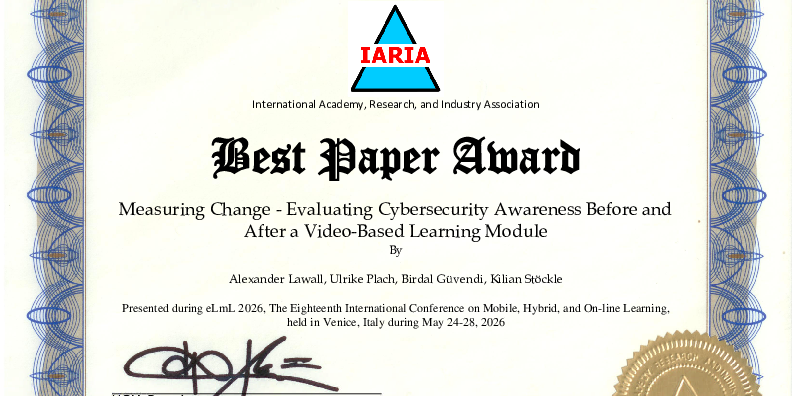
The paper “Measuring Change – Evaluating Cybersecurity Awareness Before and After a Video-Based Learning Module” was awarded the Best Paper Award at the international conference *The Eighteenth International Conference on Mobile, Hybrid, and Online Learning (eLmL 2026)*.
The award-winning paper was produced in collaboration with Prof. Dr Alexander Lawall (IU International University of Applied Sciences, Department of Cybersecurity), Prof. Dr Ulrike Plach (OTH Regensburg, Department of Business Informatics and Digital Transformation), Birdal Güvendi (lecturer, OTH Regensburg) and Kilian Stöckle (Master’s student, OTH Regensburg)
In an increasingly digitalised world, cybersecurity is becoming ever more important. A basic understanding of security measures is essential, particularly for young adults who interact with digital devices and online services on a daily basis.
Cybersecurity is also firmly established at OTH Regensburg: it forms part of the Future Skills Framework and is specifically addressed in teaching. In the Digital Business Management and International Business Management degree programmes, as well as in the supplementary ‘Digital Skills’ programme, this objective is already being implemented from the very first semesters. A key component of this is the ‘Security Challenge’, a practice-oriented learning module designed to promote cybersecurity awareness.
Two-stage evaluation of the cybersecurity learning phase
The paper examined the effectiveness of this teaching intervention using a two-stage evaluation design: initially, the students completed a questionnaire comprising 27 questions. This assessed both their existing knowledge and their behaviour when dealing with digital security risks.
The students then took part in a digital learning phase. This comprised four short educational videos on key cybersecurity topics. The content provided specific recommendations for action and raised awareness of typical risks in everyday digital life, such as phishing, password security and the handling of sensitive data.
After watching the videos, the students completed a second questionnaire. In addition, questions were asked about their subjective perception of the learning content and any planned changes in behaviour.
From knowledge to behaviour: results of the learning intervention
The results underscore the importance of early cybersecurity education: many students initially had only limited prior knowledge, and despite possessing some basic understanding, there were clear gaps in their ability to deal safely with digital risks – for example, regarding password use or the assessment of online threats.
The study also demonstrates that even brief, targeted learning interventions – such as video-based content – can make a significant contribution to raising awareness and prompting behavioural change.
Winning the Best Paper Award underlines the high quality of application-oriented research at OTH Regensburg. Particular praise was given to the innovative approach of combining teaching, digitalisation and empirical educational research.