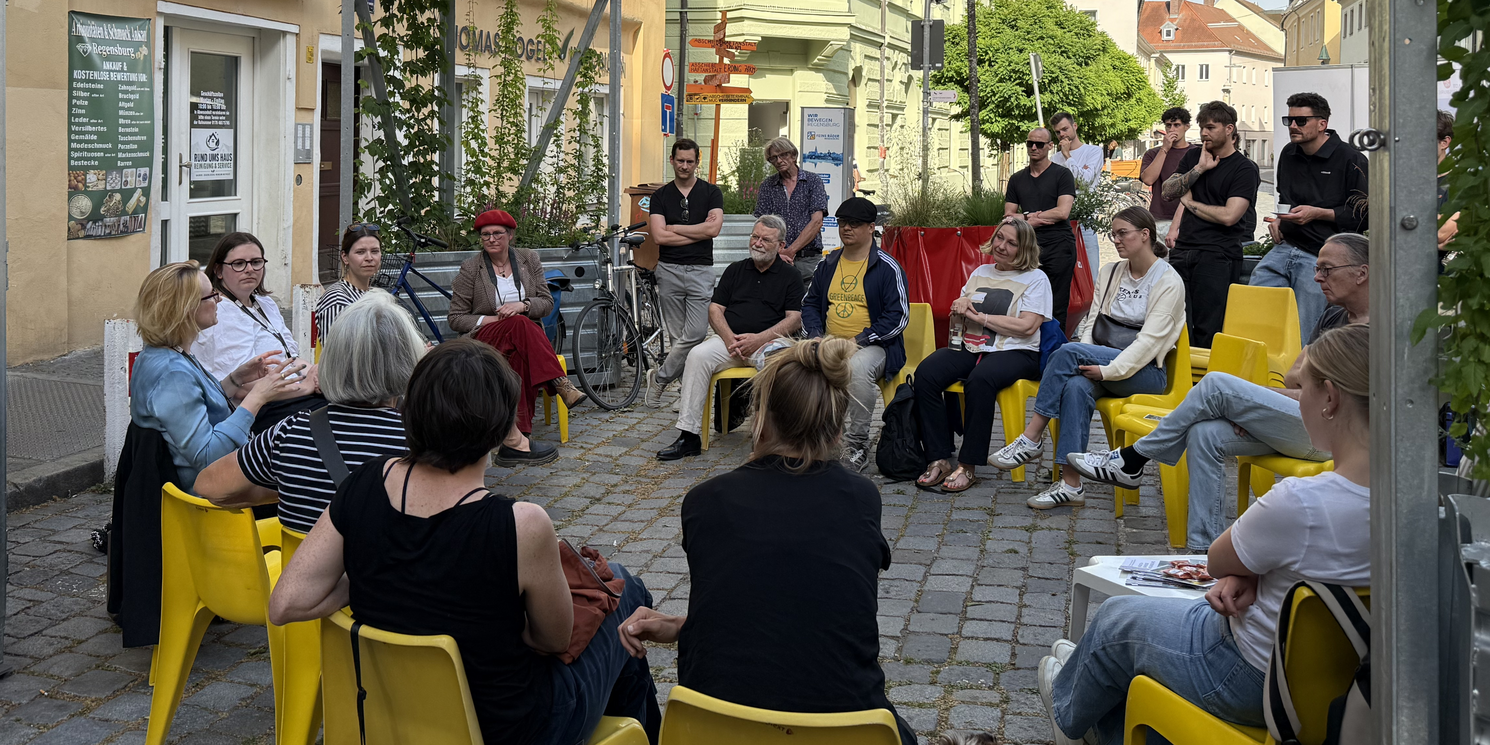
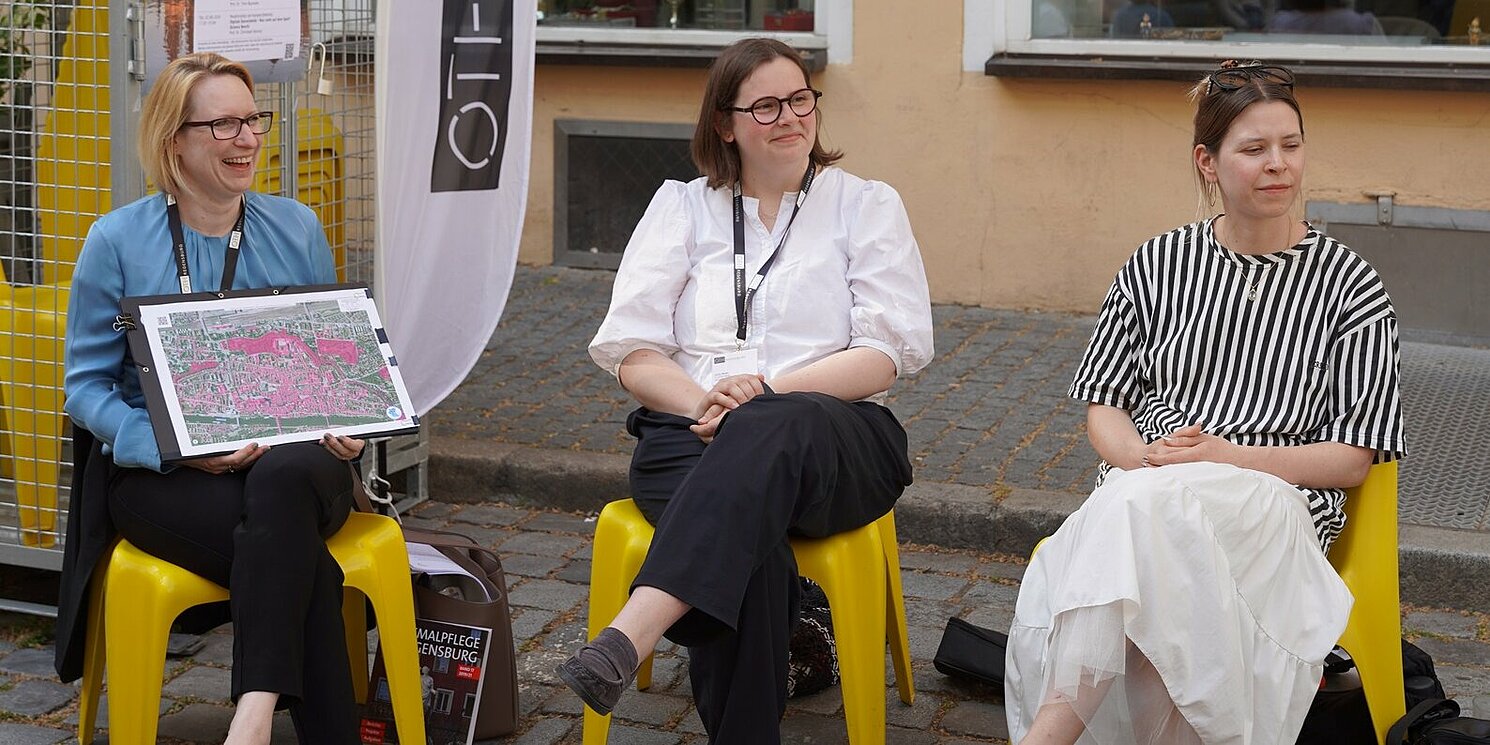
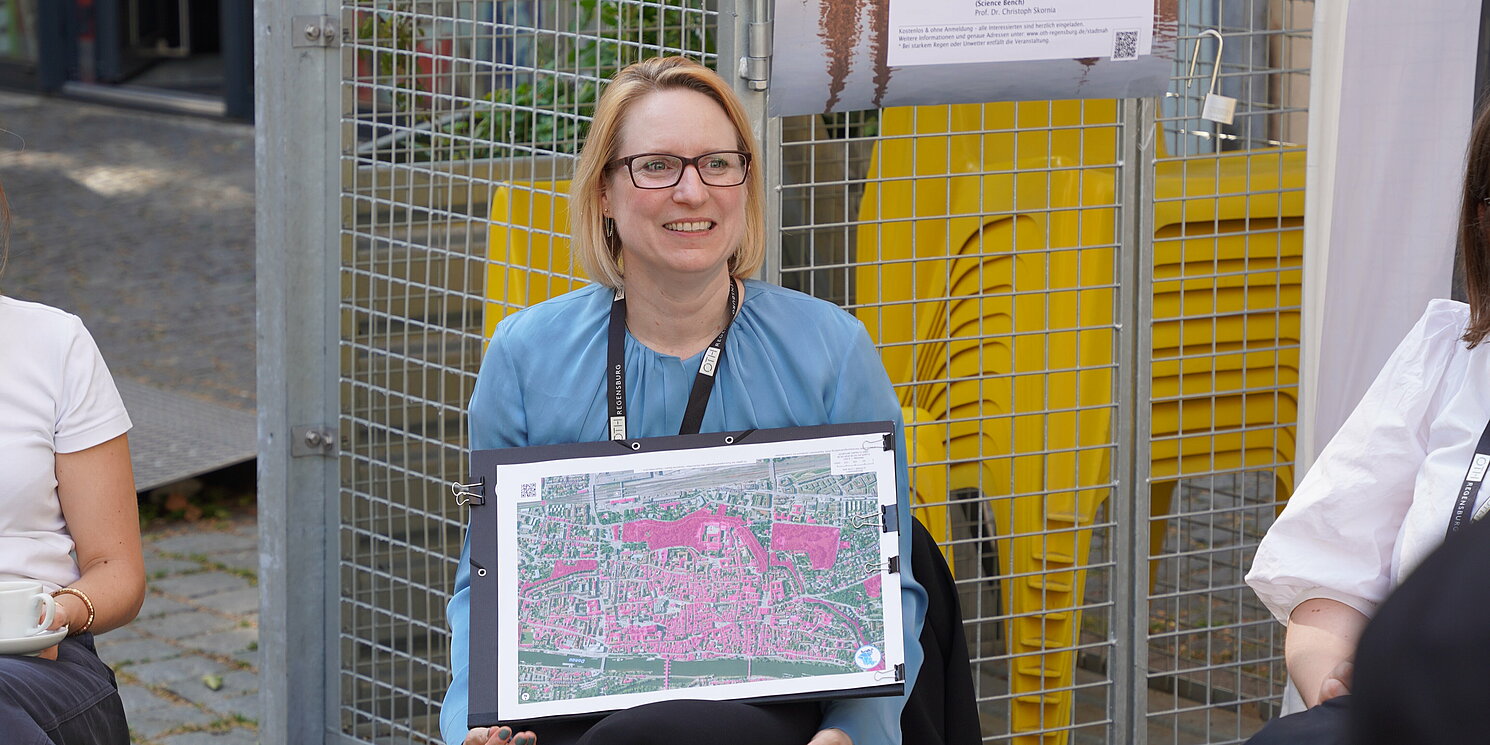
Around 30 residents of Regensburg gathered in the evening at Apollonia’s Garden to engage in conversation with experts: Prof. Dr Elke Nagel and Lucia Maier from the Faculty of Architecture at OTH Regensburg, and Caroline Hoffmann from the ‘Laboratory of Creative Minds’ (the City of Regensburg’s Creative Authority). Under the title “Urban Development between Historical Building Research and Sustainable Construction”, a lively discussion quickly developed.
What was originally planned as a traditional Science Bench was, due to the high level of interest, spontaneously transformed into an open circle of chairs. Fortunately, Apollonia’s Garden – a former car park at the western end of Obermünsterstraße, now landscaped and furnished with second-hand furniture – provided the perfect setting for exchange and discussion, complete with numerous yellow designer chairs.
Understanding the urban climate: greening and materials
A central theme of the evening was the greening of the city centre. It became clear that this is not just about traditional solutions such as trees. Hedges and shrubs can also have a significant impact on the climate, as they often grow more densely and are more versatile. Overall, the experts argued for a more diverse approach to urban greening, rather than thinking in simple categories.
Facades and courtyards also offer enormous potential. Greening does not always have to proceed from the ground up. Hanging plants are also an option when space is limited. At the same time, it was emphasised that greening takes time: plants do not grow overnight, and their cooling effect often only becomes apparent in the long term.
Another approach from the research of the Sustainable Construction and Historical Building Research Cluster at OTH Regensburg concerns innovative materials. For example, there are plaster and ceiling cladding systems that absorb heat during the day and only release it again in the evening. In this way, the heat absorbed by vertical surfaces and interior spaces is stored and utilised. Such solutions could also be used in the historic old town, barely visible from the outside but with a noticeable effect on the urban climate.
Furthermore, understanding the urban climate plays a key role. Analyses and simulations of air flows and heat hotspots provide valuable insights for planning. At the same time, attention is also turning to floor coverings: sealed surfaces store heat, whilst water-permeable materials can help alleviate this.
It is not only medieval buildings that are worth preserving
An exciting insight came from historical building research: ‘Historical’ does not just mean the Middle Ages. Not everything needs to be demolished or replaced – buildings and urban structures from the 1960s and 1970s are now also part of our cultural heritage and may be worthy of protection. Looking at different historical periods helps us to better understand the city and develop it sensitively.
Urban development as a collaborative process
It also became clear that evening just how much the design of public spaces has changed. Participatory formats and facilitated processes are gaining in importance – urban development is increasingly seen as a collective endeavour.
This was not just about the old town: neighbourhoods outside the city centre also have valuable buildings, green corridors and development potential that deserve greater attention.
Further dates in the STADTnah series
The STADTnah event series, organised by the City of Regensburg in cooperation with OTH Regensburg, continues in June and July and offers numerous opportunities to engage in conversation with researchers from OTH Regensburg and to raise your own questions.
The next event will focus on the topic “Want to become a professor? Take the 5-minute check!” with Prof. Dr Carina Braun on 13 June from 11:00 to 12:00 at Neupfarrplatz (Karavan Monument) as part of the Job Walk. In addition, other Science Benches will address topics such as trust in the media in the age of AI, digital sovereignty, and issues relating to criminal responsibility for minors.
Further information and dates can be found at:https://www.oth-regensburg.de/stadtnah