What is the title of your research project?
Extension of dynamic building system simulations using FEM-based simulation models (FEM2SYS)
Who is involved in the project?
Prof. Dr Oliver Steffens/Paul Schoplocher M.Sc.
What is your funded project?
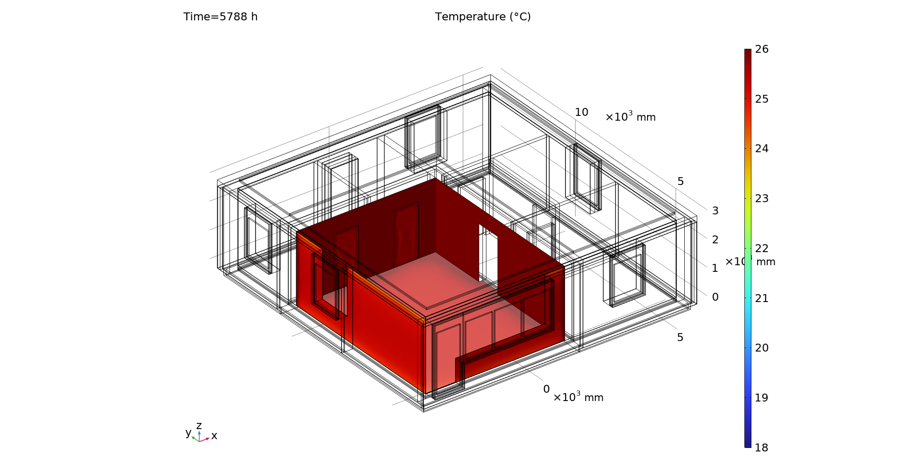
Commercial software for thermal building simulation (Building Performance Simulation, BPS) is predominantly based on the lumped-parameter method (LPM), also known as the compact model method. In this method, building components and indoor air are modelled using a small number of nodes with concentrated resistances and capacitances. These compact models enable short computation times, but neglect spatially resolved effects such as radiative exchange, convection or hygrothermal processes. In the ‘FEM2SYS’ project, simulations are therefore also carried out using coupled multiphysics models based on the finite element method (FEM) and systematically compared with LPM models. The identified and quantified effects are translated into compact correction models and integrated into existing BPS tools as software extensions.
What excites you about the project?
For us, it’s exciting to bring together two worlds that have mostly been kept separate until now: highly detailed, computationally intensive multiphysics simulation and the fast but simplified building simulation used in day-to-day planning. With the help of FEM, phenomena that are neglected or only roughly approximated in the compact model can be calculated in detail – for example, how incoming solar radiation is distributed within a room or how thermal bridges influence the indoor climate. Particularly appealing is the validation using existing real-world measurement data, such as that from the Fraunhofer IBP’s ‘Twin Houses’ in the international IEA EBC Annex 58 project. A methodological challenge lies in ‘compacting’ complex physical effects so that they can be described with sufficient accuracy in a rapid simulation. The end result is a powerful, practical tool for planners.
How can the findings from the project be applied in practice?
Building simulations are a key tool for the climate-neutral design of new buildings and refurbishments. The extensions developed can be integrated into established simulation programmes, enabling design practices to benefit from more accurate results without additional modelling effort. In view of the changing requirements brought about by climate change, more reliable forecasts help to better assess heating and cooling requirements, overheating in summer and thermal comfort. This helps to reduce the gap between calculated and actual energy consumption.
On our website, you will find an overview of OTH Regensburg’s current funded projects.