Who is involved in the IMA-GH2 project ?
Project leader: Prof. Dr.-Ing. Michael Sterner
Research staff: Dr Franz Bauer, M.Sc. Andreas Hofrichter and M.Sc. Stefan Rahim (Research Centre for Energy Networks and Energy Storage, FENES)
What is the title of the research project?
IMA-GH2 – Instruments to accelerate the market ramp-up of green hydrogen and its derivatives
What is your research project about?
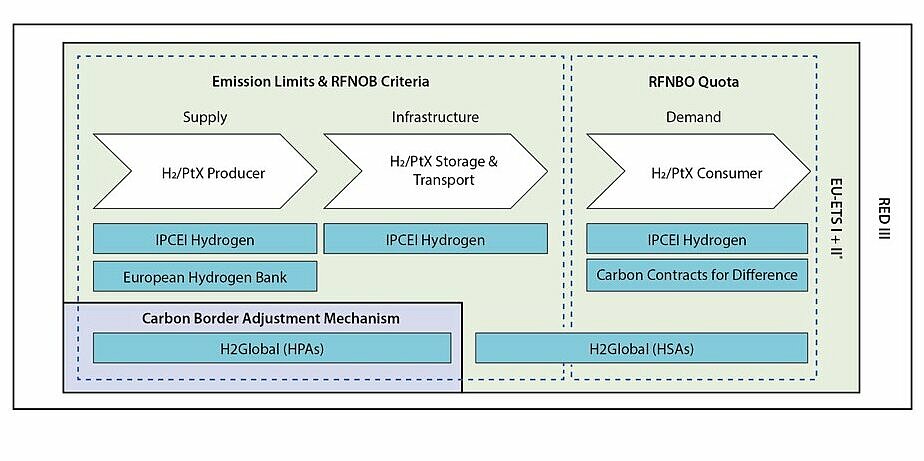
Green hydrogen and power-to-X products are regarded as key technologies on the path to a climate-neutral economy, but the global market is still in its infancy. IMA-GH2 is investigating how policy and economic instruments – such as climate protection agreements, the European Hydrogen Bank’s auctions, H2Global’s dual auctions or the US Inflation Reduction Act – can effectively support this market ramp-up. The project examines both the supply and demand sides: UTN analyses production, transport and supply chains, whilst OTH Regensburg models future demand for hydrogen and Power-to-X products in the energy sector, buildings, transport, agriculture and industry, and analyses environmental aspects. The focus is on the key question: How can effective framework conditions be created to enable the emergence of a global market for green hydrogen and PtX products?
What excites you about the project?
The global ramp-up of a hydrogen economy is one of the most complex and, at the same time, most exciting transformation processes of our time. What is particularly appealing is the combination of scientific analysis and real-world policy-making – the results feed directly into development concepts for ongoing mechanisms, as well as recommendations for instruments and measures. Another exciting aspect is the systemic perspective, which does not view supply and demand in isolation but as an interplay. The team’s very first publication in the journal *Energy Policy* already provides concrete evidence of this: it systematically compares expenditure-, revenue- and regulation-based instruments – such as the European Hydrogen Bank, H2Global, the EU Emissions Trading Scheme and the RED quotas for RFNBOs – and demonstrates, amongst other things, that the European Hydrogen Bank and H2Global achieve lower CO₂ abatement costs than other instruments, and that whilst strict sustainability criteria may slow down market take-up, they can also create benefits for exporting countries.
How can the findings from the project be applied in practice?
The scientifically sound findings can support policy-makers in further developing existing mechanisms and in designing future support instruments, such as a sensible combination of volume quotas with market-based instruments. Businesses and investors benefit from greater planning certainty, as price and volume risks can be reduced through better-coordinated support programmes. The environmental assessment criteria developed can also help in the design of international hydrogen partnerships. The findings are actively transferred to the political and business spheres through workshops, working papers and position papers.
Answers from Andreas Hofrichter, OTH Regensburg
On our website, you will find an overview of OTH Regensburg’s current funded projects.