What is the title of your research project?
PulPreg – Development of a pultrusion process for the production of continuous-fibre-reinforced plastic profiles with a thermoplastic matrix system on an industrial scale, incorporating in-line impregnation of the reinforcing fibres
Who is involved in the project?
Project leader: Prof. Dr.-Ing. Ingo Ehrlich (Scientific Director, Technology Campus Neustadt an der Donau) OTH internal partner: Prof. Dr.-Ing. Aida Nonn (Deputy Scientific Director, Technology Campus Neustadt an der Donau) Project Co-ordinator: Marco Siegl, M.Sc. (Group Leader, Technology Campus Neustadt an der Donau) Project Staff: Nishant Chavan, M.Sc. (Research Assistant, Technology Campus Neustadt an der Donau)
What is your funded project?
The overarching aim of the project is to develop an industry-ready pultrusion process for the production of continuous-fibre-reinforced plastic profiles using thermoplastic matrix systems. The focus is on developing a scaled-up impregnation line for processing multiple rovings, whereby the high melt viscosity of the thermoplastics makes efficient fibre impregnation difficult, particularly at high, industry-standard process speeds. To this end, a comprehensive model is to be created as a software-based design tool, which maps all relevant process parameters and their complex interactions, and enables the design of the impregnation line for different material combinations. Compared with established thermosetting systems, thermoplastic fibre-reinforced composites offer considerable advantages in terms of remeltability and recyclability, despite the more demanding impregnation process, and thus have great potential for resource-efficient industrial processing.
What excites you about the project?
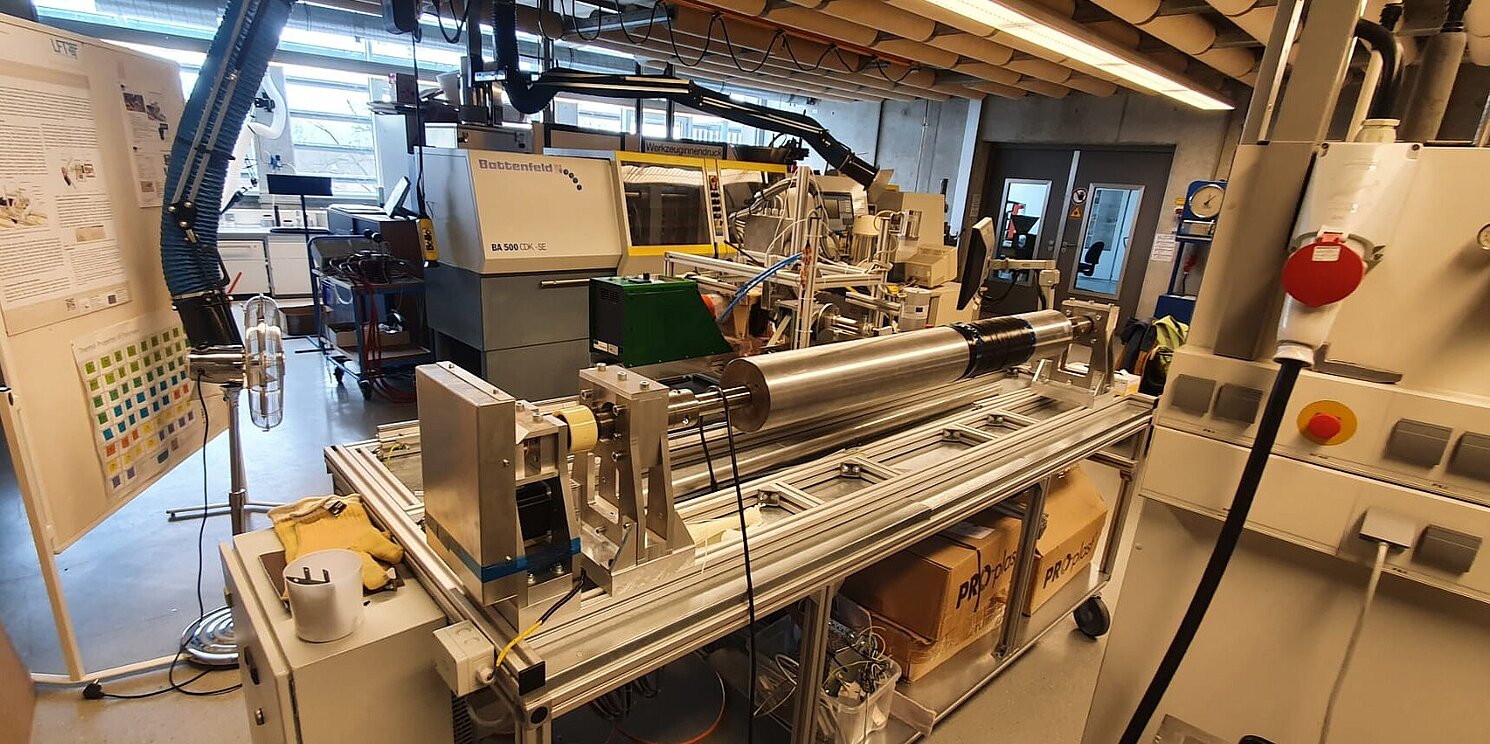
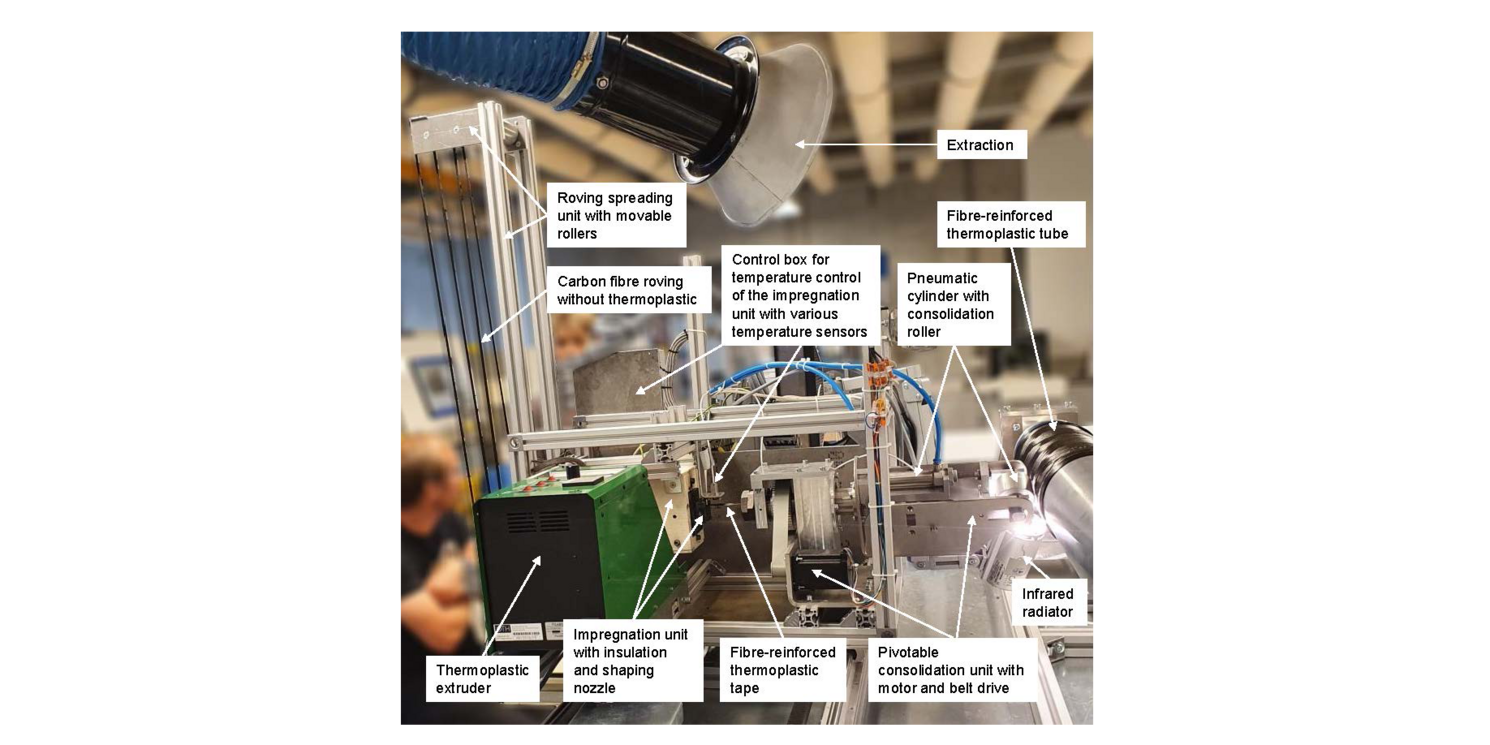
What is particularly exciting is the opportunity to transfer the already extensive expertise in the processing of thermoplastic fibre-reinforced composites – gained from the development of the thermoplastic winding process with integrated tape production as part of the TheCoS and AdWinT projects at the Technology Campus Neustadt an der Donau – to a new field of application. The work carried out to date on the direct impregnation of rovings to produce so-called organotapes, as well as on process control and modelling of the impregnation process, provides a solid knowledge base that can now be specifically adapted and further developed for the pultrusion process. The transfer to continuous pultrusion raises new scientific questions and makes it possible to pool and further expand existing expertise within the framework of the ‘Research at HAW’ funding programme, under the ‘HAW Research Focus’ funding guideline, in a new field of research. At the same time, the project offers the opportunity to establish a sustainable research focus and to provide the participating research staff with prospects for further academic qualification, including the possibility of pursuing a PhD.
How can findings from the project be applied in practice?
The impregnation concepts and models developed in the project are not only examined theoretically but are also tested and validated as part of work packages on an industry-standard pultrusion line. This allows the findings to be directly assessed in terms of their technical feasibility, scalability and transferability to different material combinations and process conditions. The associated industrial partners see the project as a major opportunity to further develop thermoplastic melt pultrusion as an economically attractive manufacturing technology and, in the long term, to establish industrial supply and process chains for continuous-fibre-reinforced thermoplastic profiles. The project results thus lay an important foundation for the transfer of the developed impregnation process to industrial applications and may, in the long term, help to open up new fields of application for thermoplastic pultruded products and enable their further processing into innovative components.
On our website, you will find an overview of OTH Regensburg’s current funded projects.