What is the title of your research project?
CEMA: Cellulose-based mosaic absorbers with a modular design
Who is involved in the project?
Prof. Dr Christoph Höller (ANK Faculty), Prof. Dr Marcus Wagner, Stefan Buchner (Faculty of Mechanical Engineering); industry partner: Papiertechnische Stiftung Heidenau
What is your funded project?
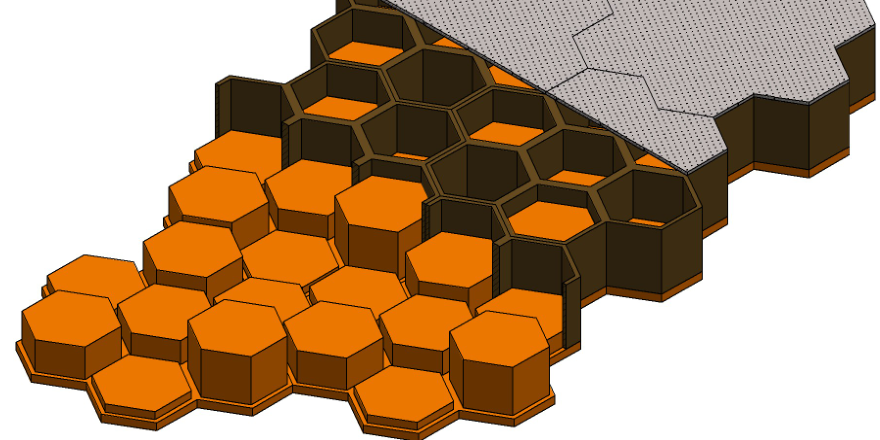
Sound absorbers are elements installed on the ceilings and walls of rooms to ensure good acoustics. For sound absorbers to be effective, it is not just the material that matters, but also the structure – for example, there are porous elements, elements with perforated panels, or multi-layered structures. The CEMA project is developing acoustic elements based on paper-based materials with an innovative mosaic structure that offer excellent absorption properties.
What excites you about the project?
We are combining our expertise in acoustic building physics and numerical simulation. Using these simulations, we can determine the acoustic properties of an absorber made from specific materials and with a specific structure, and optimise them mathematically. The required material data and the developed room acoustics modules are then measured and evaluated in the laboratory. This is how we also worked on the predecessor project, AkuPap, in which we investigated the suitability of cellulose-based materials as sound absorbers. In CEMA, we are developing paper-based acoustic modules with a mosaic structure and investigating which material structure and layer configuration yield optimal acoustic properties.
How can the findings from the project be applied in practice?
Paper-based sound absorbers are made from a sustainable raw material that can be recycled. The absorbers currently available are mostly made from minerals or polymers, the production of which is energy-intensive. Many bio-based alternatives are heavy and costly to produce. Paper offers an alternative here because it can be produced in a wide variety of forms and there is already a well-established material cycle in place. The concept not only provides a sustainable solution for room acoustic modules, but also opens up a new business area for the paper industry.
On our website, you will find an overview of the current funded projects at OTH Regensburg.