Dimensions of sustainability - possibilities and limits of measurement in research and statistics
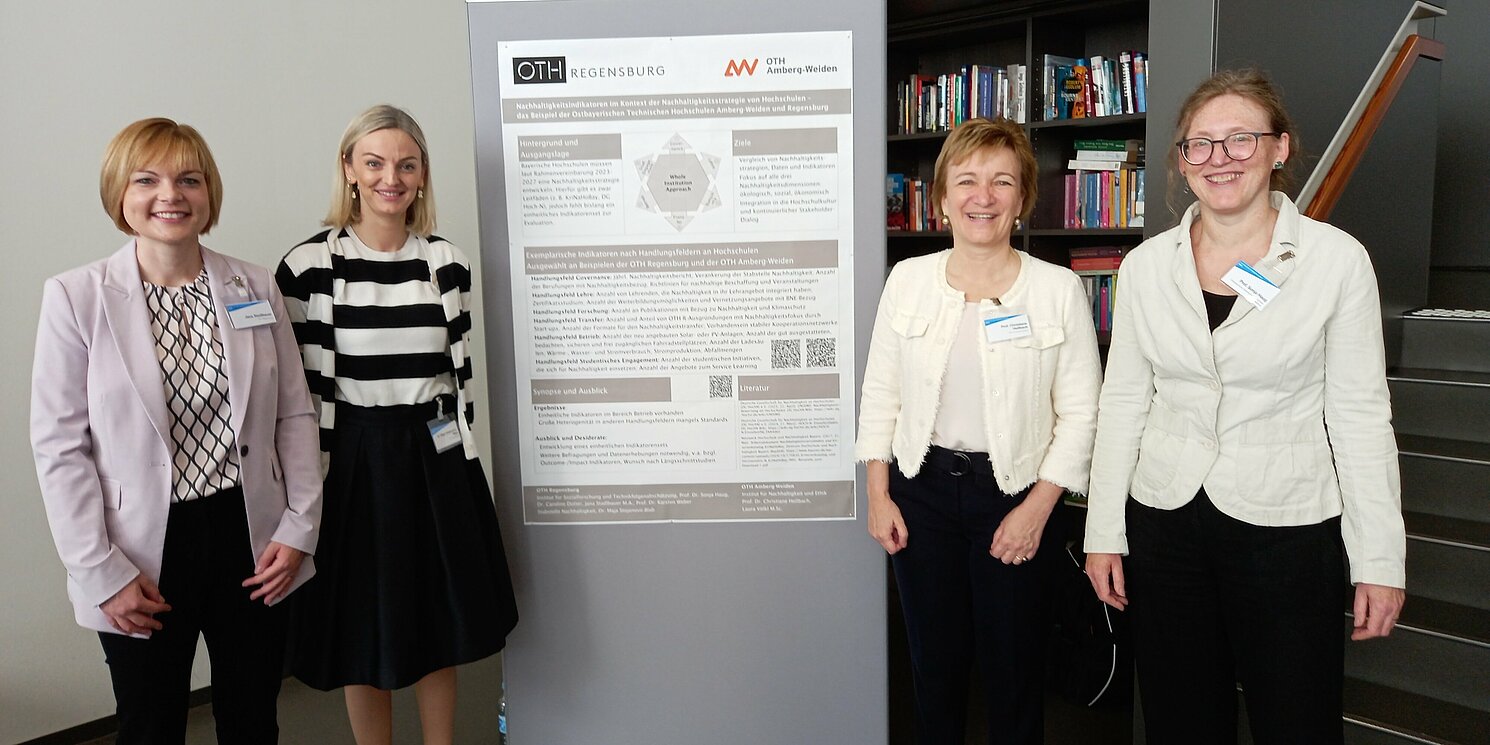
On 24 and 25 July 2025, the Statistical Days took place at the Bavarian State Office for Statistics in Fürth under the guiding theme "Dimensions of Sustainability - Possibilities and Limits of Measurement in Research and Statistics".
An interdisciplinary team from the East Bavarian Technical Universities of Regensburg and Amberg-Weiden presented the poster "Sustainability indicators in the context of the sustainability strategy of universities - the example of OTH Regensburg and Amberg-Weiden". The participating experts - including Prof. Dr. Sonja Haug, Dr. Caroline Dotter, Jana Stadlbauer M.A., Dr. Maja Stojanović-Blab, Prof. Dr. Karsten Weber (OTH Regensburg) as well as Prof. Dr. Christiane Hellbach and Laura Völkl, M.Sc. (OTH Amberg-Weiden) - analyzed the implementation and measurability of sustainability strategies at universities.
Making sustainability strategic and measurable
The starting point is the Bavarian State Government's Framework Agreement Universities 2023-2027, which obliges all state universities to develop an overall institutional sustainability strategy. The researchers showed how indicators from various sources - from administrative data and surveys to environmental indicators - can be used to evaluate the ecological, social and economic dimensions.
Particular attention is paid to practical implementation: in the area of operations, for example, key figures such as electricity, water and heat consumption as well as waste generation are regularly collected. Greenhouse gas balancing, including Scope 3 emissions from mobility, is also addressed.
Research meets practice
The results show: While technical indicators in operations are comparable, there is a lack of uniform standards in other fields of action such as teaching, research and transfer, governance or student initiatives. Outcome and impact indicators - for example, for changing the behavior of students and employees - have hardly been taken into account to date and represent a research project in their own right.
About the project participants
The scientists involved contribute expertise from the fields of social research, technology assessment, sustainability management and economics. The project is part of the cross-university research cluster Ethics, Technology Impact Research, Sustainable Management (ETN) of OTH Regensburg and OTH Amberg-Weiden in cooperation with the Sustainability Office of OTH Regensburg.