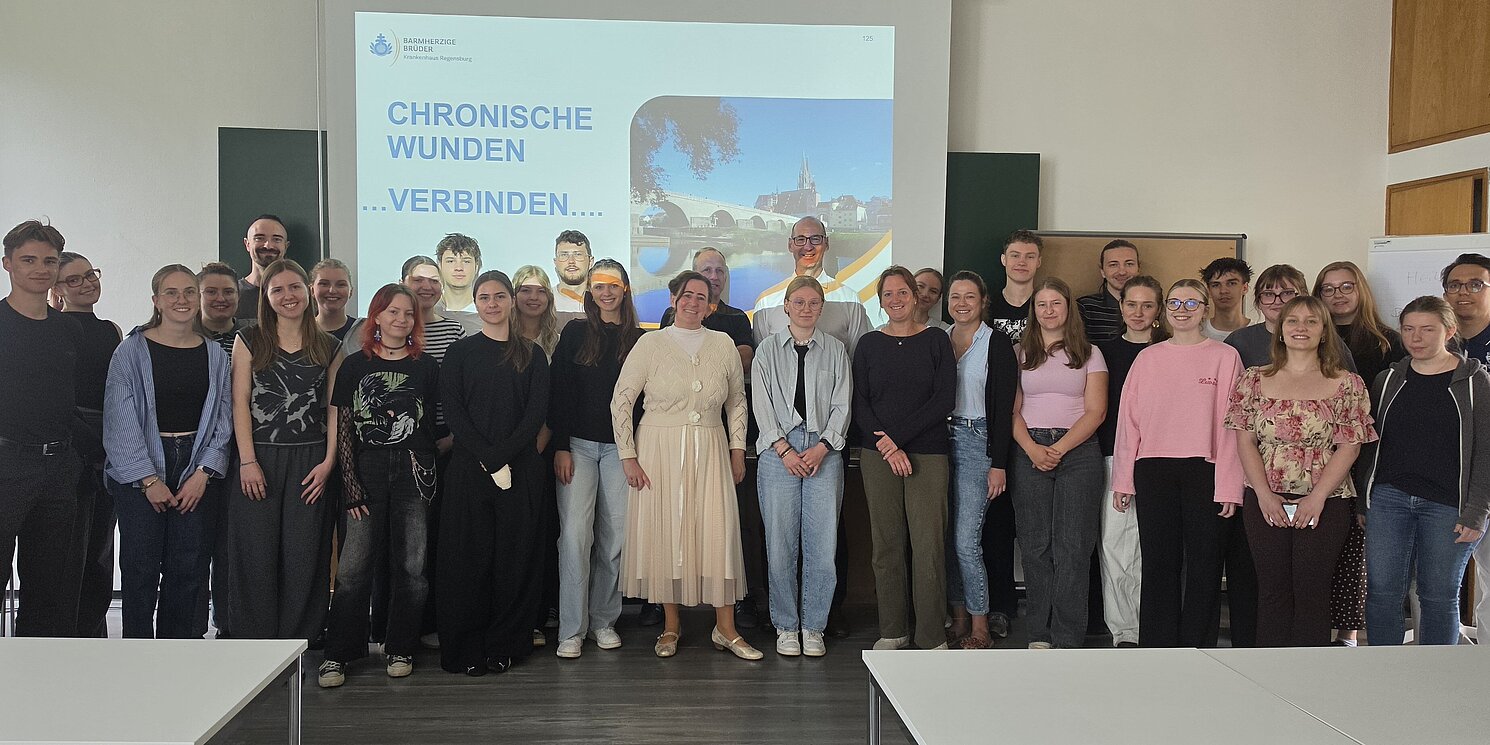
Since the 2025/26 winter semester, the primary nursing degree programme at OTH Regensburg has been breaking new ground: With the introduction of three clinical specialisms – diabetic metabolic conditions, chronic wounds and dementia – the next generation of academic nursing professionals is preparing for a broader range of responsibilities in patient care. The clinical modules in the ‘Clinical Science 2’ module began in June 2026: for the first time, renowned doctors delivered the lectures on the specialisation areas of ‘Chronic Wounds’ and ‘Diabetic Metabolic Conditions’.
“It wasn’t just an extremely fascinating lecture, but also one that gives cause for hope,” says nursing student Jana Wood, summing up the two-day course. “It shows that nursing and medicine will work together even more closely on an equal footing in future, and that through interprofessional collaboration we can benefit mutually from each other’s knowledge and skills.”
Renowned doctors provided insights
For the teaching on the topics of ‘Chronic Wounds’ and ‘Diabetic Metabolic Conditions’, the academic team was able to secure the participation of renowned doctors: Prof. Dr Markus Steinbauer (Head of the Department of Vascular Surgery), Dr Andreas Krichbaum (Head of the Department of Angiology) and Dr Tobias Weißgerber (Senior Registrar in Clinical Acute and Emergency Medicine) from the Barmherzige Brüder Hospital in Regensburg will now be providing students with in-depth insights into diagnostics, treatment and care.
In the ‘Chronic Wounds’ module, the topics covered were wide-ranging: from peripheral arterial disease (PAD) through diabetic foot syndrome to compression therapy, the students were given a comprehensive overview of complex clinical conditions. During discussions with the students, Dr Andreas Krichbaum emphasised the value of thinking outside the box: “Chronic wounds represent just the tip of the iceberg and require complex diagnosis and treatment planning involving various specialist groups and professions. Chronic wounds need long-term, coordinated and compassionate care.”
The group also addressed the legal and professional policy guidelines governing the new delegation of medical care. This was particularly relevant to the students, as it concerned their future role within the healthcare system. Discussions centred on the differences between the delegation of medical tasks and the independent substitution of such tasks.
Healthcare can only succeed as a team
Dr Weißgerber’s statement confirms this: “Healthcare in Germany today can only succeed as a team effort. Nurses with academic qualifications will therefore assume greater responsibility in the care and treatment process in future and will thus carry out certain medical tasks independently. This qualified substitution is not a replacement for medical expertise, but a useful complement that can help to close gaps in care across the region.”
The partnership is the result of conceptual collaboration behind the scenes. The new delegation of medical authority is being jointly developed and refined at OTH Regensburg. The team of professors on the B.Sc. in Nursing programme – comprising Prof. Dr Christiane Wissing (Programme Director / Clinical Liaison Officer, specialising in diabetic metabolic conditions), Prof. Dr Dorothea Thieme (specialist area: chronic wounds) and Prof. Dr Christa Mohr (Programme Director for the Master’s in Advanced Nursing Practice, specialising in dementia) – is shaping the three specialisation areas in consultation with Dr Weißgerber, who holds medical responsibility for all three clinical specialisation areas within the programme.
Nursing students benefit from the exchange
“The topic of chronic wounds really brought home to me the responsibility involved in the transfer of medical care,” explains nursing student Michael Helgert. “The direct exchange with the doctors has helped us enormously in professional terms and shown us how important close interprofessional collaboration is for high-quality patient care.” Prof. Dr Markus Steinbauer also emphasised this approach: “For patients with chronic wounds, the transfer of medical care will lead to a significant improvement in care through interprofessional collaboration.”
The successful delivery of the first medical teaching modules in the field of nursing demonstrates how OTH Regensburg is implementing the legislative changes introduced by the Nursing Studies Strengthening Act and the Act on the Expansion of Powers and Debureaucratisation in Nursing (BEEP). Through these three specialisations, students are specifically prepared to apply scientifically sound expertise directly in practice and to take on greater responsibility for people with chronic conditions. For Regensburg’s nursing students, one thing is certain: the future of nursing has begun – and they are actively shaping it.