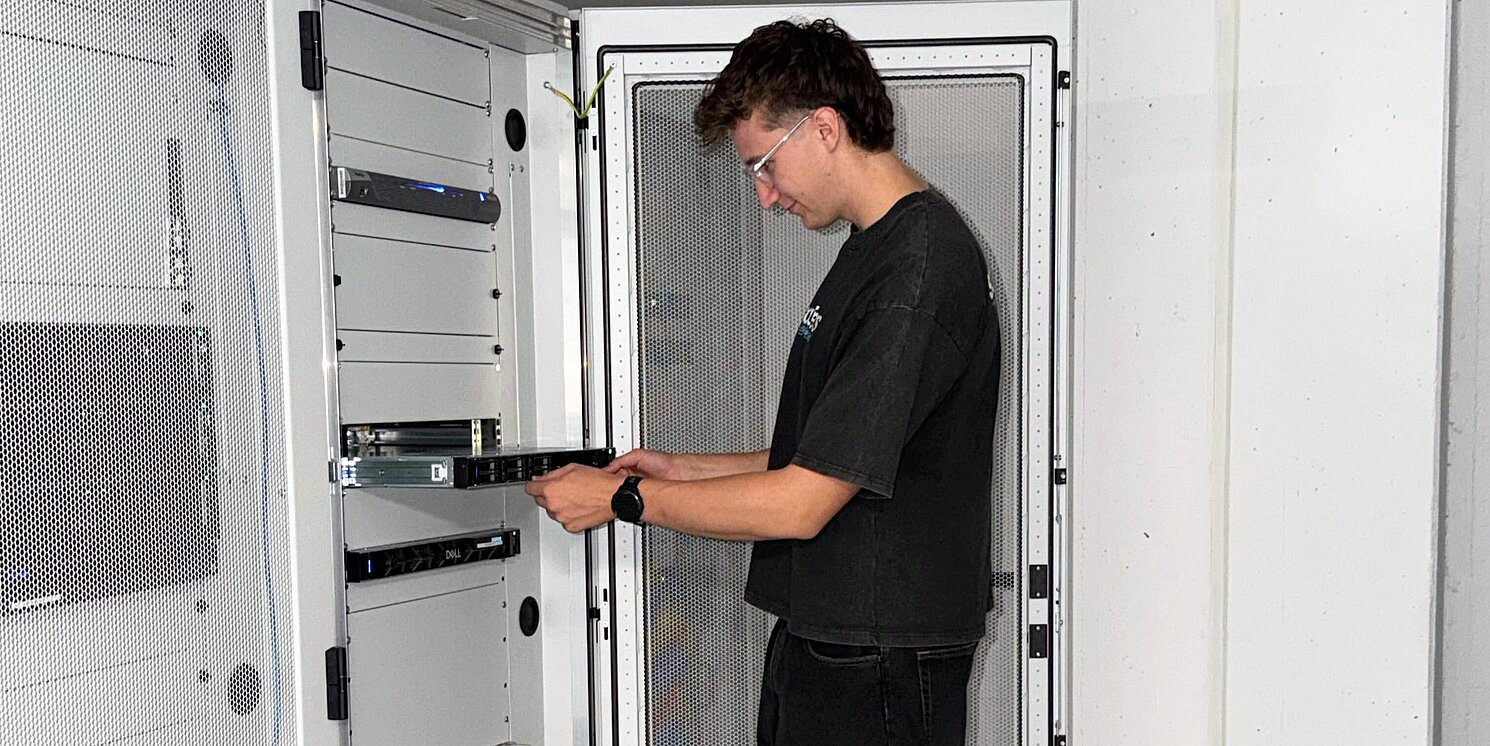
The training programme was launched at the time on the initiative of Dr Christian Broser, Head of the IT Centre. As training manager, Wolfgang Moosbauer oversees its practical implementation at the IT Centre. “We wanted to give young people the opportunity to gain hands-on experience of the diverse tasks involved in modern university IT,” explains Dr Broser. At the same time, the training programme is intended to help the university attract qualified IT specialists to join its staff in the long term.
Working on real systems rather than just exercises
After completing his FOS qualification, Kilian Kragler made a conscious decision to embark on a practical course at OTH Regensburg. One thing was particularly important to him: “One of the best things was that my work here was more than just an exercise that was deleted afterwards. What I did had long-term benefits – for others as well.”
Initially, his main tasks involved mapping out and documenting established IT structures. To this end, he analysed existing systems, identified the interconnections between them and represented them graphically. “The hardest part at the start was understanding the interconnections. Sometimes one system retrieves data from another, and at first you have no idea that this connection exists. But that is precisely what you need to understand, so that we can later trace where a problem arises and where we need to look for the cause."
He enjoyed setting up completely new systems just as much. Among other things, he set up database systems for laboratories, which are still in use today. Kragler was also involved in digital examinations: within OTH Regensburg’s central examination system, he configured examinations for lecturers so that students could complete their assignments on a computer.
From trainee to running your own project
Towards the end of his training, Kragler undertook his own final project. As part of this, he replaced a system for analysing network traffic with a modern, virtualised solution. He began by identifying the technical requirements that the new solution had to meet. He then procured a suitable server, commissioned it and set up the new solution on it. The new system enables the IT centre to analyse network traffic and investigate anomalies in a targeted manner.
Direct entry and studying in parallel
“The training programme at the IT Centre is particularly varied because our trainees deal with a wide range of tasks and technologies,” explains Dr Broser. “Our trainees work alongside a diverse group of users comprising students, lecturers, researchers and administrative staff, and are able to take on responsibility for their own tasks and projects even whilst they are still in training.”
The IT Centre intends to continue training its own IT specialists in the future. With Lukas Reichl and Jakob Wallner, there are already two further apprentices training as IT specialists in system integration at the OTH Regensburg IT Centre. The plan is to continue offering one apprenticeship place each year.