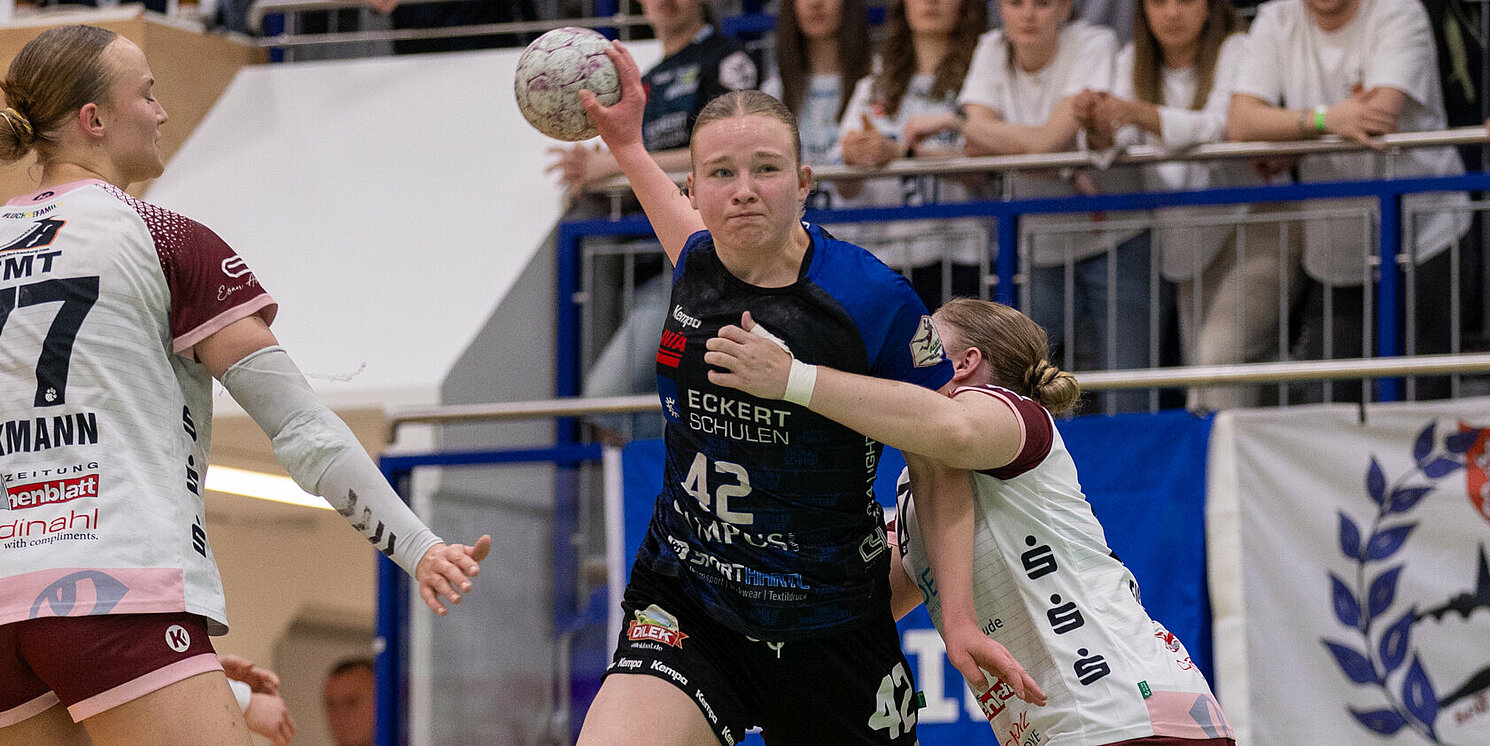
Milena Stürenburg, a second-year Business Management undergraduate at OTH Regensburg, has been selected for the FISU World University Handball Championship. From 21 to 27 June 2026, she will represent Germany at international level in Pessac (France). This marks the first time a German national team has taken part in this official world university championship.
“I’m really happy to be here and I’m looking forward to lots of new experiences,” says Milena Stürenburg. For the 20-year-old, the nomination marks another milestone in her handball career so far.
Entered a handball boarding school at the age of 15
During the coronavirus pandemic, Milena Stürenburg moved from her parents’ home in the Bremen/Oldenburg region to the boarding school at the Blomberg Handball Academy so that she could train under professional conditions. There, she made rapid progress as an athlete and was already playing in the Youth Bundesliga at the age of 15.
“It was a difficult decision, because the commitments at the weekend meant I couldn’t just pop home for a quick visit, but it was exactly the right choice for me. Living at boarding school taught me to be independent at an early age, which has helped me develop both as an athlete and as a person,” the student reflects today.
A tight schedule: studies, work and competitive sport
Milena Stürenburg made a conscious decision to study in Regensburg. The deciding factor for her was the combination of the courses offered by OTH and the opportunity to play competitive handball for the Bunkerladies, the women’s team of ESV 1927 Regensburg. The partnership between the university and the club was another plus point.
Balancing full-time studies, a part-time job and daily training requires a great deal of organisation and discipline from Milena Stürenburg. Her day is usually tightly scheduled: after lectures and her part-time job, she heads straight to training, and she often doesn’t finish until between 8 and 10 pm.
“There are times when you just want to do what other 20-year-olds do, but generally speaking, I’m used to it being this way,” she says.
A clear priority despite unequal treatment in women’s sport
Despite her great passion for sport, her studies are her clear priority. She explains why: “You know that a career in competitive sport doesn’t last forever. The body can’t cope with such constant strain; it usually comes to an end in your early 30s.”
Another reason for the focus on academic education lies in the structure of the sport. Whilst many men in professional handball can make a living from the sport, women in the top flight often receive only an expense allowance. “Yes, it is unequal treatment. But it forces us to build up a second source of income alongside handball. And in the end, that’s a good thing, even if it is more stressful,” says Milena.
Uncertain prospects for the World Cup debut
It is difficult to gauge the German team’s chances. “As this is Germany’s first time taking part, we are not yet able to assess the standard of the other nations,” explains the backcourt player. “Our squad consists of very good second-division players who are usually my opponents in league matches.”
Her advice to other young competitive athletes is: “Just try to keep everything well organised, don’t take it all too seriously, take a moment to catch your breath now and then, and make sure you give yourself some breathing space. In the end, you always manage to make it work somehow.”