The OTH Start-up Lab’s low-threshold funding enabled teams and individuals to rapidly turn their ideas into initial prototypes, proofs of concept, proofs of principle and user tests, with up to 7,500 euros available per project. KickStart was part of the StartupLab@FH funding scheme run by the Federal Ministry of Research, Technology and Space (BMFTR), under which the OTH Start-up Lab was established. Further innovative projects were also supported during the final funding phase.
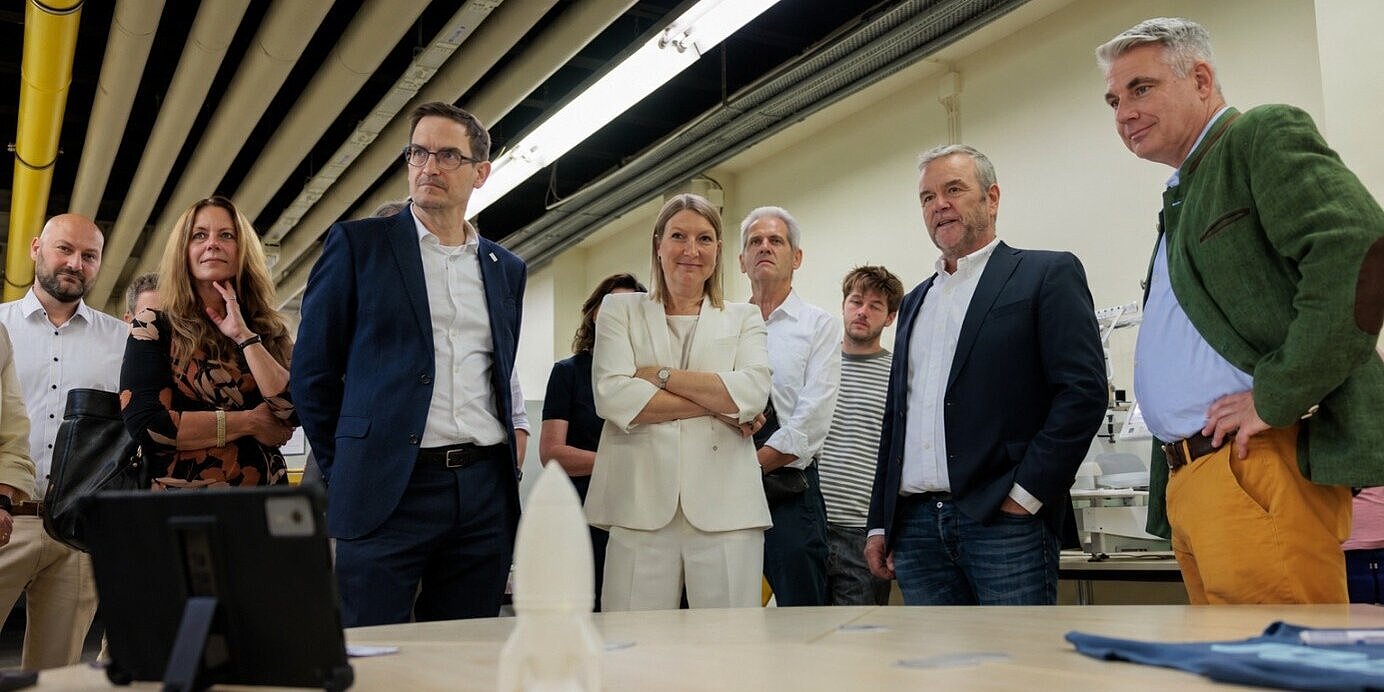
A meeting between the university management and Magnus Milde, Ministerial Councillor at the Federal Ministry of Research, Technology and Space (BMFTR) – the initiator of the StartupLab@FH funding scheme – provided an opportunity to present selected KickStart projects. The projects presented served as prime examples of how the funding scheme supported innovative ideas from the initial development stage right through to the establishment of a start-up.
Funding as the cornerstone of successful start-ups of all kinds
Several success stories demonstrate that KickStart frequently served as the starting point for further start-up activities. The former KickStart project NeuroVR gave rise to what is now Olatu Medical Technologies GmbH. The RocketMind team continued to develop its project as a start-up and applied for further funding at the time of the project presentation. Following KickStart, the start-up project Prinity was able to secure EXIST start-up funding and continue its development. The team is based at TechBase Regensburg, a partner of the OTH Start-up Centre. NOX also took the step of setting up a company and is now further developing its technology at the regional partner BioPark Regensburg. These examples illustrate how early support from the OTH Start-up Centre helped to develop scientific ideas into marketable innovations.
Dr Almut Hochstädter pursued a project of particular social relevance with the development of a smart tonometer for home use. The planned device is designed to help people at increased risk of glaucoma detect changes in intraocular pressure. To this end, the concept combines the tried-and-tested air puff method with modern sensor technology and a smartphone, which handles user guidance and data analysis. The aim of the development is to create a cost-effective, easy-to-use system that could advise users to seek medical advice in the event of abnormal readings. The KickStart funding was used to develop and miniaturise the measurement technology and to build a functional prototype.
The newly founded start-up NOX is developing an intelligent, sensor-based training system for neurorehabilitation. A multi-sensory boxing pad combines therapeutic movement exercises with visual, auditory and haptic stimuli and records training data such as reaction times or movement asymmetries. The aim is to specifically enhance and scientifically investigate the motor and cognitive abilities of people with neurological conditions – for example, following a stroke or in cases of Parkinson’s disease. The KickStart funding supported the development of a functional prototype suitable for clinical trials. A letter of intent has already been received from a neurorehabilitation centre regarding a potential pilot study.
Another start-up project funded by KickStart is Daedalus Defence. The team is developing a drone defence system in which a specially developed interceptor drone is designed to remove other drones from the airspace using a capture net. The approach is intended to reduce the risk of falling debris. With the support of the KickStart grant, the team was able to press ahead with prototype development and test the technology in initial demonstrations. In the future, the system is intended to operate largely autonomously with the aid of artificial intelligence. Potential areas of application include the protection of critical infrastructure, airports and major events. The team took second place in the 2025 5-Euro Business Competition with their business idea.
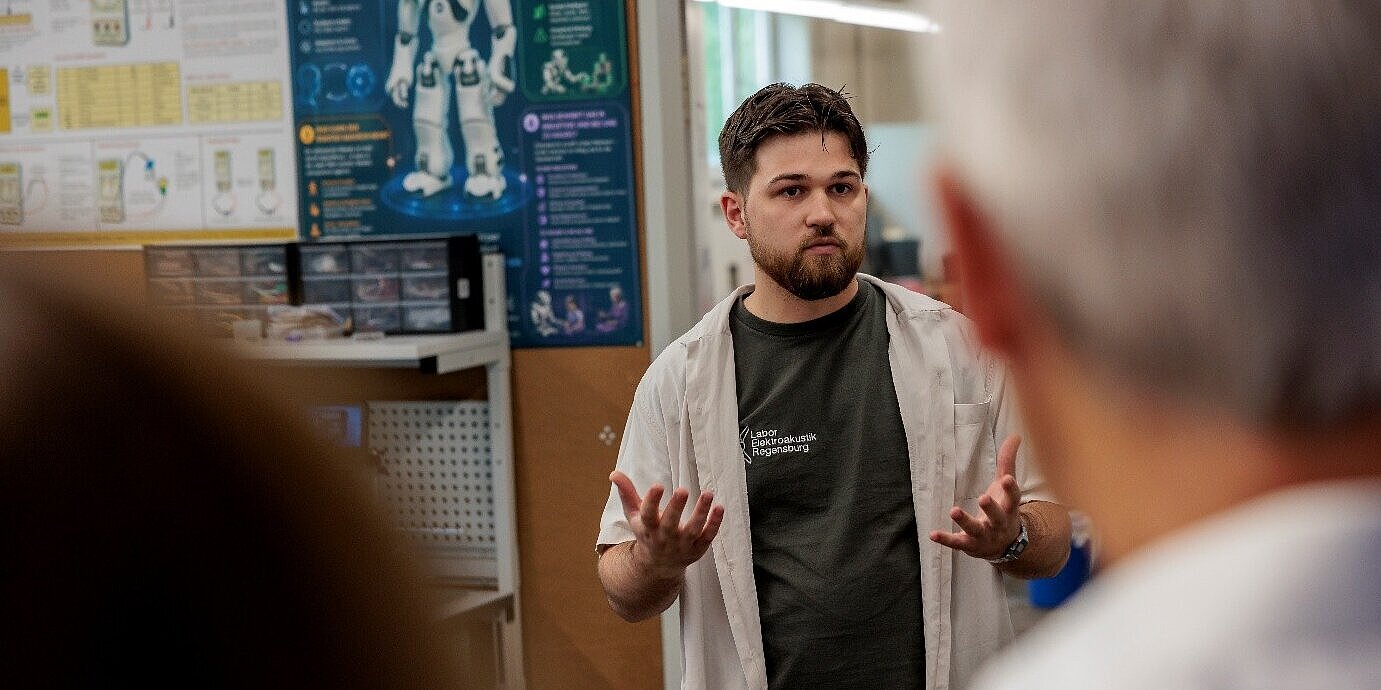
Curitas Health is also pursuing a socially relevant goal: the team is developing a system designed to prevent pressure ulcers (decubitus) in wheelchair users and thereby improve their quality of life. Azamat Musaev presented the funded project NoctuaSense on behalf of his team. As part of the KickStart funding programme, the team is developing a mobile 3D acoustic camera designed to locate sound sources in real time and identify them using artificial intelligence. The system combines a spherical microphone array with optical sensors. Potential applications range from surveying animal populations and forest monitoring to the detection of drones. The approved KickStart funding will support the development of an initial demonstrator.
32 projects, diverse ideas and new perspectives
The range of funded projects highlights the innovative strength at OTH Regensburg. During the funding period, developments emerged in areas including medical technology, robotics, virtual reality, sustainable materials, educational technologies, industrial automation and digital health solutions. Several teams further developed their ideas and secured follow-up funding or took the path towards setting up their own businesses.
Through KickStart, the OTH Start-up Lab provided a particularly accessible entry point to start-up support. Students, PhD candidates and staff were able to test their ideas in practice at an early stage and develop prototypes – often a crucial step on the path to further funding programmes, spin-offs or marketable innovations. In total, around 210,000 euros were approved for 32 different projects and fully spent by the end of the funding period. The diversity of the projects that emerged shows that KickStart has made an important contribution to the development of OTH Regensburg’s start-up ecosystem.