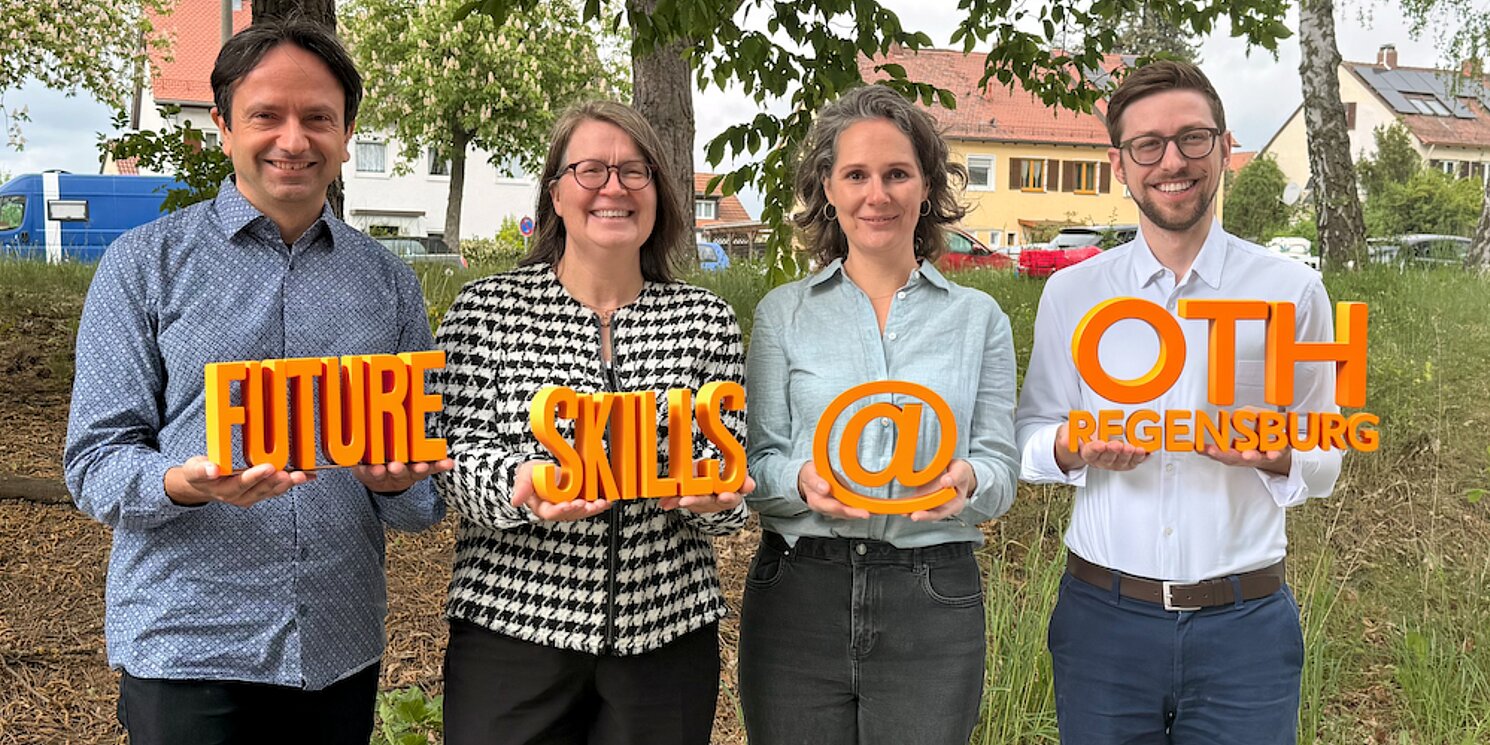
OTH Regensburg has developed a university-wide Future Skills Framework. It highlights what already characterises good teaching at the university today – and how students and lecturers can work together to prepare for a changing world. From the outset, the aim was not to reinvent teaching at OTH Regensburg. On the contrary: the framework highlights what is already being practised at the university today – committed teaching, close links to professional practice, personalised support, academic excellence and the commitment to equip students not just for their next career step, but for a complex future.
The new Future Skills Framework builds on these strengths. It has emerged from numerous discussions, academic discourse on teaching methodology, peer-to-peer consultation within the Higher Education Forum on Digitalisation at the Stifterverband für die Deutsche Wissenschaft, and feedback from teaching, student life and professional practice; it was consolidated, developed further and systematically compiled as part of the OTHorizont project.
Not a break, but a shared next step
At first glance, ‘future skills’ conjures up images of the future, technology and new demands. However, the OTH Regensburg framework deliberately takes a broader approach. It does not view future skills as a collection of ever-changing buzzwords, but as a contemporary update of fundamental educational objectives. Critical thinking, judgement and ethical reflection are not new – but they must continually be adapted to new social conditions and taught in new ways.
“This is precisely where the particular strength of the approach lies: the framework does not seek to make abrupt changes, supplant tried-and-tested methods, or impose an additional template on teachers. Rather, it invites us to work together to further develop existing teaching quality,” says Prof. Dr.-Ing. Birgit Rösel, who has accompanied and supported the development of the framework from the outset in her role as Vice-President for Studies and Teaching. “Good teaching remains good teaching – the framework simply provides it with a common language, greater visibility and new points of reference for the future.”
Three perspectives, one common goal
The Future Skills Framework developed by OTH Regensburg brings together the skills of the future in a harmonious triad: personal development, social responsibility, and digitalisation and transformation. “These three areas are deliberately not conceived of as separate from one another. Digital skills only come into their own when combined with ethical judgement and a sense of social responsibility; personal development remains abstract without a connection to real-world transformation processes,” says Prof. Dr Thomas Kriza. He is the scientific director of the flagship project OTHorizont and has driven forward the work on the framework.
This makes it clear that, at OTH Regensburg, future-proof teaching means more than just the competent use of new technologies. It is also about thinking critically, taking responsibility, dealing with uncertainty, acting democratically, making sustainable decisions and actively shaping change.
This is also reflected in the specific future skills described in the framework. These include, amongst others, critical thinking and reflective skills, communication and collaboration skills, ambiguity management, resilience, sustainability skills, democratic skills, AI literacy, data literacy, cybersecurity, and change management & AI leadership.
Designed for students and lecturers
The framework is specifically aimed at both sides of the teaching process: students and lecturers. It helps students understand which skills they can develop during their studies – for their personal development, their professional capabilities and their participation in society. For lecturers, it offers university-wide guidance on how to specifically address, reflect on and further develop future skills in courses, programme development and teaching formats.
Prof. Dr Kriza emphasises: “This is precisely why the framework is not a static set of rules, but a living framework for guidance. It is intended to help bring good ideas to the fore, better link existing programmes and strengthen future skills where teaching takes place every day: in the faculties, the degree programmes, in the courses, and in the exchange between lecturers and students.”
Keeping our finger on the pulse together
With the Future Skills Framework, we at OTH Regensburg are demonstrating that we want to actively shape the education of the future – not in abstract terms, but in concrete ways, across the whole university and with great commitment. I am delighted that such a dedicated team has come together and that we have reached this important milestone for OTHorizont and for us as a university. It is a sign that our university remains at the cutting edge whilst focusing on what makes it strong: people who take teaching seriously, support students and see education as more than just the transfer of knowledge,” says Prof. Dr.-Ing. Birgit Rösel.
The framework therefore represents the first step: building on today’s high-quality teaching, developed with passion – and with the aim of preparing students even better for the challenges of tomorrow.
Further links:
- Contact via the OTHorizont functional address: othorizont(at)oth-regensburg.de
- To the OTH Regensburg Future Skills Framework
- To the OTHorizont project
- Current Future Skills Framework available for download