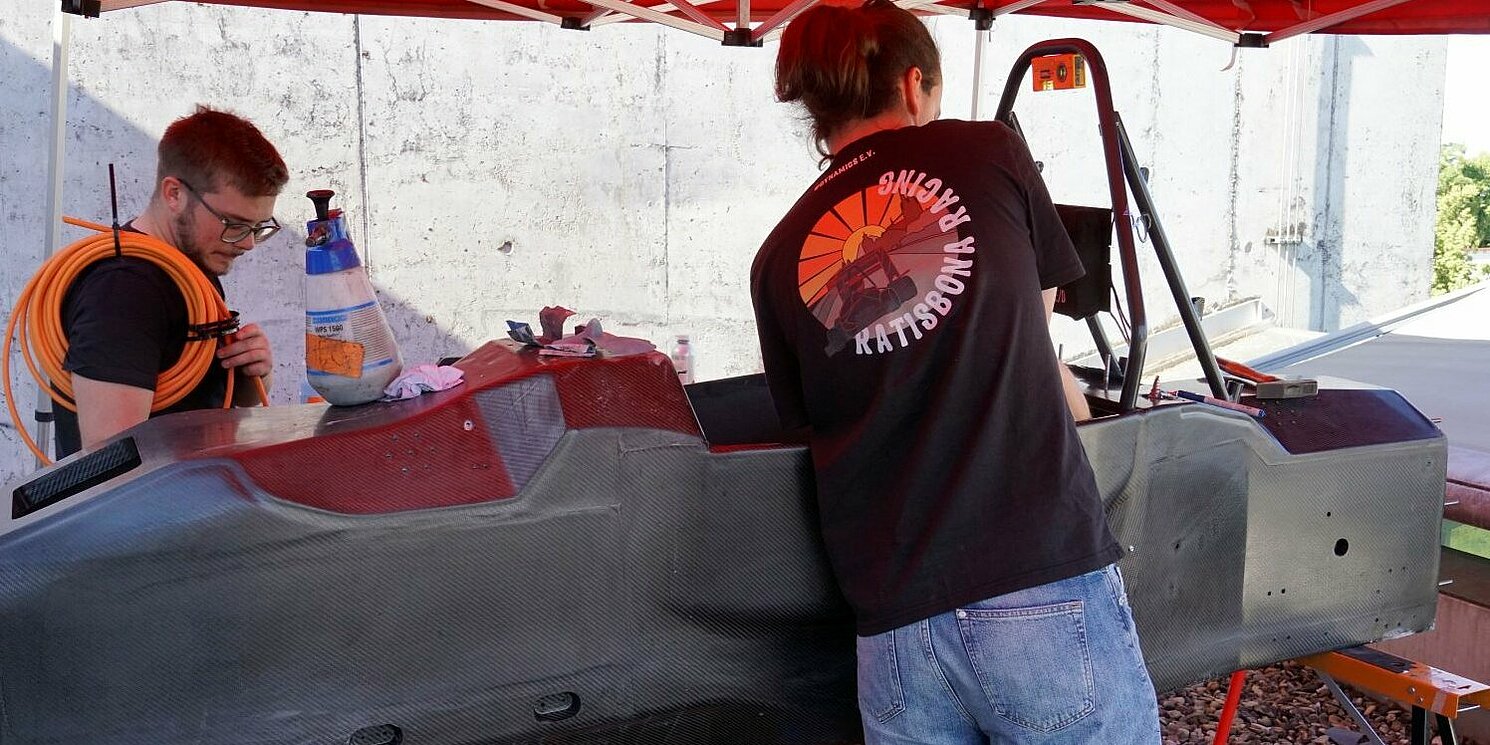
Formula Student is an international university competition in which teams of students design their own racing cars and compete against each other on racetracks around the world.
What began with traditional combustion-engine cars and pure driving vehicles has evolved significantly in recent years: first came electric racing cars, and now more and more teams are working on autonomous systems. Dynamics is now taking the next logical step: the so-called driverless system (fully automated driving) in competitive racing. The aim is to compete successfully in the autonomous disciplines at international events. The aim is to perform successfully at international events, including in the autonomous disciplines. The vehicle will be unveiled on 3 June at OTH Regensburg, followed by Germany’s first fully driverless race on 11 August.
The vehicle’s name encapsulates the concept: ‘Racing Project 2026: electric and driverless’. The project is the result of months of development work by around 100 students from a wide range of disciplines, including computer science, electrical engineering, mechanical engineering and business administration. This is because autonomous driving in motorsport is considered particularly complex, as sensor technology, software and vehicle engineering must all work together in real time. Many team members devote between five and 20 hours a week to the project, with some team leaders working up to 40 hours. During busy periods, work in the laboratory often continues late into the night.
Decisions in milliseconds
“Autonomous driving in motorsport means that the vehicle has to make decisions in milliseconds, whilst operating at the limits of its performance,” says Ricardo Schmidt, sub-team leader in the Driverless division.
Whilst driving, the software continuously calculates the vehicle’s position, identifies the route and plans the ideal driving line. Parts of the system respond within 10 to 20 milliseconds. To further develop the technology, the team is using, among other things, a driving simulator they have developed themselves.
Technically, too, the racing car relies on in-house developments. The team is particularly proud of the electric all-wheel drive system with four individually controlled electric motors, which enable precise vehicle control, for example by selectively braking individual wheels in corners. This is a real competitive advantage, as it is not the theoretical top speed of around 120 km/h that is decisive, but above all acceleration, cornering speed and precision.
A dedicated ‘Vehicle Dynamics’ sub-team works on simulation and setup optimisation, thereby specifically enhancing the vehicle’s performance in autonomous mode.
Competition featuring cutting-edge technology
Formula Student is regarded worldwide as one of the largest student engineering competitions. The judging criteria include not only racing performance, but also design, efficiency, innovation and business concepts.
“Many teams are now developing autonomous systems for the first time; the field of driverless technology is growing rapidly,” said Schmidt. “Those who succeed in this area not only score points in the competition, but also develop technologies that are relevant beyond motorsport.”