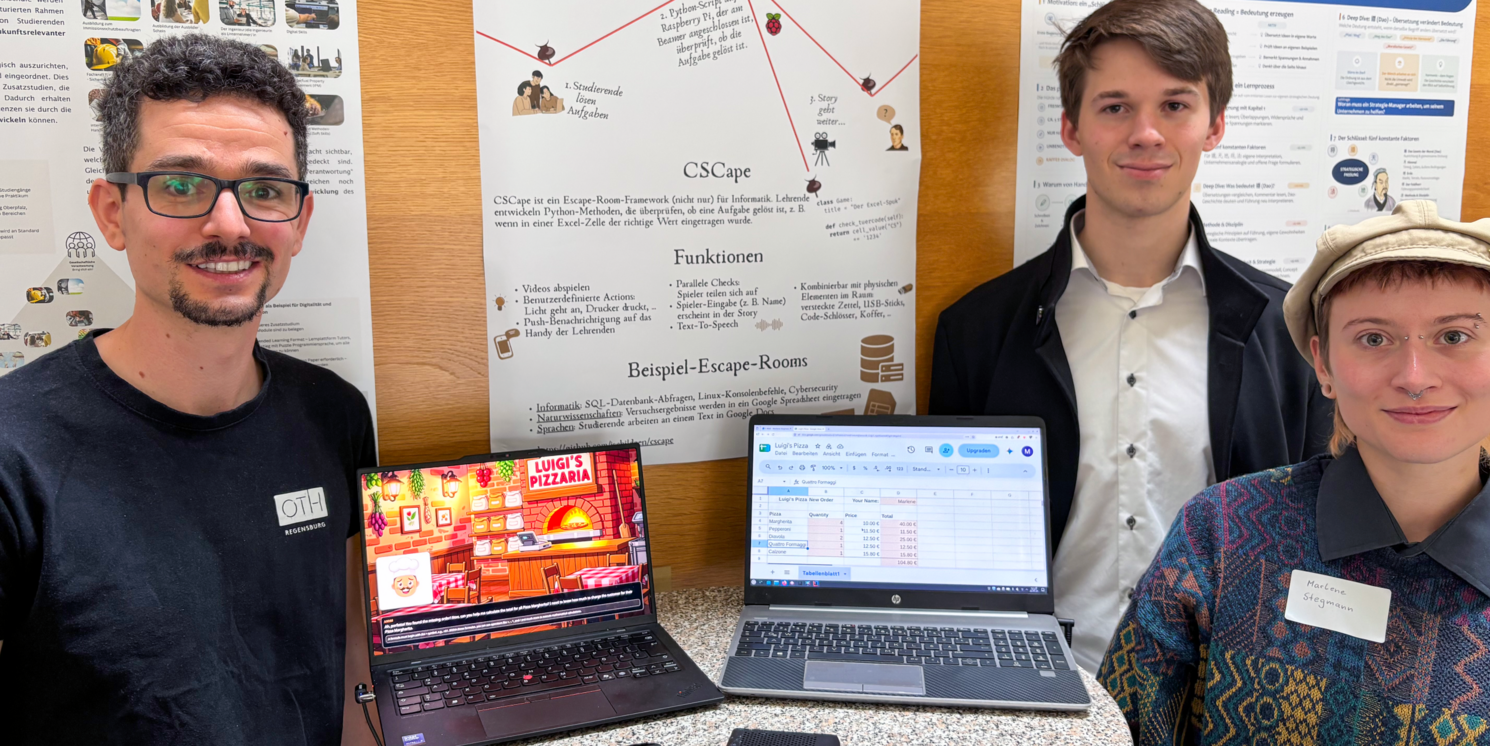
“The database has been hacked! You have to fix it!” That is all the help there is – there isn’t even a laptop at the front of the room. Now it is up to the two to five students. One of the tasks reads: what was the date 10,000 days ago? The group has to write a program to work out the answer and enter it. If it is correct, the next video starts on the screen and the story continues.
Johannes Schildgen, Professor of Databases and Big Data Analytics at the Faculty of Computer Science and Mathematics at OTH Regensburg, builds rooms like these for his courses and takes care of the decorations himself. Everything is meant to look as if it were happening on its own. In reality, a Raspberry Pi – a small computer connected to the projector – is pulling the strings. It continuously checks whether the correct solution has come in, for instance whether the right data is in the database. Once it has, Professor Schildgen is notified too: a message pops up on his phone, allowing him to follow the group’s progress from outside. Smart plugs connected via Wi-Fi can also switch lamps on and off. Once a task has been solved, the lights come on as if by magic.
CSCape is open source, and the code is freely available on GitHub. Professor Schildgen envisages a kind of marketplace where lecturers can swap, adapt or directly adopt ready-made rooms. And it doesn’t have to be computer science. Students could, for example, enter measurements from chemistry, physics or biology experiments into a spreadsheet – and if the values are plausible, the story moves on.
10 per cent of the final mark
Marlene Stegmann is in the first semester of her Master’s in Computer Science; Elias Wagner is also studying for a Master’s in Computer Science, specialising in software engineering. Both have played Schildgen’s rooms. At first, everyone puzzles away on their own, then several heads bend over the same task. It was always fun, they say, and sometimes stressful too, as the timer keeps ticking relentlessly. Ten per cent of the final mark depends on how far you get. Ask the two what has stuck with them, and the stories are the first thing that comes to mind. There was the Christmas market where someone had switched off the lights and the group had to get them shining again. And there was the character who appears on the screen as soon as the first task is solved, asking the group for help in the fight against the villain.
Do you learn more this way? Yes, says Marlene Stegmann: “In a lecture I listen; in the escape room I apply what I’ve learnt myself. That suits my learning style better.” Elias Wagner puts it like this: “When you’ve cracked a task, you know it’s sunk in. And it’s simply more fun.” The two have since built rooms of their own, including one on mathematics.
Selfies thanks to SQL Island
Why go to all this trouble? “I want my students to still be saying in ten years’ time: OTH Regensburg wasn’t boring – we did things there that you didn’t find everywhere,” says Professor Schildgen. There is no magic formula for good teaching, he says, so he experiments.
He has already seen for himself how long this kind of thing can resonate. In 2013, he programmed his first educational game, SQL Island, which teaches the database language SQL. Today, he says, it is played in schools all over the world. People have come up to him and asked whether he was the one who programmed SQL Island – and then asked for a selfie. They knew the game from school.
Even so, the escape room is not a model for everyone, as Schildgen himself points out. “An escape room like this doesn’t suit every professor. But if everyone tries out what suits them, a university becomes more diverse. Then not everything is the same.”
Schildgen will present CSCape at the 20th European Conference on Games Based Learning at TU Darmstadt from 30 September to 2 October.