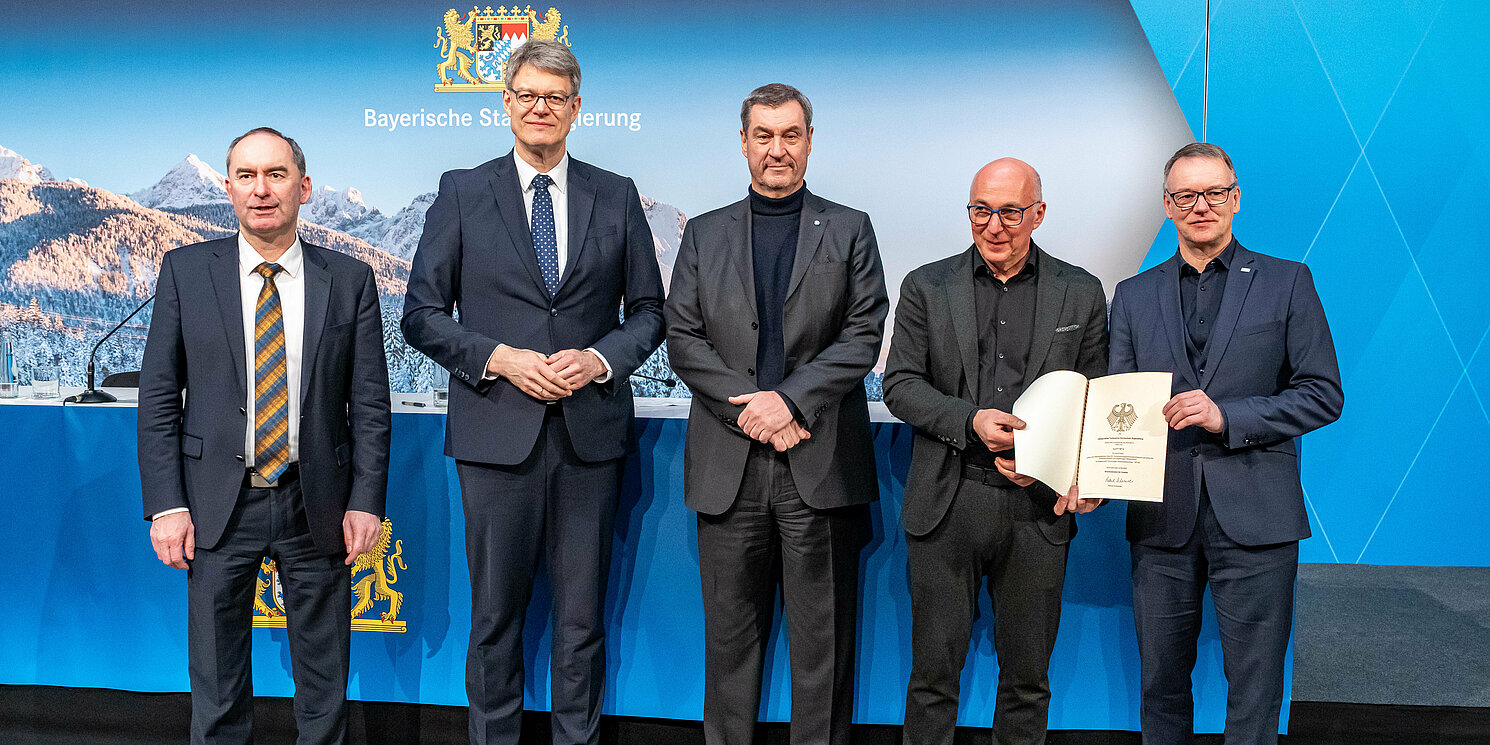
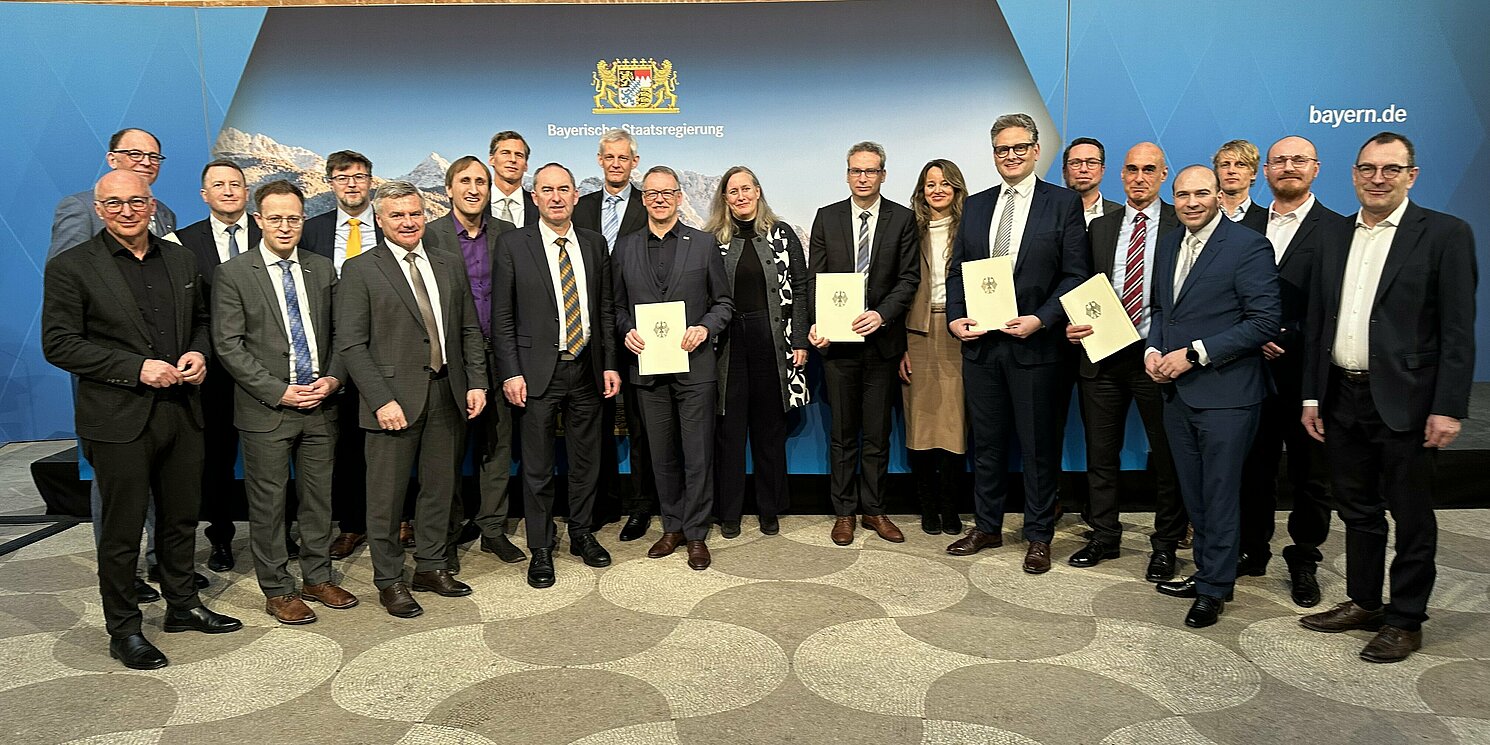
On Tuesday, 10 February 2026, OTH Regensburg, together with the companies HyTACC and HyTACC CRYO, as well as the universities TH Ingolstadt (THI) and Landshut University of Applied Sciences, received funding approvals for the globally unique hydrogen supply infrastructure and test facilities of the Hydrogen Technology Application Centre (WTAZ) from Federal Transport Minister Patrick Schnieder in the presence of Bavarian Prime Minister Dr Markus Söder and Bavarian State Minister Hubert Aiwanger. This marks the start of the implementation phase for the Hydrogen Technology Application Centre on the site in Pfeffenhausen, where the electrolyser of the HyPerformer hydrogen model region HyBayern already went into trial operation in autumn 2024. As part of its funding for the National Innovation and Technology Centre for Hydrogen (ITZ), the federal government is providing €32 million in grants for the three universities and up to €22 million for commercial infrastructure developers.
Federal Transport Minister Patrick Schnieder: "Germany is an international leader in hydrogen and fuel cell technology. For this key technology to make its way from research into widespread application, it needs bold entrepreneurial spirit and powerful innovation spaces. This is exactly what the Hydrogen Innovation and Technology Centre in Pfeffenhausen, Bavaria, is doing. That is why we are supporting the establishment of the centre with start-up funding of €54 million. This will create a central innovation platform for hydrogen technologies that will significantly advance the transition to new drive systems in transport and at the same time ensure sustainable value creation in Germany."
The Free State of Bavaria has promised up to €30 million in funding, part of which has already been used to purchase land and develop the hydrogen centre by the municipal company H2LA in Pfeffenhausen.
Minister President Dr Markus Söder: ‘This is a strong signal for the mobility of the future. The project reinforces our strategy to expand domestic energy sources and research into future technologies such as hydrogen. Bavaria is a leader in Germany in the expansion of renewable energies. We are making a clear commitment to climate protection and transformation. It is a strong signal for the whole of Lower Bavaria that the federal government supports this.’
Minister of State Hubert Aiwanger: "The implementation of the WTAZ marks another milestone in the implementation of hydrogen in mobility. Thanks to start-up funding from the federal government and grants from the Free State, both the basic infrastructure and the corresponding testing, inspection and certification facilities for components in the areas of tanks, refuelling and propulsion can be built at the Pfeffenhausen site. This will particularly benefit small and medium-sized enterprises, start-ups and the supply industry in the transformation towards mobility with green hydrogen. In addition, a strong research network consisting of the three universities of Ingolstadt, Regensburg and Landshut is ready to provide the necessary scientific expertise to local industry. The additional production of green hydrogen in the neighbouring electrolyser will create a promising hydrogen hub on site, where German and European hydrogen technology standards will be set."
OTH Regensburg builds H2 combustion engine test bench and hydrogen injection rate test bench
With the receipt of the funding approvals, a globally unique hydrogen infrastructure is being implemented. HyTACC CRYO GmbH will build the first hydrogen liquefier directly connected to an electrolyser to produce 100% green liquid hydrogen, enabling the testing of commercial vehicle, special vehicle, small aircraft and drone propulsion systems with liquid hydrogen, CRYOGAS (cryogenic compressed gas) and compressed gas produced from liquid hydrogen, as well as supplying other regional users with liquid hydrogen in accordance with the European RFNBO standard (Renewable Fuel of Non-Biological Origin). Furthermore, planning is underway for a hydrogen test hall with outdoor test areas for the operation of large test benches by the three Bavarian universities OTH Regensburg, TH Ingolstadt and Hochschule Landshut, as well as for use by commercial users, in particular small and medium-sized enterprises (SMEs) and start-ups.
OTH Regensburg is taking the lead in the construction and operation of an H2 combustion engine test bench and a hydrogen injection rate test bench. The project manager at OTH Regensburg is Prof. Dr Hans-Peter Rabl. Prof. Rabl is also the scientific director of the Technology Campus Hydrogen Cluster Danube in Kelheim.
The Technical University of Ingolstadt is planning to set up a complete vehicle test bench for commercial vehicles with a climate chamber and simulators. The University of Applied Sciences Landshut is starting to plan the construction and operation of a thermal hydrogen test bench for hydrogen pressure storage tanks and storage components.
Green hydrogen for the region
The WTAZ, as the southern location of the ITZ, focuses on hydrogen drives and refuelling technology for heavy goods vehicles and short-haul air transport, as well as unmanned aerial vehicles (drones) using liquid hydrogen (LH2), cryocompressed hydrogen (CRYOGAS, CcH2) and gaseous hydrogen at pressures of up to 700 bar (CGH2). The WTAZ offers a basic hydrogen infrastructure for testing, inspecting and certifying drive components and for hydrogen refuelling technology with high mass flows. The hydrogen required to operate the test and inspection centre can be supplied entirely ‘green’ from the neighbouring HyBayern electrolyser or from external sources. The liquefier will be used to produce green liquid hydrogen in a sustainable process and make it available for use on site and in the region.
The WTAZ (ITZ SÜD) is funded by the Federal Ministry of Transport (BMV) with a total of 54 million euros as part of the ‘Guideline for the Promotion of Projects in the Course of Establishing a Decentralised Hydrogen Innovation and Technology Centre’. Funding for this measure is also provided under the German Recovery and Resilience Plan (DARP) through the European Recovery and Resilience Facility (ARF) in the NextGenerationEU programme. The funding guideline is coordinated by NOW GmbH and implemented by Project Management Jülich (PtJ).