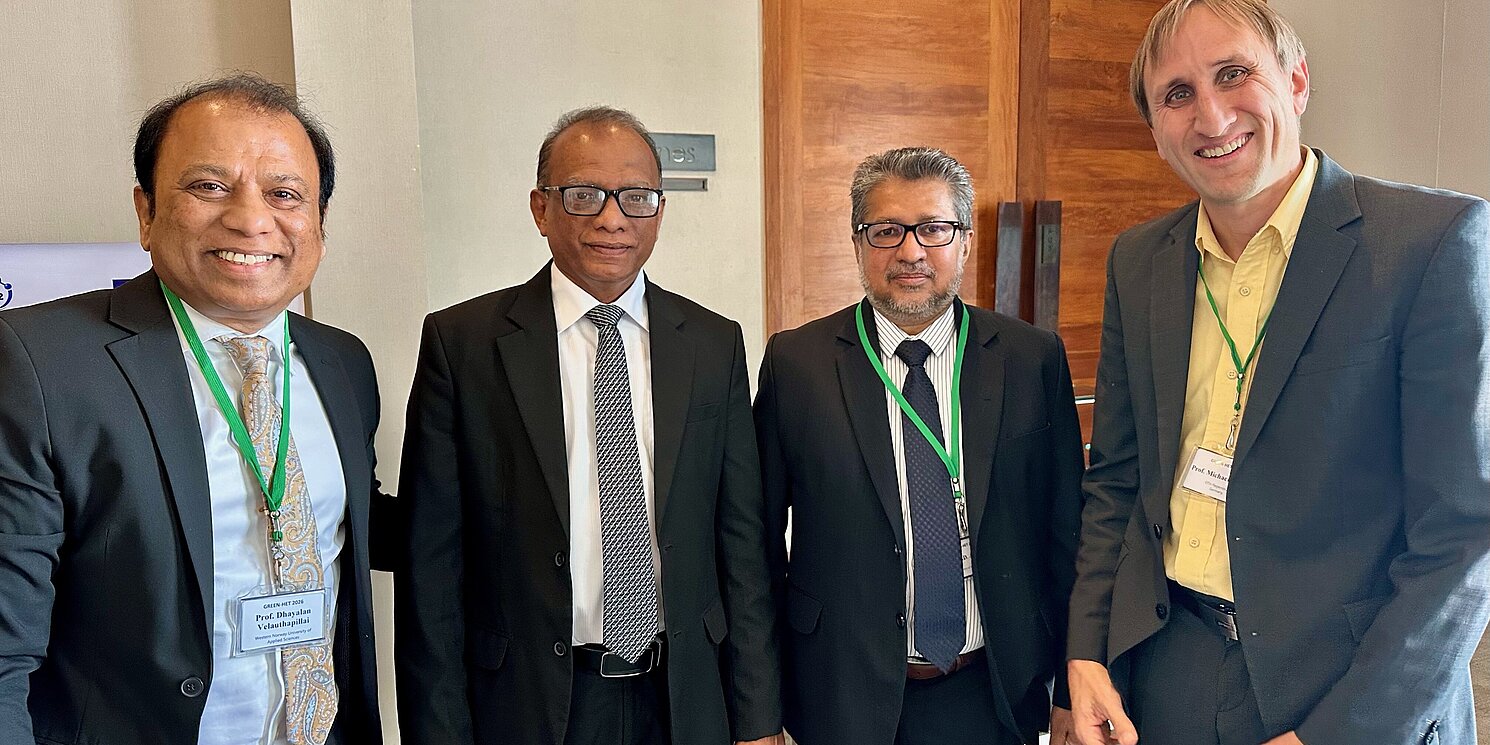
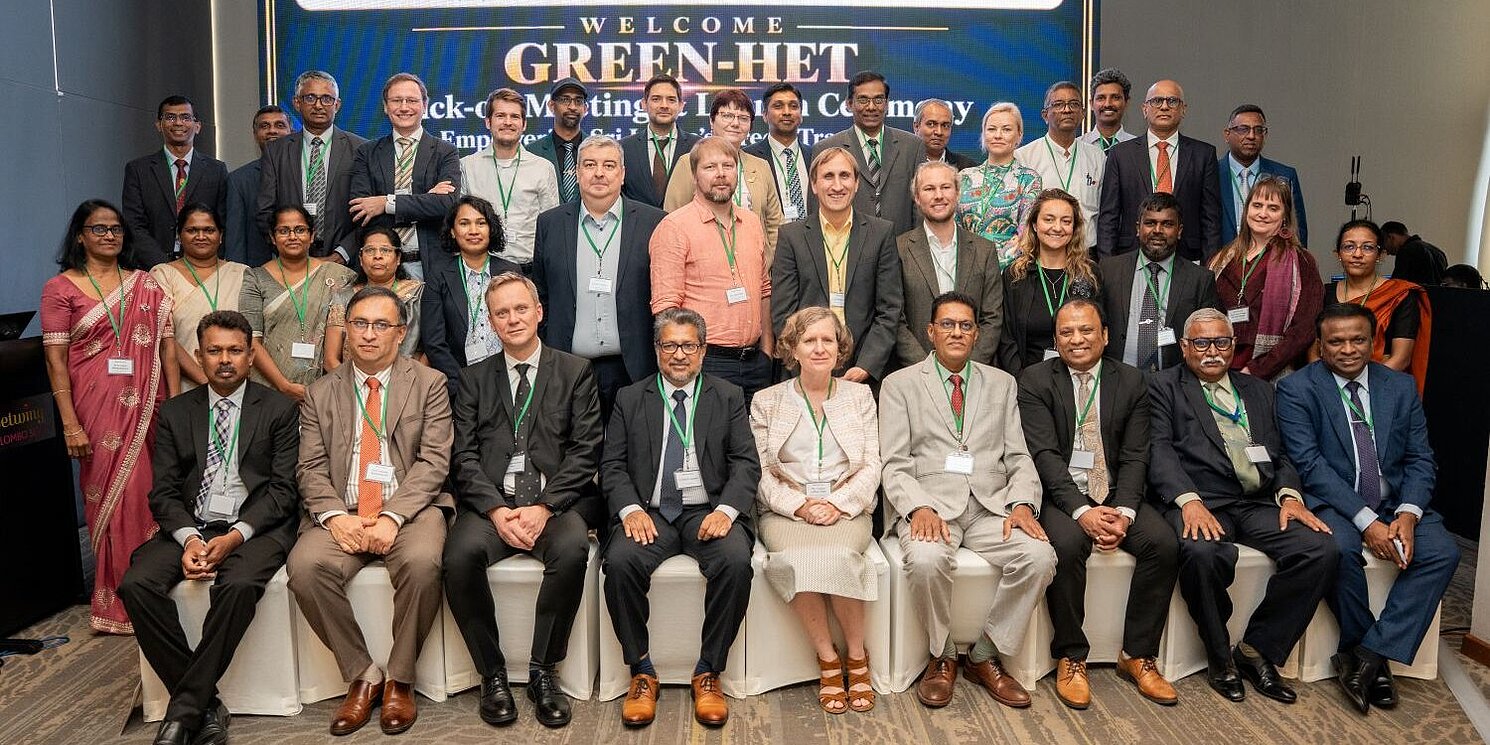
Representing OTH Regensburg in Colombo were Prof. Dr Michael Sterner, one of the heads of the Research Centre for Energy Networks and Energy Storage (FENES), and doctoral researchers Anton Achhammer and Alexander Meisinger. They were there when the project was opened with the lighting of a traditional oil lamp. Guests included three Sri Lankan government ministers, among them Anura Karunathilaka, Minister of Energy and Minister of Ports and Civil Aviation. Also present were a representative of Prime Minister Dr Harini Amarasuriya, the Norwegian Ambassador and a representative of the EU.
“We sensed a great deal of interest here from both government and industry. International cooperation produces strategies that benefit Sri Lanka and Europe alike,” says Prof. Dr Sterner. His team has already had positive experiences with green ammonia for fertiliser in Namibia and Kenya. “While international shipping needs sustainable fuels across the board, green fertiliser makes a direct difference to people on the ground.”
Sri Lanka is roughly the size of Bavaria. In 2025, around 60 per cent of its electricity came from renewable sources, mainly hydropower, which is a similar share to Germany. To expand further, the country needs energy storage, and it is well placed for this. It has high potential for wind and solar energy, including around 56 gigawatts offshore alone, as well as suitable sites for pumped-storage power plants. Power-to-X is another option: renewable electricity is used to produce hydrogen, which can then be stored and processed further. For example, it can be turned into climate-friendly fuels for ships or into ammonia for fertiliser. Sri Lanka needs both. The country’s major ports lie on one of the world’s busiest shipping routes, and it currently has to import all of its nitrogen fertiliser. This year’s energy crisis, triggered by the US and Israeli war against Iran, showed just how urgent this is. Since February, Sri Lanka has had to raise fuel prices by almost half, which has driven up the cost of living considerably.
The new programme is to cover the entire chain, from the production, storage and transport of hydrogen through to its use and Power-to-X. It will be offered by the Universities of Moratuwa, Jaffna, Peradeniya and Ruhuna in Sri Lanka. The project is led by the Western Norway University of Applied Sciences (HVL), one of OTH Regensburg’s partner universities in the European University Alliance ARTEMIS. So far, 18 modules have been proposed, and the partners are currently agreeing which of them will be included in the programme. Prof. Dr Sterner expects around 200 students across the four universities.
Sri Lankan lecturers to visit Bavaria in 2027 and 2028
OTH Regensburg is working with the University of Groningen in the Netherlands and Tallinn University of Technology in Estonia to prepare the teaching staff and laboratories for the new programme. OTH Regensburg is contributing content from its own lectures, while the universities in Sri Lanka will teach the courses themselves. In May 2027, a delegation from the four universities will visit OTH Regensburg to get to know its teaching. A second trip will follow in October 2028, this time to companies in Bavaria that work with hydrogen. Anton Achhammer and Alexander Meisinger are contributing experience from their course “Modelling Sustainable Energy Systems” at the Virtual University of Bavaria (vhb). In this course, students use the freely available energy system model PyPSA to calculate their “own energy transition” for individual regions or countries.
The European Union is funding GREEN-HET (short for Green Hydrogen Enabling Technologies) through its Erasmus+ education programme. Of the approximately €800,000 in project funding, around €80,000 goes to OTH Regensburg. The project runs until 2029.
OTH Regensburg itself also stands to benefit: it plans to set up a student exchange with one of the four universities. According to Prof. Dr Sterner, this would be attractive for students from Regensburg, as teaching there is in English and of a good standard.
“We are delighted to be part of this international consortium, which is advancing security of supply, climate action and sustainability in the education sector,” says Prof. Dr Sterner.
Further information: fenes.oth-regensburg.de/forschung/projekte/green-het