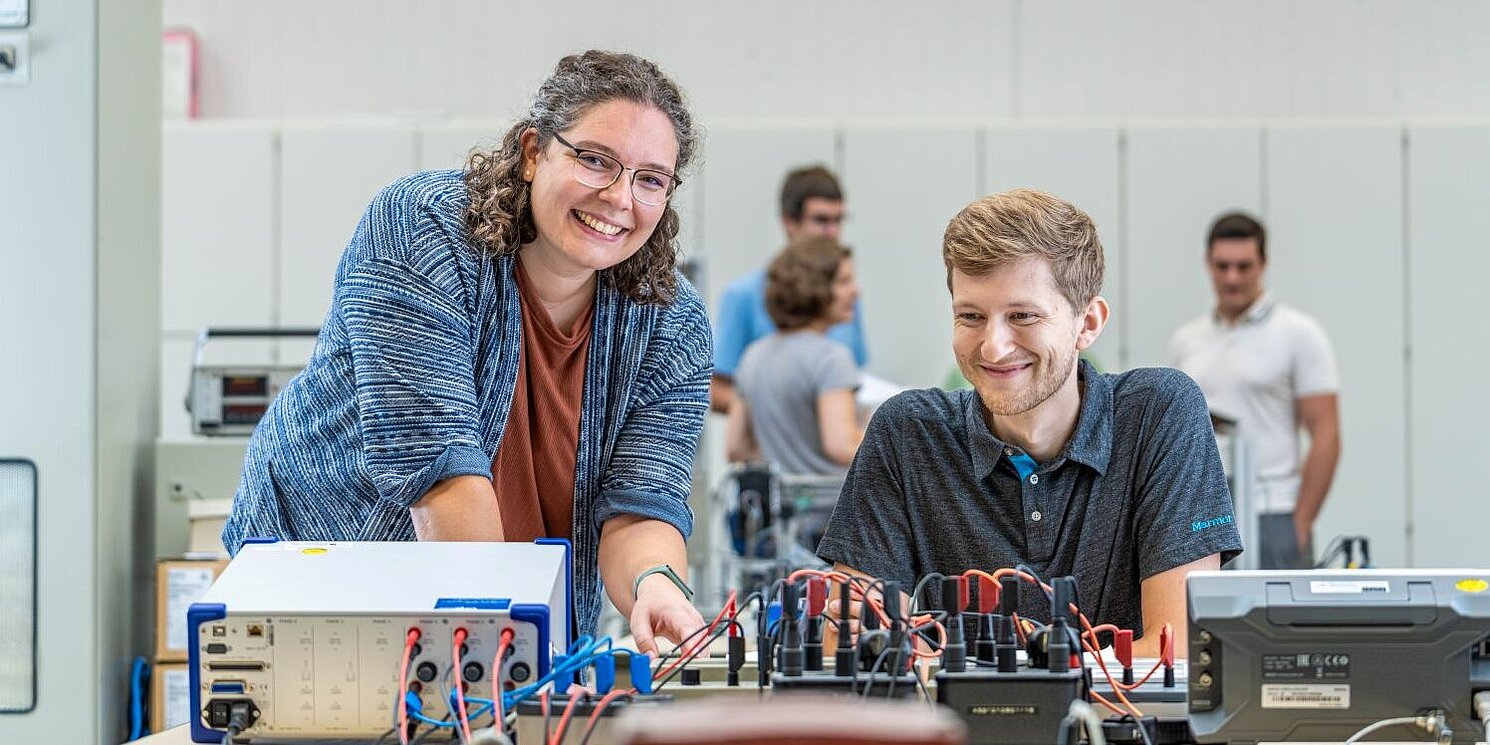
On 10 April 2027, OTH Regensburg and Deggendorf Institute of Technology (TH Deggendorf) will launch their joint part-time Master’s programme in Car IT and Electronics. It has grown out of the Master’s in Automotive Electronics, which was introduced in 2007. The curriculum has been specifically developed further on the basis of a needs assessment: vehicle technology and electronics remain, now joined by dedicated block weeks on automotive cybersecurity and on AI and data science. “The needs assessment showed quite clearly where things are heading: alongside hardware development, increasingly towards data security and AI,” says programme director Prof. Dr. Christian Schimpfle from the Faculty of Electrical Engineering and Information Technology at OTH Regensburg. “That’s why we restructured the programme rather than simply renaming it.”
The Master’s continues to be aimed at professionals from electrical and mechanical engineering, but now increasingly also at people working in the automotive industry who come from a computer science background. “In a vehicle, hardware and software have long since stopped being developed separately. That’s why people from electrical engineering, mechanical engineering and computer science sit side by side in the same block week on this Master’s,” says Prof. Dr. Rainer Holmer, Dean of the Faculty.
Threat analysis for remote diagnostics
Since July 2024, any manufacturer wishing to register new cars, buses or lorries in the EU has had to demonstrate that it systematically protects its vehicles against cyberattacks. This is required by UN Regulation No. 155. In the Automotive Cybersecurity block week, participants carry out a simplified threat analysis and risk assessment themselves – for example, for a scenario in which a garage reads out fault data from a vehicle remotely. “This concerns everyone who develops a vehicle function or a control unit, not just the security department,” says Prof. Dr. Schimpfle.
The AI and Data Science week covers machine learning in the Python programming language, including a data analysis project of the participants’ own choosing. The remaining weeks range from the vehicle as an overall system and software that has to respond within fractions of a second to connectivity – both within the car itself and between vehicles and traffic infrastructure. As with its predecessor, the programme is taught by lecturers from both universities and by experts from the automotive industry; the degree is awarded jointly by OTH Regensburg and TH Deggendorf. The programme is organised by OTH Regensburg’s Centre for Continuing Education and Knowledge Management (ZWW).
Six block weeks in Regensburg
The programme lasts four semesters and leads to a Master of Engineering (M.Eng.). In each of the first three semesters, participants travel to Regensburg twice for a week at a time. This is complemented by around 250 hours of self-study per module. The fourth semester is devoted to the Master’s thesis. Applicants need a completed degree in electrical engineering, mechanical engineering, mechatronics, computer engineering or a related subject, as well as at least one year of professional experience. The application deadline is 17 January 2027.
Anyone interested can contact programme coordinator Bianca Hirthammer at the ZWW at any time for a no-obligation online consultation on the programme’s concept, content and organisation. Contact and applications: www.oth-regensburg.de/weiterbilden