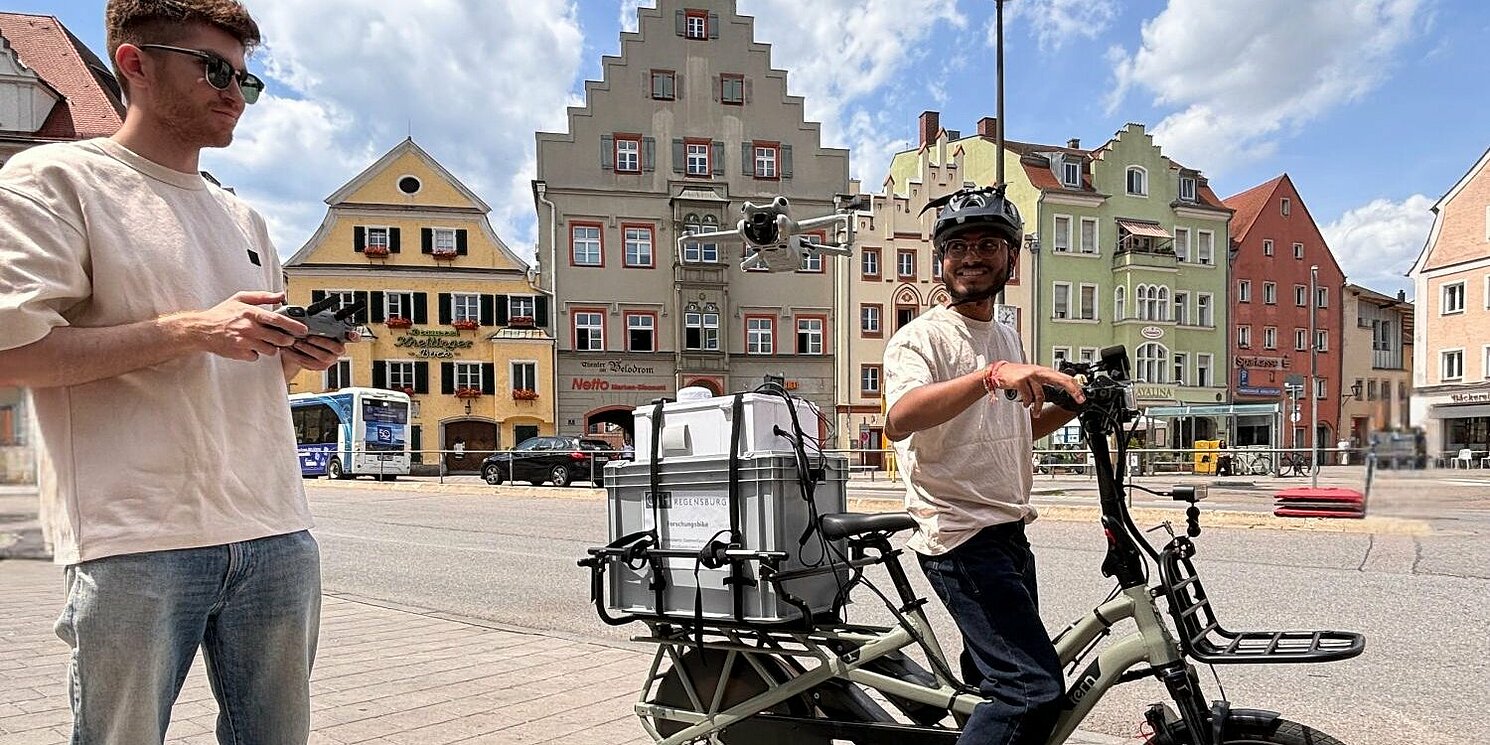
Anyone who walks or cycles in Regensburg is familiar with dangerous situations at junctions. Whilst extensive data on traffic volumes and driving behaviour has been available for motor vehicles for years, cities have often lacked a comparable data set for cycling and walking. This is precisely where the research of Prof. Dr Simone Weikl at OTH Regensburg comes in.
“Our aim is to create a better data set using new survey methods. This applies in particular to so-called vulnerable road users, that is, unprotected road users such as cyclists and pedestrians,” explains Prof. Dr Weikl. The data collected is then analysed using AI to derive concrete insights for transport planning.
OTH team monitors traffic in Regensburg from two perspectives
Using a homemade sensor bike and a video drone, the research team is currently scrutinising ten junctions in Regensburg. Whilst a student cycles along, the drone simultaneously records traffic conditions from the air. This generates data from two perspectives. With the help of AI, the recorded objects are then classified – for example, as a car, bicycle, pedestrian or e-scooter.
The data can be used to create detailed movement profiles, from which speeds, accelerations, distances between road users and other safety metrics can be calculated. The analysis reveals where critical situations regularly occur.
For Prof. Dr Weikl, one thing is clear: AI will not replace humans. “AI is not the sole saviour. It will only help us if it remains understandable to users. For transport planning, we still need experts who can work with the improved data and critically assess the results.”
Another project at the University of Regensburg’s bus station demonstrates how such analyses can be put to practical use. There, students analysed LIDAR data collected as part of the City of Regensburg’s Real-World Laboratory for Urban Mobility. This data consists of three-dimensional environmental data captured using laser scanners. The analysis clearly highlighted the locations where conflicts arise between buses, cars, cyclists and pedestrians, and where vehicles are travelling too fast. Based on these findings, the team drew up specific recommendations for action and submitted them to Regensburg City Council.
“Women in Data Science” Event
As part of the “Women in Data Science Regensburg” event on 18 June, Prof. Dr Simone Weikl will be giving an insight into her current research at the Jahnstadion in Regensburg. The focus will be on how new mobility data and AI can help us better understand transport systems and make cities safer and more liveable.