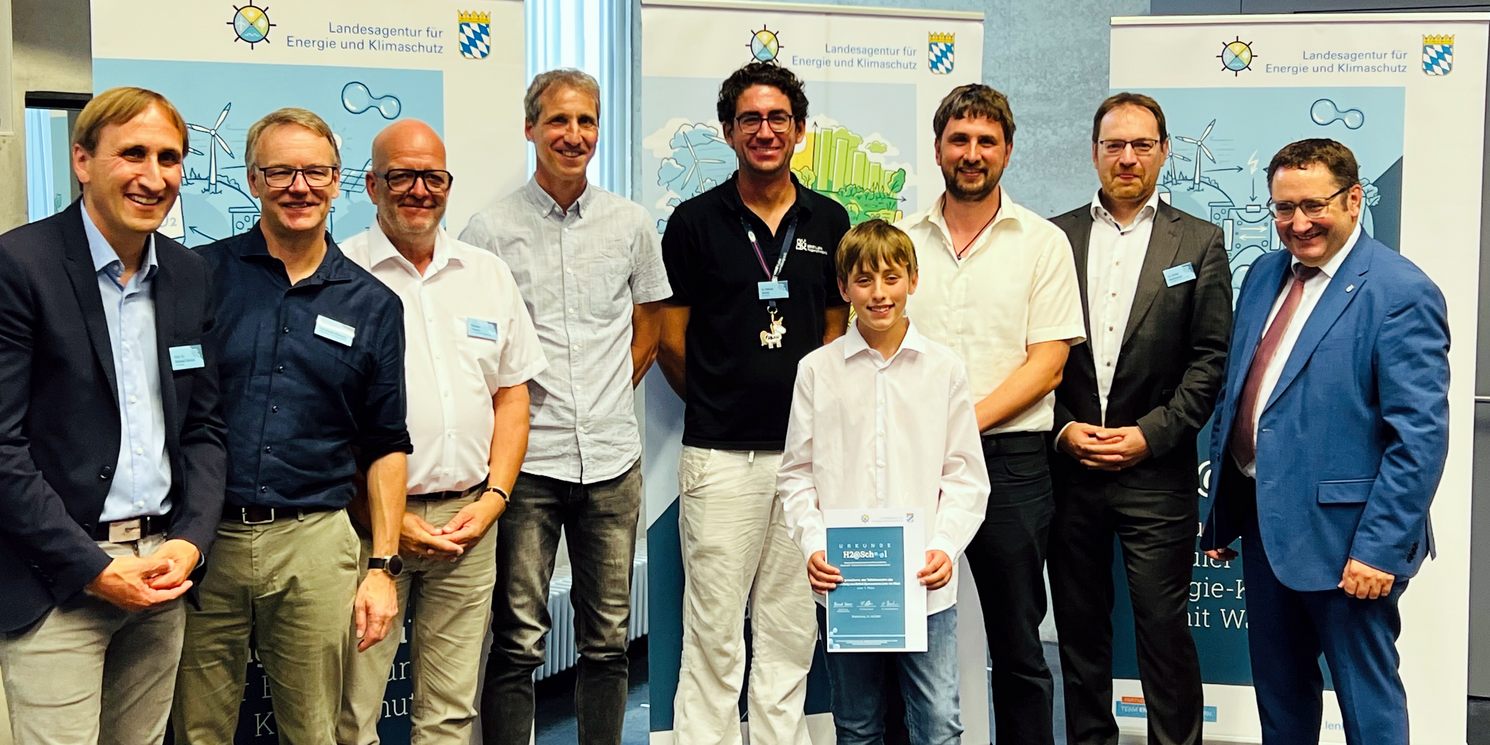
First place went to the Franz-Ludwig-von-Erthal Gymnasium in Lohr am Main. The jury was particularly impressed by the pupils’ magazine ‘VOLTVision’, which was produced entirely by hand. Whilst AI-supported projects have certainly been recognised in previous years, this team stood out with an exceptionally detailed analogue project. According to the jury, the proposed energy centre – incorporating hydropower, hydrogen production and storage systems – was technically sound, creatively designed and thought through down to the last detail.
The jury was particularly impressed by the Dientzenhofer Gymnasium from Bamberg, which took second place. For the experiments, the team spent a whole day at the University of Bayreuth, conducted an interview with an expert in energy technology and developed a concept for a fictional company that uses hydrogen technology in crisis-hit areas. The pupils then even passed on their knowledge to younger pupils during lessons. “Keeping this knowledge to ourselves would be a waste,” as one pupil put it.
Third place was shared by the Ernestinum Grammar School in Coburg and the Korbinian-Aigner Grammar School in Erding. All teams that took part in the practical stage of the competition also received a financial reward for their efforts.
Prof. Dr Christoph Skornia, Vice-President of OTH Regensburg, placed the competition within the context of the university: “We can only tackle challenges such as climate change and energy supply through appropriate research and education.” He encouraged the pupils to remain curious and to engage with issues facing the future. “It is crucial not just to stand by and watch, but to get actively involved where things are happening.”
State Secretary for Economic Affairs Tobias Gotthardt encouraged the participants to remain open to new technologies. Speaking on behalf of the Bavarian Ministry of Economic Affairs, he emphasised the importance of hydrogen for the future: “For the energy transition to succeed, we need hydrogen as a means of energy storage. The participants in H2@School have explored how hydrogen can help solve specific problems, and in doing so have developed some outstanding ideas. We need young, bright minds like that in Bavaria."
Background to the competition
The competition, initiated by Minister of State Hubert Aiwanger, took place for the third and final time this year. It was organised by the State Agency for Energy and Climate Protection (LENK) on behalf of the Bavarian State Ministry of Economic Affairs, Regional Development and Energy (StMWi). The aim was to inspire young people from Year 8 onwards to take an interest in hydrogen, a key topic for the future.
On board from the very beginning: OTH Regensburg as an academic partner. It set the tasks, provided expert guidance on the projects and was also represented on the judging panel by Prof. Dr Michael Sterner, Head of the Research Centre for Energy Networks and Energy Storage at OTH Regensburg.
A total of 18 teams from 15 Bavarian schools took up the challenge. The eleven teams with the highest scores qualified for the practical phase of the competition. Under the theme ‘Hydrogen for Humanity’, they developed, amongst other things, concepts that used hydrogen to provide solutions for a self-sufficient electricity supply in crisis-hit areas.