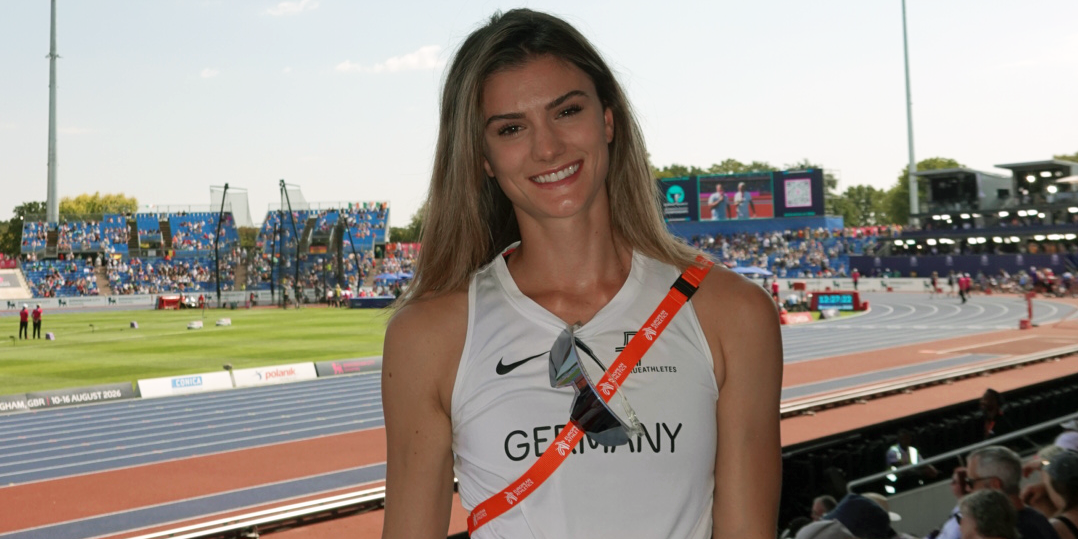
This summer, the German Bundestag passed a new Sports Promotion Act. One of its central questions is how Germany can support elite athletes in building a second career for life after sport. Jana Lakner knows this challenge from her everyday life: the 26-year-old 400-metre runner is a member of the national squad, reached the final with the German relay team at the European Championships and is writing her bachelor's thesis at OTH Regensburg at the same time.
For now, though, Jana Lakner is relaxed. Back from the European Championships, she has a four- to six-week break from competition ahead of her. She is using this quieter period to work on her bachelor's thesis in the Environmental and Industrial Sensor Technology programme at OTH Regensburg, which she aims to complete this semester. In it, she is investigating whether so-called micro-electromechanical systems (MEMS) – tiny sensors like those found in smartphones – can measure vibrations in engines as reliably as conventional sensors. This could make engine testing more efficient in future. She has not yet decided whether to go on to a master's degree after her bachelor's.
Jana Lakner deliberately accepts the double burden of sport and study, as she does not want her identity to depend solely on how fast she can run 400 metres. 'Something can always happen that brings a season to an abrupt end. Besides, I want to enjoy my sporting career. When I can no longer do that, I want to find a new passion,' says Lakner.
The fact that both are possible – a degree and a sporting career – is also thanks to the flexible environment the university provides. Her professors, for example, allow her to complete some of her coursework online while she is away at international training camps. 'I'd say there's always a solution. Sometimes my coach makes allowances, and sometimes my lecturers do,' says Lakner.
A late starter in the fast lane
The real starting gun for her career as a 400-metre runner was her move to Regensburg. At 19, she was already a late starter compared with many other athletes. Before that, she had mainly been a swimmer, and although she had reached Bavarian level, she had not yet pursued competitive sport with the same commitment. The decisive change came when she began her studies at OTH Regensburg and started training with her current coach, Stefan Wimmer. He recognised her potential and encouraged her to take the sport more seriously. Since 2021, she has improved her personal best from 56.66 to 51.60 seconds.
Another turning point was her sports scholarship in the USA. During those eighteen months, she got to know an elite sports system in which studies are organised more around sport. 'Your timetable is basically built around your training,' says Lakner. Even though a later placement semester, combining a 40-hour week with hard training, was extremely demanding, she came away not only with experience of intensive training sessions but also with a better feel for the balance between strain and recovery. Above all, she says, it left a lasting mark on her mindset: not talking things down from the outset, but approaching them positively.
Bringing elite sport and study together
Jana Lakner trains six times a week, around three hours a day, year after year. Yet what outsiders see are the few seconds that appear on the scoreboard at the end of a race. The discipline and rigorous routines behind them are often underestimated. 'Most people probably misjudge the length of the track, too. Anyone who thinks it can't be that hard should try running 400 metres at their absolute limit,' explains Lakner. Especially over the final 100 metres, where races are often decided, you have to be able to deliver your best while thinking as little as possible about what is happening. 'Ideally, I run myself into a state of flow – that's when it works best.' This is exactly what she wants to keep working on.
Ensuring that a sporting career like this need not conflict with academic and professional development is also a priority for OTH Regensburg. To this end, the university deliberately relies on partnerships with clubs such as ESV 1927 Regensburg, the Eisbären Regensburg, the Guggenberger Legionäre, SSV Jahn Regensburg and, since this year, NawaRo Straubing. The aim is to open up academic prospects for athletes through more flexible study conditions and individual support in their day-to-day studies. For degree programmes with restricted admission, there is also a special two per cent quota for elite athletes.
Jana Lakner's next big goal is the 2028 Olympic Games in Los Angeles. But she is no grimly obsessive athlete – she approaches it with a mix of discipline and composure. 'The journey is the destination. I'll keep developing step by step,' says Lakner, looking to the future.