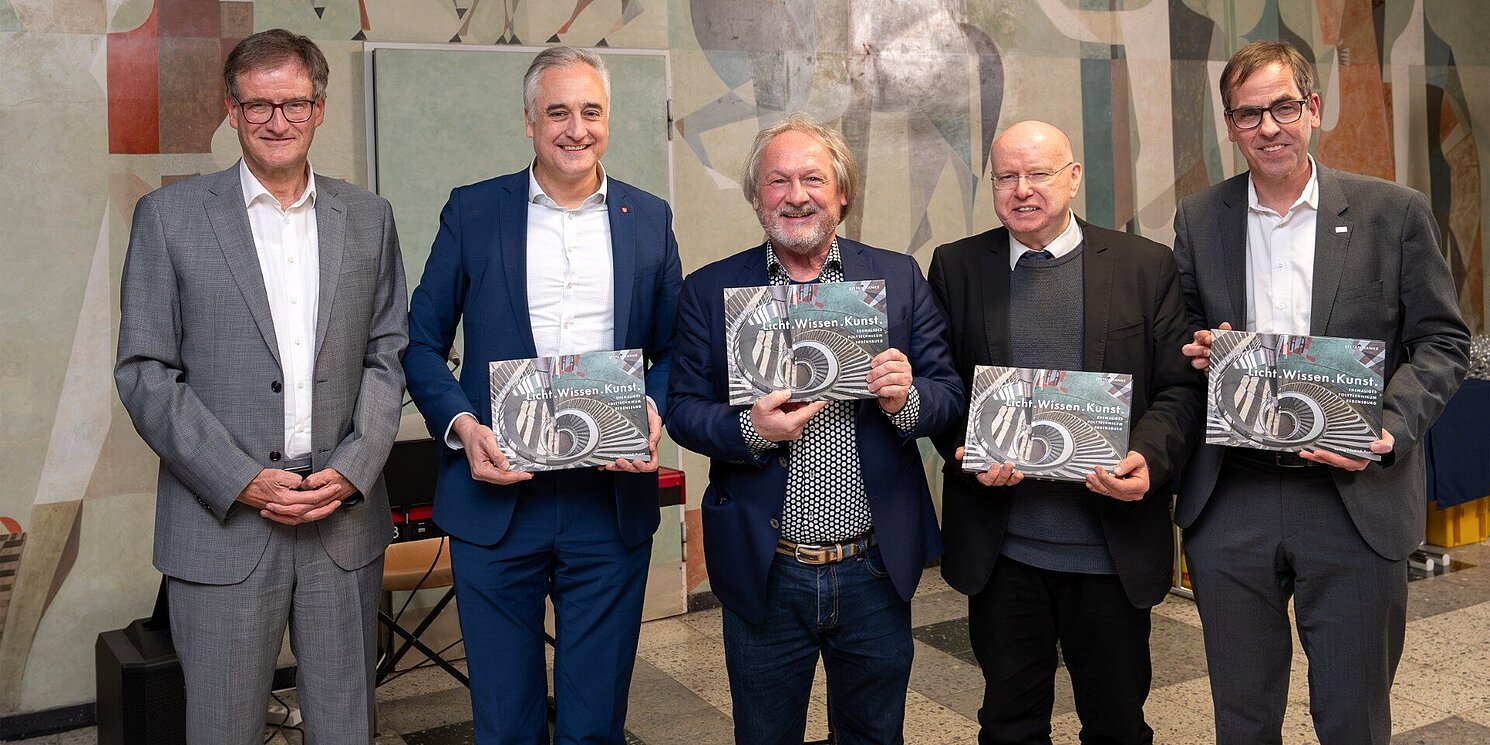
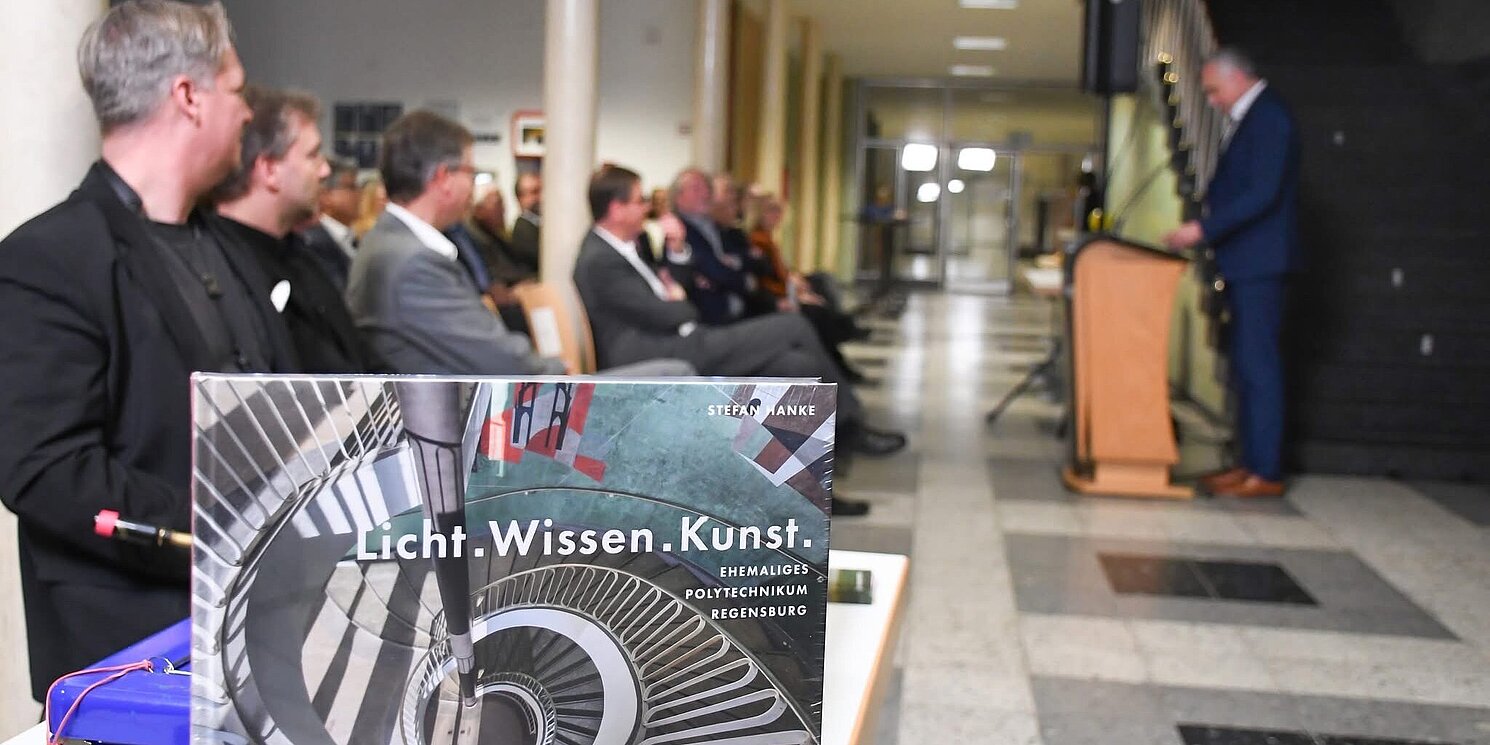
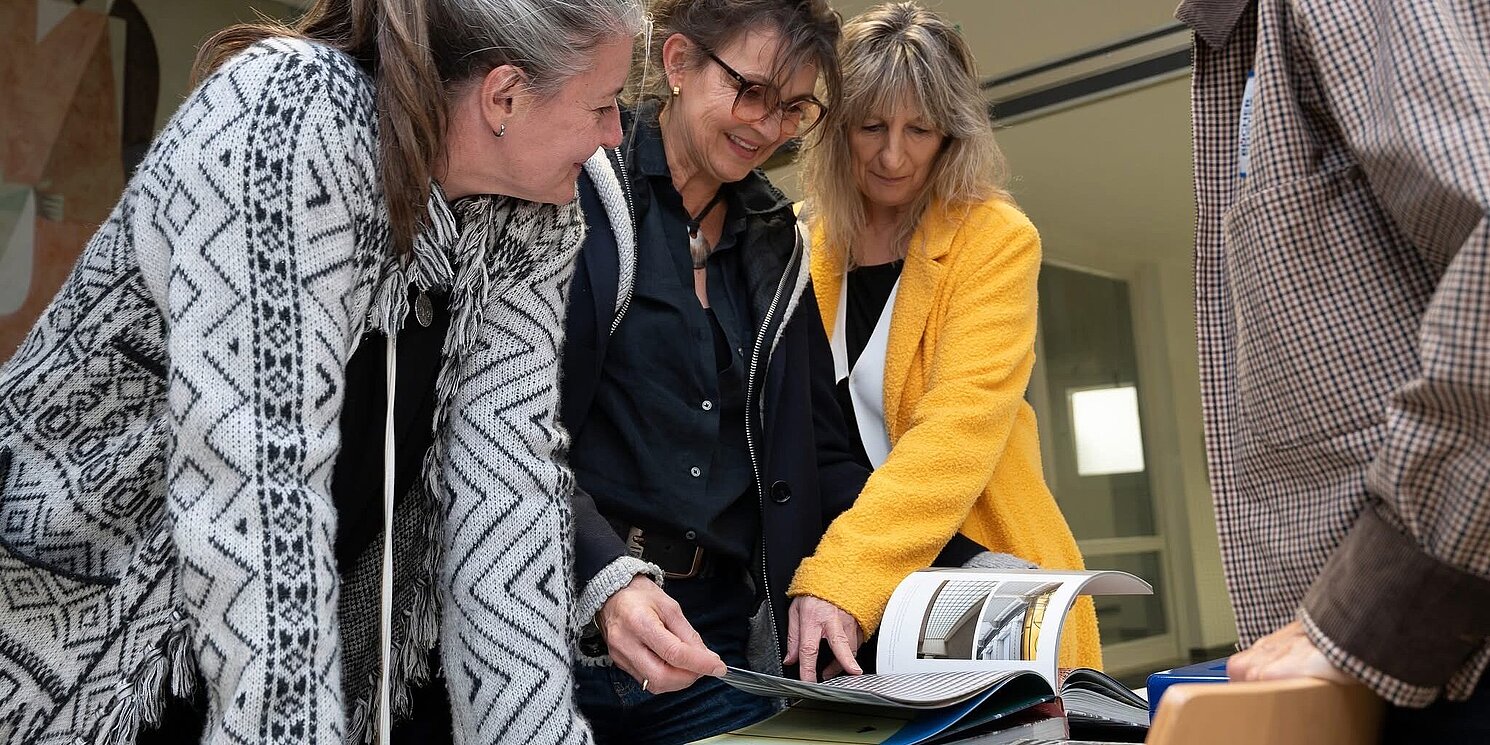
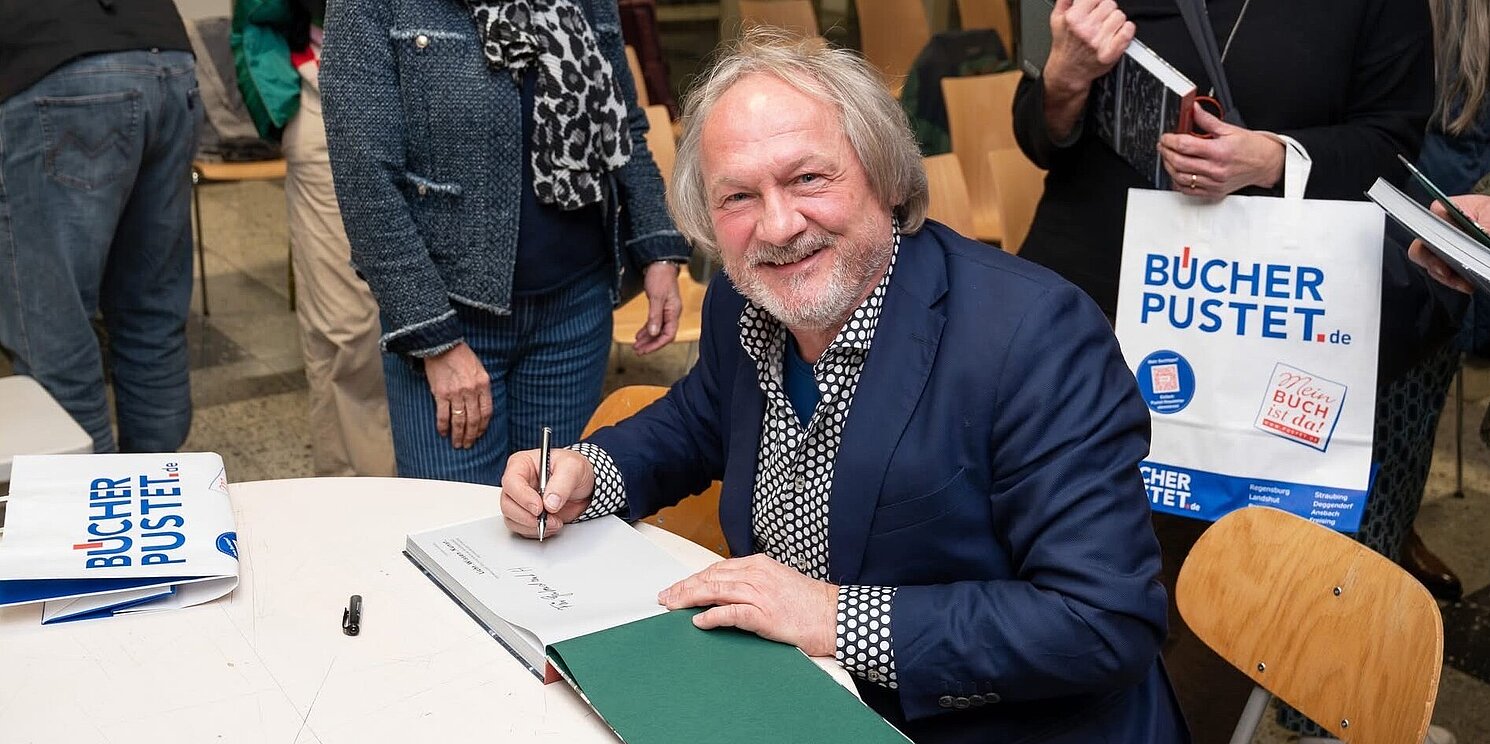
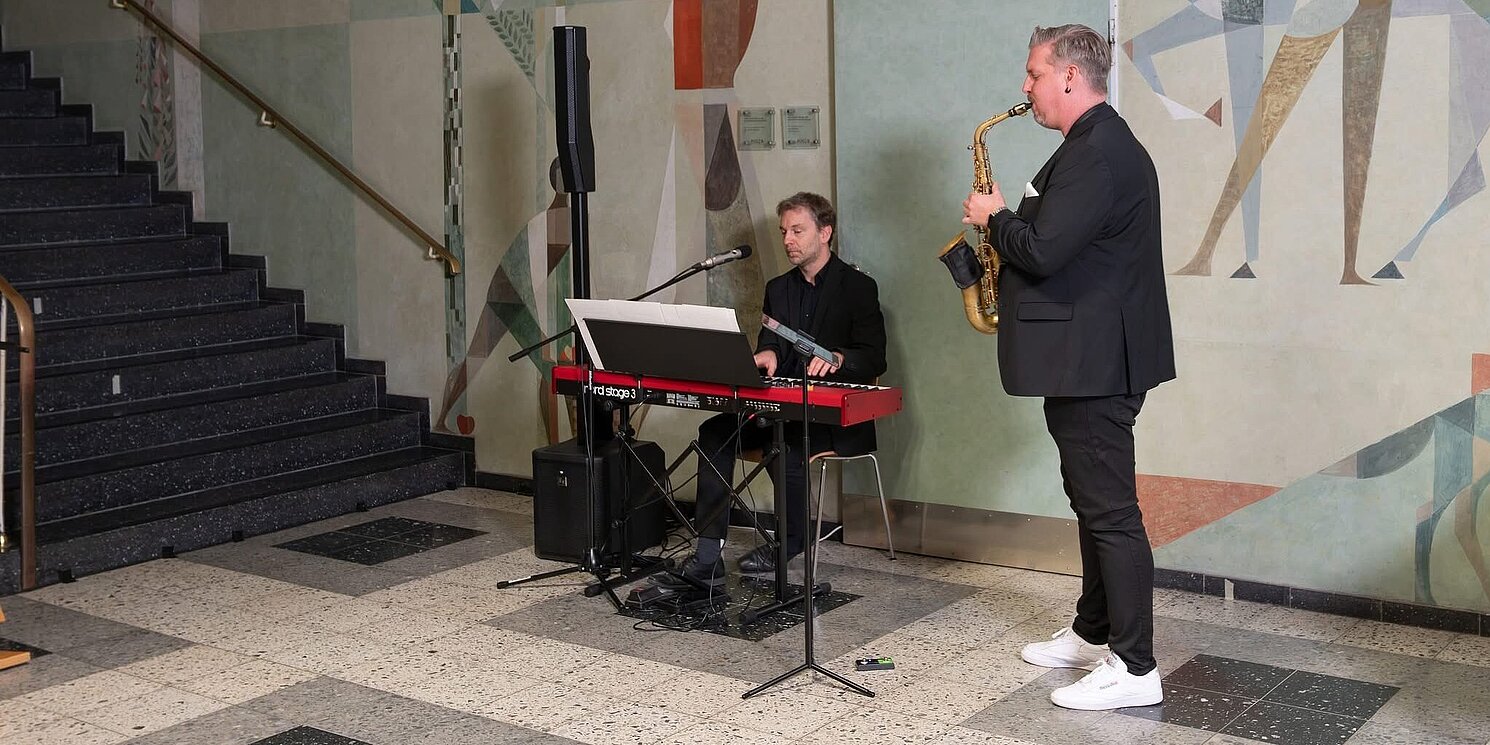
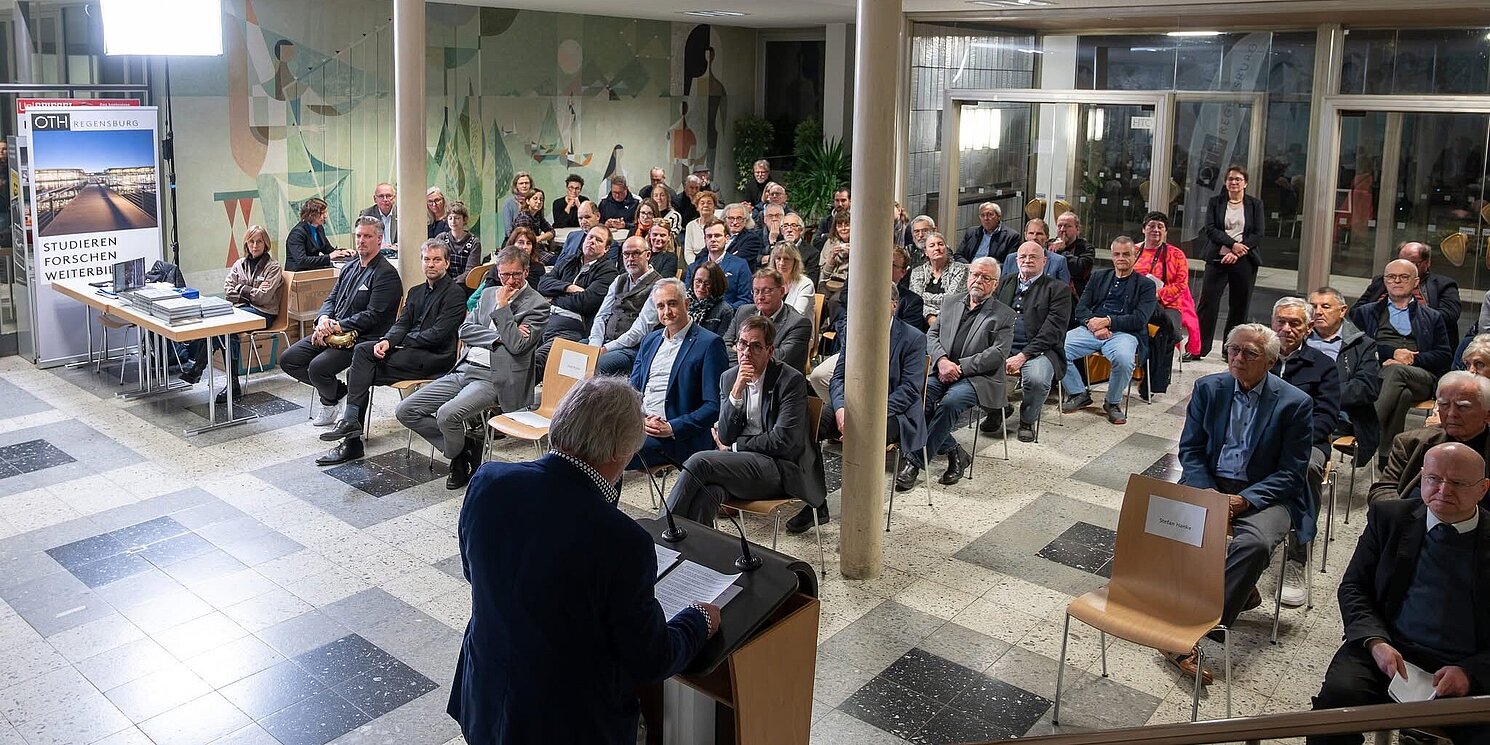
On 4 November, the book, published by Friedrich Pustet, was launched in the foyer of the listed President’s Wing at OTH Regensburg. Around 90 guests from the worlds of politics, academia, culture and the wider community accepted the invitation. Dr Johannes Buhl on the piano and Sebastian Burzer on the saxophone provided the musical accompaniment, performing pieces that captured the spirit of the building’s era of origin.
“Anyone who looks around here immediately understands what makes this place so special,” said Prof. Dr Ralph Schneider, President of OTH Regensburg, in his welcoming address. Architecture, art and education have formed a special bond at this site for decades. The title of the illustrated book captures this perfectly: “Stefan Hanke’s photographs allow us to see a familiar place in a new light. They depict a place of learning and, at the same time, a total work of art, in which even those who come and go here every day can discover something new.”
One of the most significant buildings of Regensburg’s post-war modernism
The former Polytechnic on Prüfeninger Straße in the west of the city is one of Regensburg’s most significant examples of post-war modernist architecture. The complex, which now forms part of OTH Regensburg, reflects the development from the School of Architecture through the Polytechnic and the University of Applied Sciences to the present-day university. Characteristic elements such as the striking spiral staircase by Hans Wenz, the transparent and light-filled extensions by Hans Beckers, and the ‘art in architecture’ works by Jo Lindinger, Blasius Spreng and Willi Ulfig continue to define the site to this day. The complex has been a listed building since 2018.
For Regensburg-based photographer Stefan Hanke, the project was a long-standing journey of discovery. He first set foot in the building back in 2016, and a few years later began his intensive photographic work. Over the course of seven years, he produced a photo book that focuses on well-known rooms as well as hidden corners, materials and design elements. Hanke directs his camera not only at the grand architectural lines, but also at details that are easily overlooked in everyday university life: artfully crafted metalwork at the President’s entrance, the iconic clock above the main entrance, terrazzo floors, window handles and murals that tell stories ranging from antiquity to the modern era, and from student life to idyllic natural scenes.
Bringing a hidden treasure of the city to light
“It’s not me who finds the projects; the projects find me,” said Hanke at the book launch, speaking about the book’s genesis. His fascination with the complex grew primarily through his encounters with its architecture and works of art. The recipient of the City of Regensburg’s Culture Prize sees the book as a contribution to bringing to light an often-overlooked treasure of the city.
The photographs are complemented by texts by the architect Stefan Krabatsch. As deputy head of the university construction division at the Regensburg State Building Authority and a lecturer at the Faculty of Architecture at OTH Regensburg, he has been familiar with the site for many years. In his contribution, he traces the history of the complex’s construction and use, drawing attention to its architectural features. At the book launch, he described the former Polytechnic as a “total work of art combining modernity and lightness”. Many graduates associate the site with formative memories of their studies and a special spirit of exchange and community.
A keen eye for detail and atmosphere
Regensburg’s Lord Mayor, Dr Thomas Burger, also paid tribute to the work. He said that Hanke, with his keen eye for detail and atmosphere, had brought another piece of Regensburg’s history to life. The illustrated book opens up new perspectives on a place that seems familiar to many and whose qualities are easily overlooked, particularly in everyday life.
For publisher Fritz Pustet, the book also holds special significance. The former Polytechnic is one of the outstanding examples of high-quality architecture from the 1950s in Regensburg and deserves to be honoured accordingly. Through its design, production and presentation, a volume has been created that does justice to its subject matter, even in terms of craftsmanship.
For OTH Regensburg, ‘Licht.Wissen.Kunst’ documents far more than just the history of a university campus. The illustrated book reveals how architecture, art and educational culture can shape a place over the decades. It invites readers to rediscover the familiar and to view one of Regensburg’s most significant post-war modernist buildings through a new lens.
Light.Knowledge.Art. Former Regensburg Polytechnic
Photographs: Stefan Hanke
Texts: Stefan Krabatsch and Stefan Hanke
224 pages, illustrated in colour throughout
39 euros
Friedrich Pustet Publishers