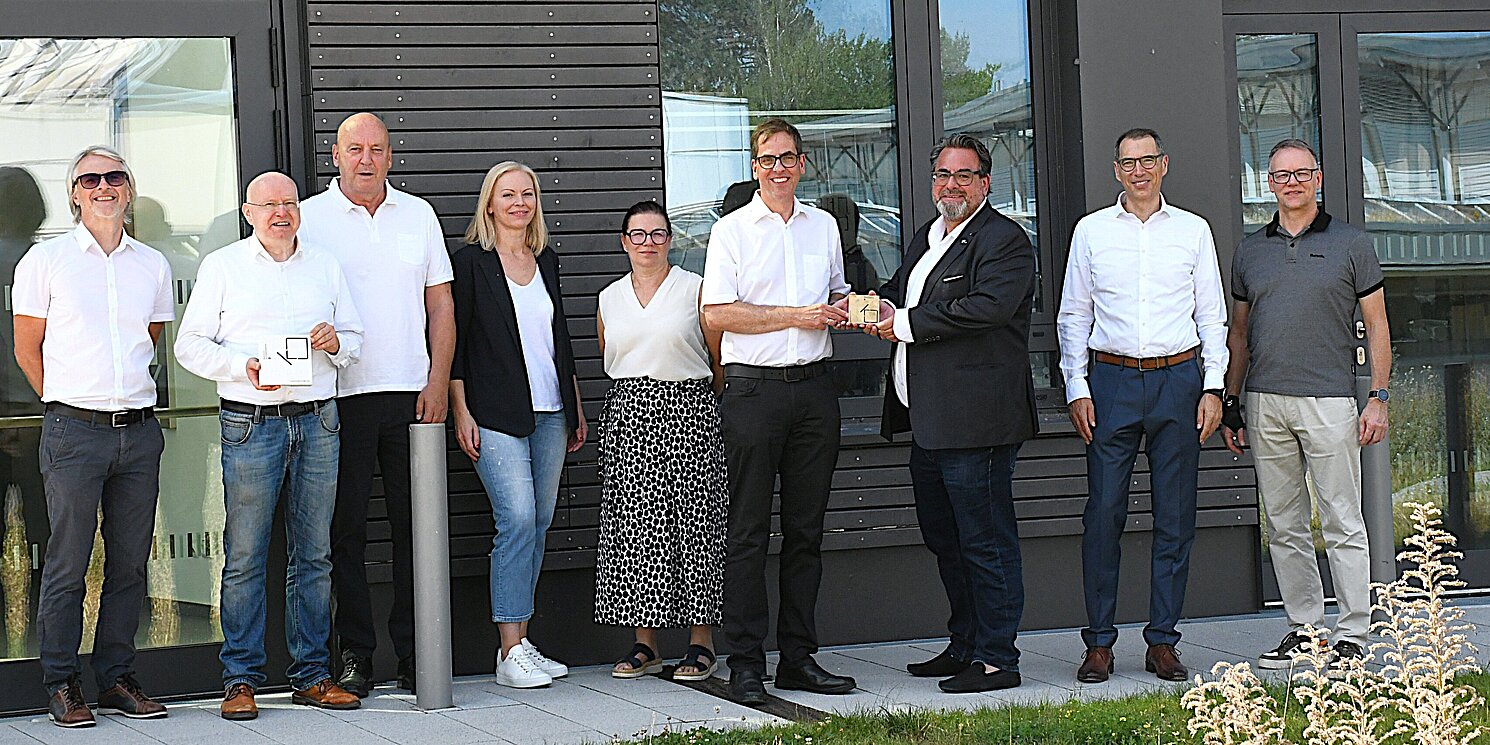
“KlimaKulturKompetenz”: this is the name of the quality seal with which the Bavarian Chamber of Architects recognises outstanding construction projects. The House for Innovation and Transfer (HIT) at OTH Regensburg has now been awarded this honour. University President Prof. Dr Ralph Schneider accepted the plaque on behalf of everyone involved. The HIT impressed the jury above all with its high energy efficiency and its consistent implementation of accessibility measures.
“The HIT exemplifies what we aim to achieve as a university: enabling innovation, bringing people together and, in doing so, taking responsibility for the environment and society. This honour and my heartfelt thanks go to everyone who planned, supported and implemented the project,” said Prof. Dr Ralph Schneider.
Modular construction and architectural quality complement each other perfectly
The building was designed by the practice meuer – planen beraten Architekten GmbH. For architect David M. Meuer, the HIT is a landmark project: “With this building, we were able to demonstrate what is possible. The chosen method of construction – known as modular construction – is certainly controversial in architectural circles. The HIT now proves that modular construction and architectural quality are not mutually exclusive, but complement each other perfectly. However, such projects can only succeed with clients who are prepared to break new ground.”
The Regensburg State Building Authority played a key role in the project’s implementation. Gerhard Haslbeck, Head of the University Construction Division, emphasised the building’s status as a model project: “The particular challenge lay in realising a high-quality, cost-effective and sustainable building within a short timeframe. We owe our success to the dedicated collaboration of all those involved. I would like to express my sincere thanks to our staff and to all our project partners.”
Setting new standards on campus
The building’s qualities are not merely reflected in its technical specifications. Its consistent focus on accessibility makes it easier for students, staff and visitors to use the building in their day-to-day lives and reinforces the university’s commitment to inclusivity. At the same time, the HIT is setting new standards on campus in terms of climate-friendly construction. This was also emphasised at the award ceremony by Chancellor Utto Spielbauer and Prof. Dr Christoph Skornia, Vice-President for Sustainability and Digitalisation.
The building has already demonstrated its role as a model: as part of the ‘Architektouren’ architectural tours, the HIT opened its doors to the general public and offered insights into contemporary university architecture.
Right next to the HIT, the Johannes Kepler Building of International Services – the next striking building on campus – is currently under construction. Although the two buildings follow different design concepts, they appear as a unified whole from the outside and together define the new look of this part of the campus.
The ‘KlimaKulturKompetenz’ award
The Bavarian Chamber of Architects awards the ‘Climate, Culture and Competence’ accolade to projects that set particularly high standards in sustainable planning and construction. Criteria assessed include energy efficiency, climate adaptation, land-use efficiency, accessibility and other aspects of sustainability. The HIT particularly impressed in the categories of energy efficiency and accessibility.