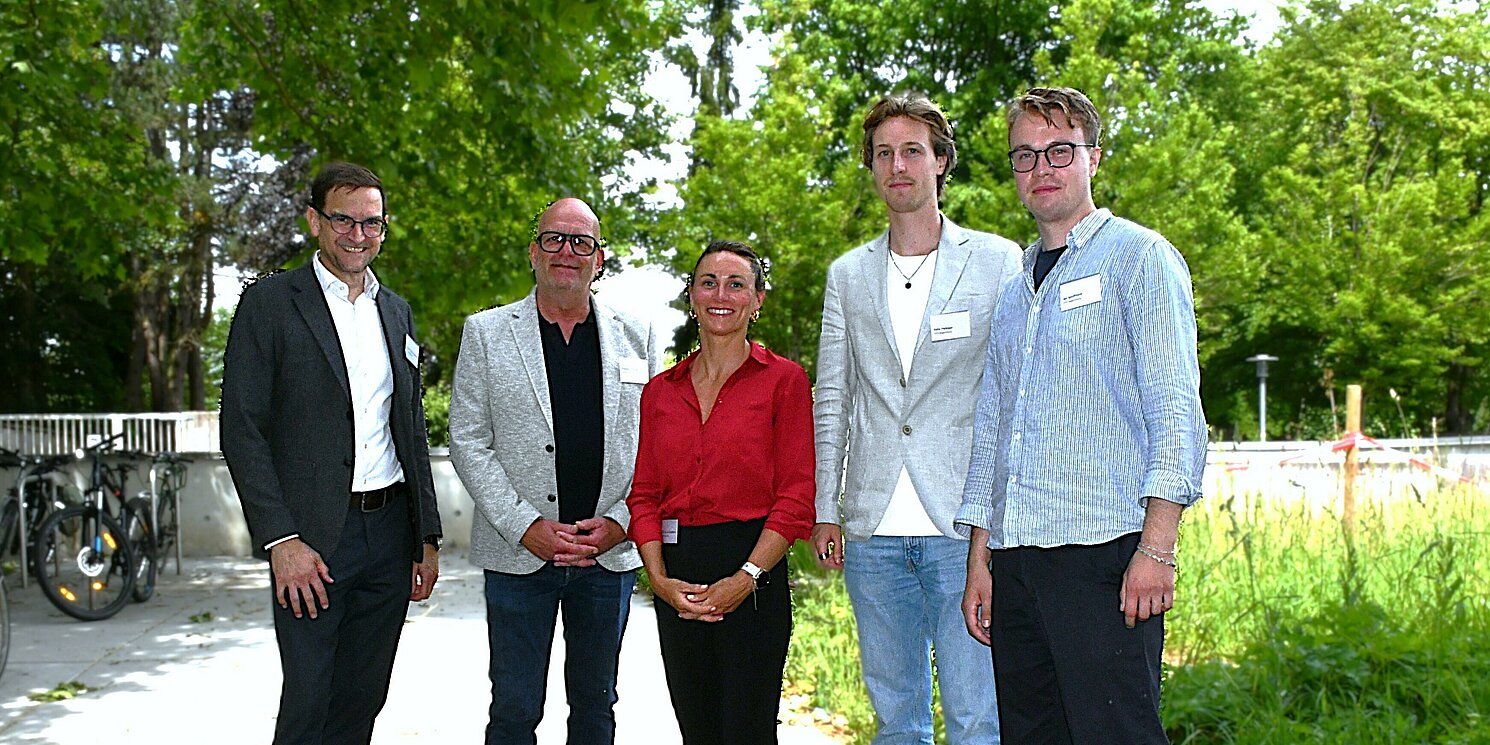
At the launch event for the Faculty of Social and Health Sciences on 2 June 2026, research assistants Jan Igloffstein and Felix Fiebiger summed up the downside of local development: “Above all, Regensburg is an expensive city. One that fewer and fewer people can afford.” To counter this trend, the university is collaborating with the City of Regensburg on the project. The project, which is based on a city council resolution passed in June last year and is funded by the city, builds on the baseline report from 2025. As part of this close cooperation, which in particular involves the exchange and joint analysis of data, the project will now continue in a new cycle until 2028.
Prof. Dr Oliver Steffens, Vice-President of OTH Regensburg, emphasised the importance of academic support at the launch: “The fact that this project is anchored here demonstrates the strength of applied research: we address socially relevant issues and present the results in such a way that they can have a direct impact on local politics and social practice.”
In the new research phase, which is based on a city council resolution, the team is deliberately shifting the focus of the printed report to the areas of social participation and health. Comprehensive statistical data, for example on Regensburg’s housing market, will in future be continuously updated on a dedicated website.
Cost of living and social participation
The discussion focused on the rising cost of living. According to the research team’s assessment, it is not only people in already precarious circumstances who are affected; the middle class is also coming under increasing pressure due to high housing costs and rising energy and fuel prices. The situation is particularly acute for older people, for whom a lack of mobility, the need for care and social isolation often go hand in hand.
One of the key challenges discussed at the event was the lack of coordination between stakeholders, as well as the question of why existing support services often fail to reach those affected. For the new report, the team is therefore examining five key areas of social participation: the social environment, housing, sport, religion and political participation. The aim is also to shed light on the structural level – for example, whether barriers in sports clubs or church communities are so high that an unconscious pre-selection takes place, preventing those affected by poverty from turning up in the first place.
From research to practice
The survey continues to rely on interviews and the involvement of students. The aim is to produce concrete recommendations for urban policy. One topic under discussion, for example, is a targeted expansion of the Regensburg City Pass.
“The broad response to the meeting shows that we have been able to establish ourselves within the city’s community,” concluded project leader Prof. Dr Ina Schildbach. “We also need this practical support in the new research cycle. Only in this way can practice-oriented research succeed and help ensure that the recommendations developed are taken into account in policy and practice.”
Read also: OTH Regensburg exhibition at M26 offers new perspectives on poverty