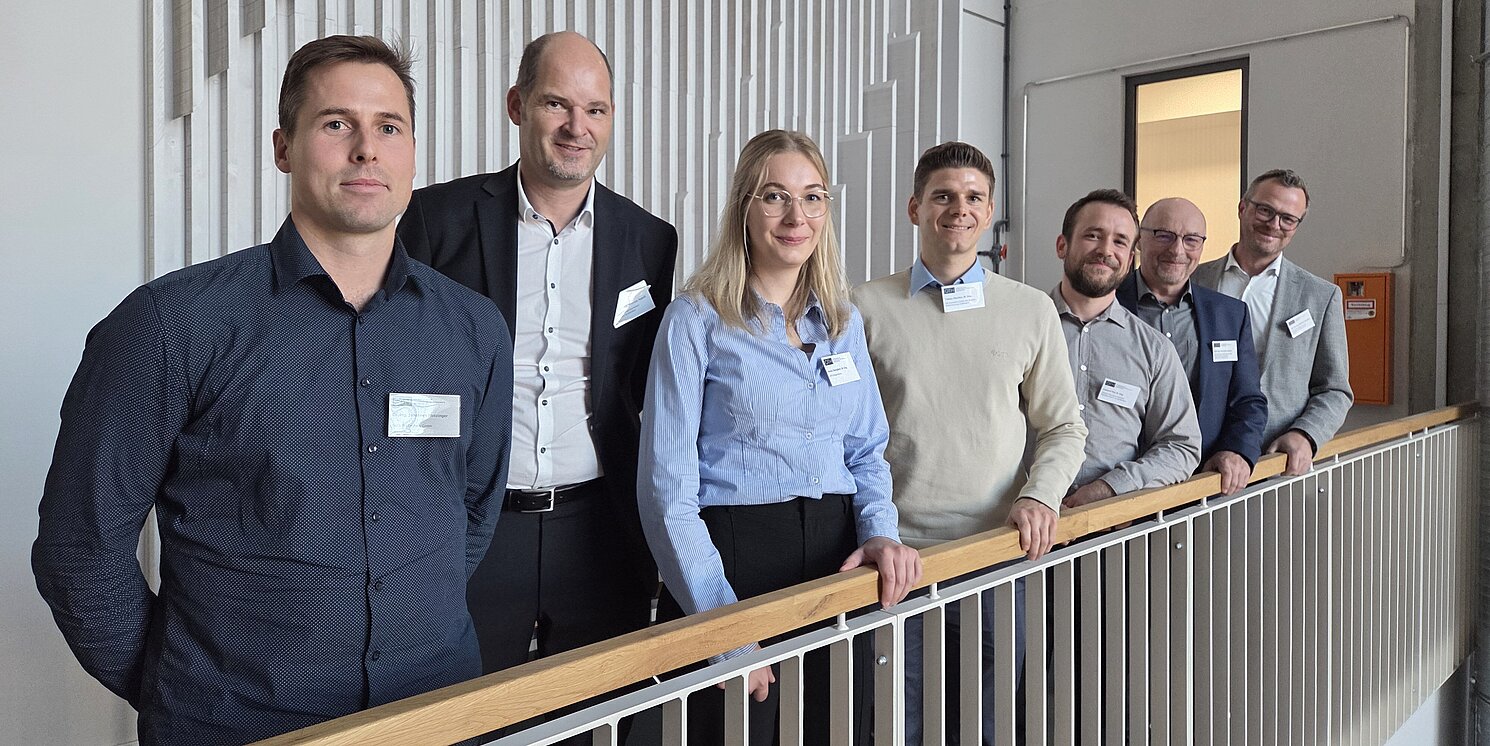
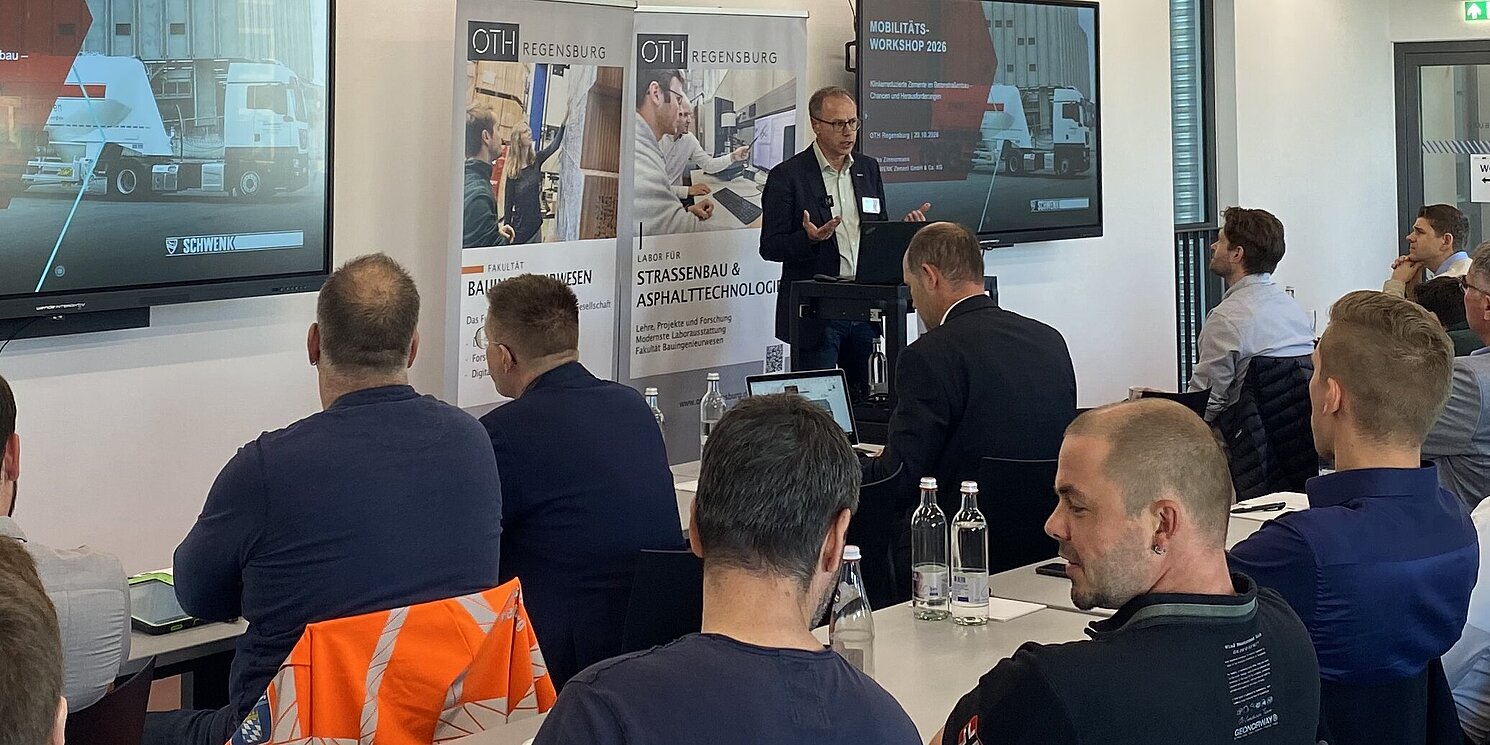
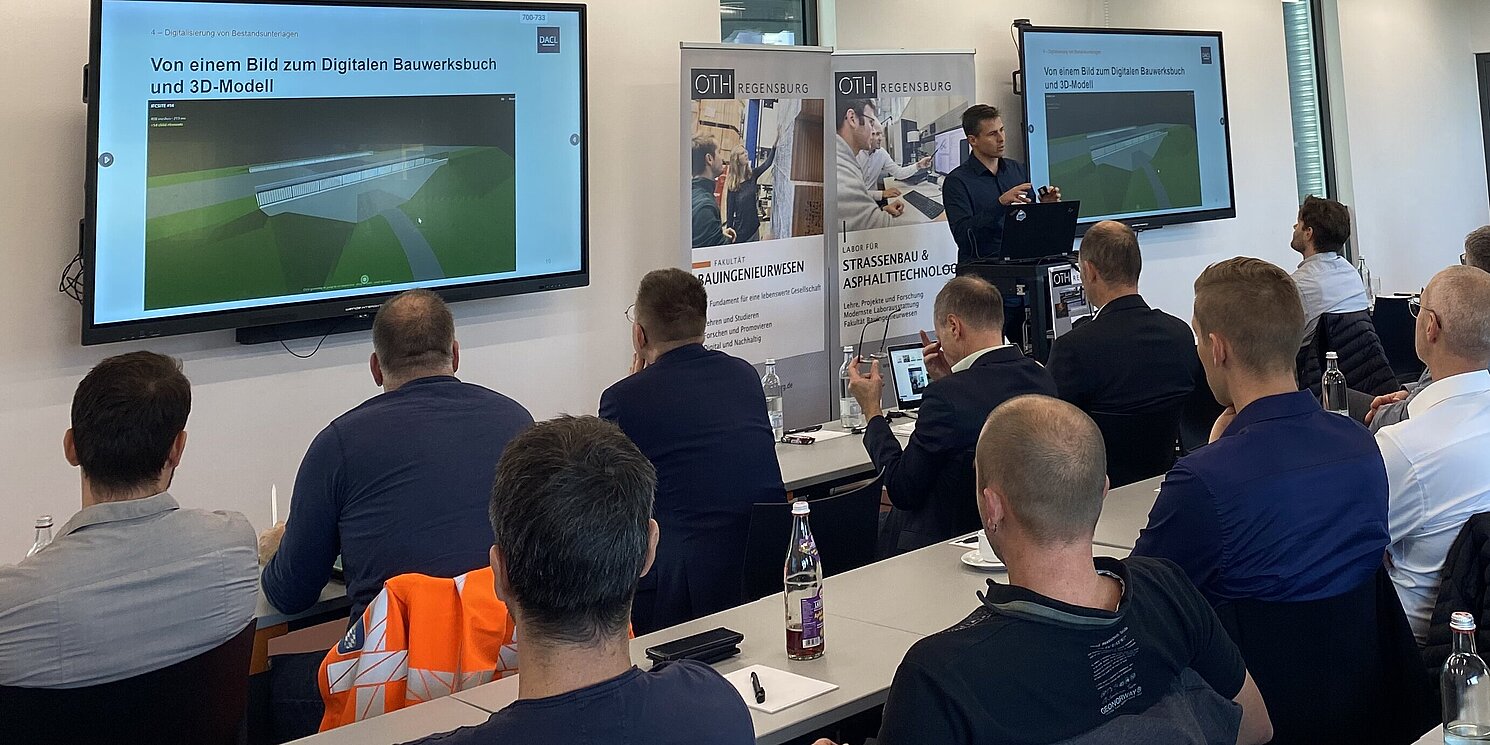
On 20 October 2026, the 19th Regensburg Mobility Workshop on current issues in transport infrastructure construction took place at OTH Regensburg. Over recent years, the event has established itself as a tried-and-tested platform for professional exchange between academia, public administration and industry.
This year’s workshop was organised jointly by the Faculty of Civil Engineering at OTH Regensburg, the Regensburg branch of Autobahn GmbH des Bundes, and the Concrete Information Centre. The focus was on the following topics:
- Artificial intelligence in bridge inspection
- Asbestos exposure during the demolition of bridge structures
- Greenhouse gas footprint and sustainability of cements in transport infrastructure construction
- Quality control and temperature monitoring integrated into the construction process in asphalt road construction
- Improving traffic flow at lane contractions on motorways
The Mobility Workshop was once again held in a hybrid format and attracted considerable interest. In keeping with this year’s key themes, the event took place at the Building Lab at OTH Regensburg. A total of 50 participants were welcomed in person at the Centre for Digital Construction, whilst a further 45 people joined online via Microsoft Teams.
Following a welcome address by Prof. Dipl.-Ing. Andreas Appelt, who also provided an overview of current developments at the Faculty of Civil Engineering, and a welcome message from Dipl.-Ing. Christian Unzner, Head of the Regensburg branch of Autobahn GmbH des Bundes, the technical programme began.
Live demonstration showcases the use of AI in structural inspection
Dr.-Ing. Johannes Flotzinger, founder and managing director of DACL Prüftechnik GmbH, kicked off the event. He presented current applications of artificial intelligence in structural inspection. As part of a live demonstration, he presented a system for the automated identification and documentation of damage, which significantly facilitates the localisation, assessment and pinpointing of structural damage.
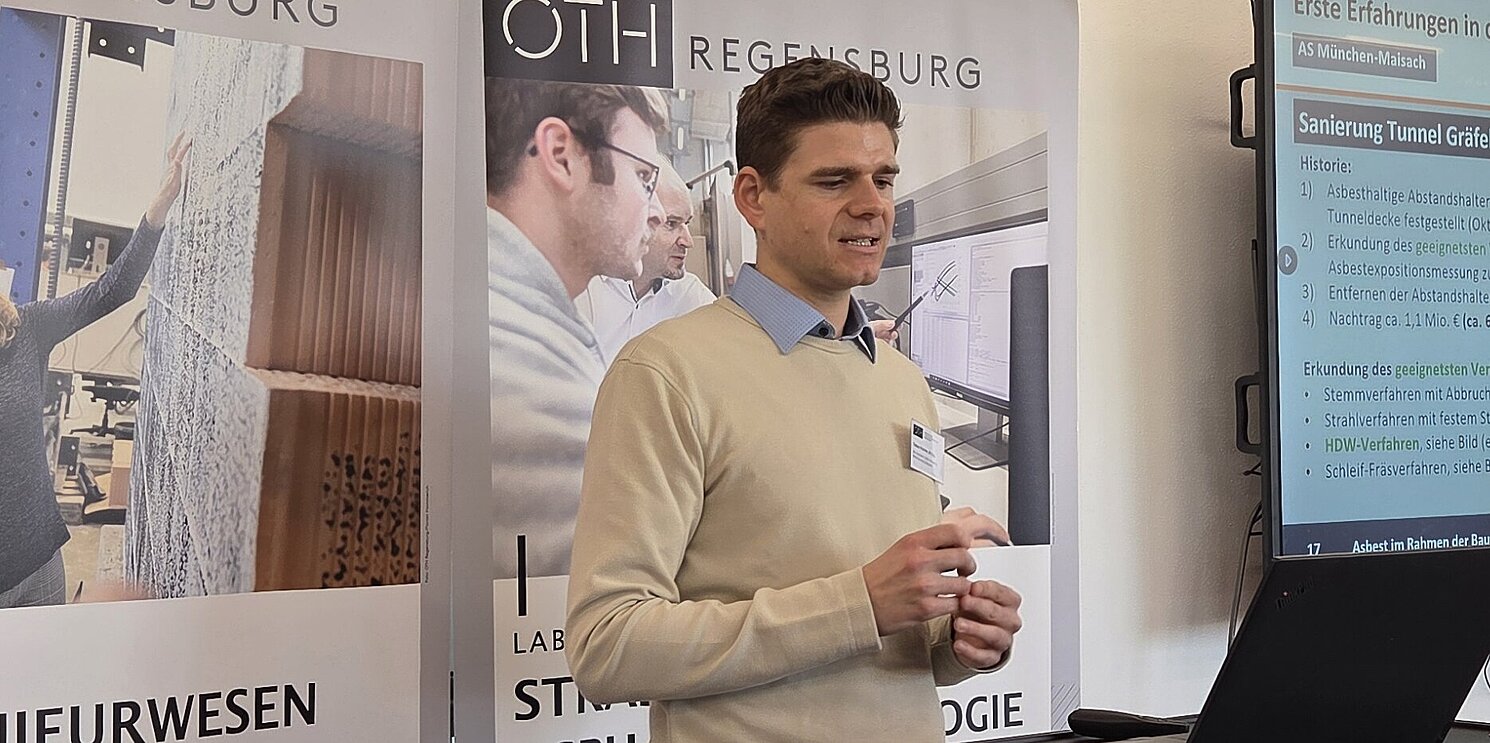
Tobias Pascher, team leader at Autobahn GmbH, then spoke about the challenges involved in dealing with asbestos-containing components during bridge renovation works. The focus was on identifying components containing asbestos and developing suitable demolition and disposal strategies. He also explained the key requirements for safe construction management, taking into account occupational health and safety and environmental protection requirements.
Following a break providing an opportunity for professional discussion, structural engineering topics took centre stage in the second block of presentations. Heiko Zimmermann from Schwenk Zement GmbH presented clinker-reduced cements and their potential applications in concrete road construction. In addition to the technical options for reducing the clinker content, he outlined the impact on the greenhouse gas footprint and the company’s research and development activities. He also reported on experiences to date from pilot and test sections. The results show that CEM II and CEM III cements can also be successfully used in concrete road construction and will play an increasingly important role in more sustainable construction methods in the future.
Prof. Andreas Appelt and Anna Stenglein, a Master’s graduate from OTH Regensburg, then presented findings on integrated construction process monitoring in asphalt road construction. The focus was on investigations into thermographic monitoring of construction sites. Such methods are becoming increasingly important, particularly in connection with low-temperature asphalt construction methods. With the aid of thermographic measurements, weak points in the paving process can be identified and documented at an early stage. Particular attention is paid to ensuring as uniform a temperature profile as possible across the entire paving length, in order to guarantee a consistently high standard of workmanship. Although relevant temperature data is often available in practice, it has so far rarely been used systematically to optimise construction processes.
A3 widening: Optimising road safety on a section of the motorway
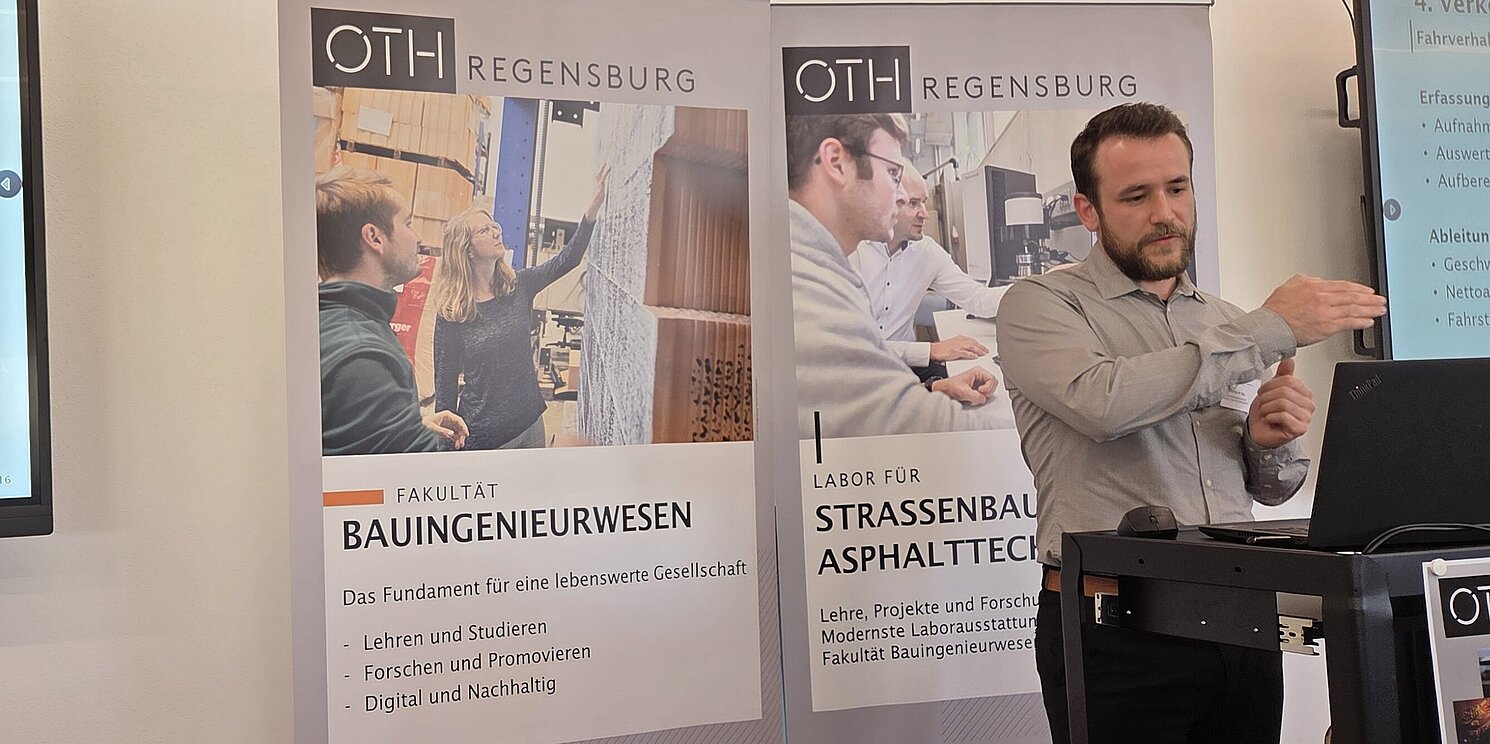
The workshop concluded with a presentation on traffic engineering. At the end of the six-lane widening of the A3 in the direction of Passau, anomalies were identified regarding traffic flow and road safety. Lennard Pye, also a Master’s graduate from OTH Regensburg, analysed this section of the motorway in detail as part of his Master’s thesis. Lidar scanners and side-looking radar systems were used to improve the data set. On this basis, a simulation model was developed and calibrated, enabling various optimisation measures to be investigated. The results made it possible to derive specific recommendations for action to improve the performance and road safety of the section in question.
The participants took the opportunity to engage in in-depth discussions and a lively professional exchange. In conclusion, Prof. Andreas Appelt thanked all the speakers, the participants and the institutions involved for their commitment. He expressed particular thanks to Mr Richter from the Concrete Information Centre for his long-standing and trusting collaboration, as well as to the faculty staff for the excellent organisation of the event.
The continuation of the mobility workshop is already assured: it has been agreed that an anniversary event marking the 20th anniversary of the format will be held in 2027.