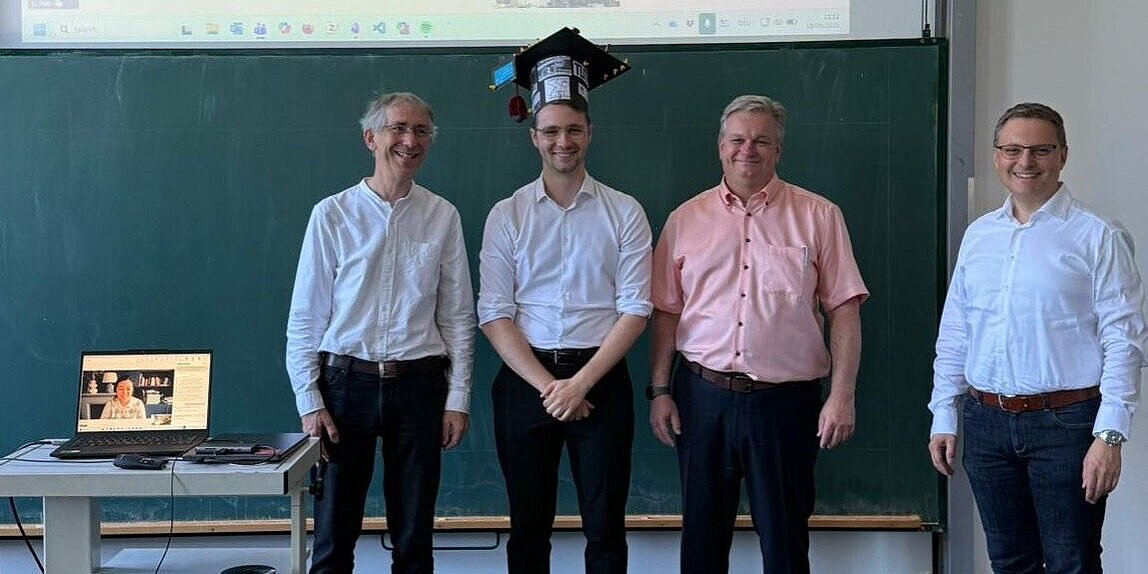
1. You’ve completed your PhD – what does that mean for you personally?
A PhD involves a wide range of challenges. I’m grateful for the opportunity to have grown both professionally and personally through these tasks.
2. What is your thesis about?
The development of components for vehicle chassis is a complex and time-consuming process. Throughout the entire development phase, it is essential to ensure that the designed components can subsequently be manufactured reliably. Simulation techniques provide valuable mechanical assessments for this purpose, but are often associated with long computation times and thus delay the development process.
This is precisely where my research comes in: using artificial intelligence, I am developing methods that automate these assessments and deliver them in a significantly shorter time. This provides developers with faster feedback and enables them to make informed decisions as early as the initial stages of product development.
3. What was a highlight or a special experience in connection with your PhD?
Many worthwhile scientific discoveries come at the end of an arduous journey. It’s a real highlight when, at the end of such a journey, your own idea actually works.
4. What are your plans for your future career?
I have already put these plans into action. Artificial intelligence has long since become part of everyday life – including in engineering, where innovative software solutions make existing development processes significantly more efficient. In my day-to-day work, I collaborate with clients to develop bespoke applications that intelligently combine artificial intelligence with traditional engineering. The result: shorter product development cycles and higher-quality products.
5. What advice can you give to future PhD students?
As every PhD is as individual as the person behind it, there’s no one-size-fits-all formula – the important thing is to savour your successes, see the low points through, and form as realistic a picture as possible of what a PhD entails from the outset. In any case, a thirst for research and technical curiosity are helpful
6. Why did you choose OTH Regensburg for your PhD?
Good supervision is a key prerequisite for a successful PhD. I got to know Prof. Marcus Wagner whilst I was still an undergraduate at OTH Regensburg. Even back then, I was confident that our collaboration would be successful – and that confidence was confirmed.
LINKS