Innovation Centre for Production and Logistics (IZPL)
When valuable expertise retires: How digital twins can help
When experienced staff members retire, companies often lose more than just personnel. Valuable knowledge and experience frequently disappear with them: who knows which processes are particularly prone to disruption? When are additional vehicles or staff required?
At the same time, many companies are under pressure to operate more cost-effectively and to deploy scarce skilled staff as efficiently as possible. At OTH Regensburg, researchers are investigating so-called ‘digital twins’ that can support companies in this regard. These enable various courses of action to be tested in advance on a computer and their potential impacts to be assessed.
More than just a simulation
The term ‘digital twin’ is frequently used, but is often understood in different ways. Put simply, it is a digital representation of a real-world system, such as a warehouse, a production facility or a transport process. At first glance, this resembles a traditional simulation. The difference is that a digital twin is linked to its real-world counterpart and reflects its state using real-time data. A traditional simulation recreates a process to address a specific question.
At the Innovation Centre for Production and Logistics (IZPL), Prof. Galka and his team are researching how such digital models can support businesses in their day-to-day operations. Their work focuses on simulation-based digital twins for complex systems in logistics and production.
Testing decisions virtually
The benefits of digital twins are particularly evident in logistics, for example. Large central warehouses are highly complex systems. Goods must be stored, picked and loaded. Forklift trucks move between different storage zones, lorries wait to be loaded, and staff carry out a variety of tasks.
This raises a host of questions: How many forklift trucks are needed? How many staff should be deployed on a particular shift? Where might bottlenecks arise? How can all the lorries be dispatched on time?
Too many forklift trucks incur unnecessary costs because they are left waiting for jobs. Too few can result in lorries waiting to be loaded and deliveries leaving the warehouse late. A digital twin makes it possible to simulate such scenarios virtually and visualise the impact of potential decisions.
Good decisions require good data
As compelling as the benefits of digital twins may sound, setting them up is a complex process. The biggest challenge often lies in providing the necessary data. This requires data from various sources to be consolidated – for example, from the warehouse management system, sensors, machinery or the company’s software.
“A digital twin is never really finished. For the model to reliably reflect reality, it must be continuously fed with up-to-date data,” explains Prof. Galka. “This requires a permanent technical infrastructure and high data quality.”
In practice, this involves a considerable amount of work. Data must be collected, verified and linked together. Only on this basis can digital twins provide reliable insights. This is why they have so far been used relatively rarely in operational decision-making processes. Instead, companies often use simulation models, which provide valuable insights but are not permanently linked to the real-world system.
Research at OTH Regensburg
At the Innovation Centre for Production and Logistics (IZPL) at OTH Regensburg, Prof. Galka and his team are conducting research into simulation-based digital twins for logistics and production. The aim is to replicate real-world systems as accurately as possible and to support companies in their decision-making. The focus is on developing models that clearly illustrate real-world processes and help companies assess the consequences of various decisions before they are implemented. At the same time, the IZPL is investigating how simulation models and modern AI techniques can be usefully combined.
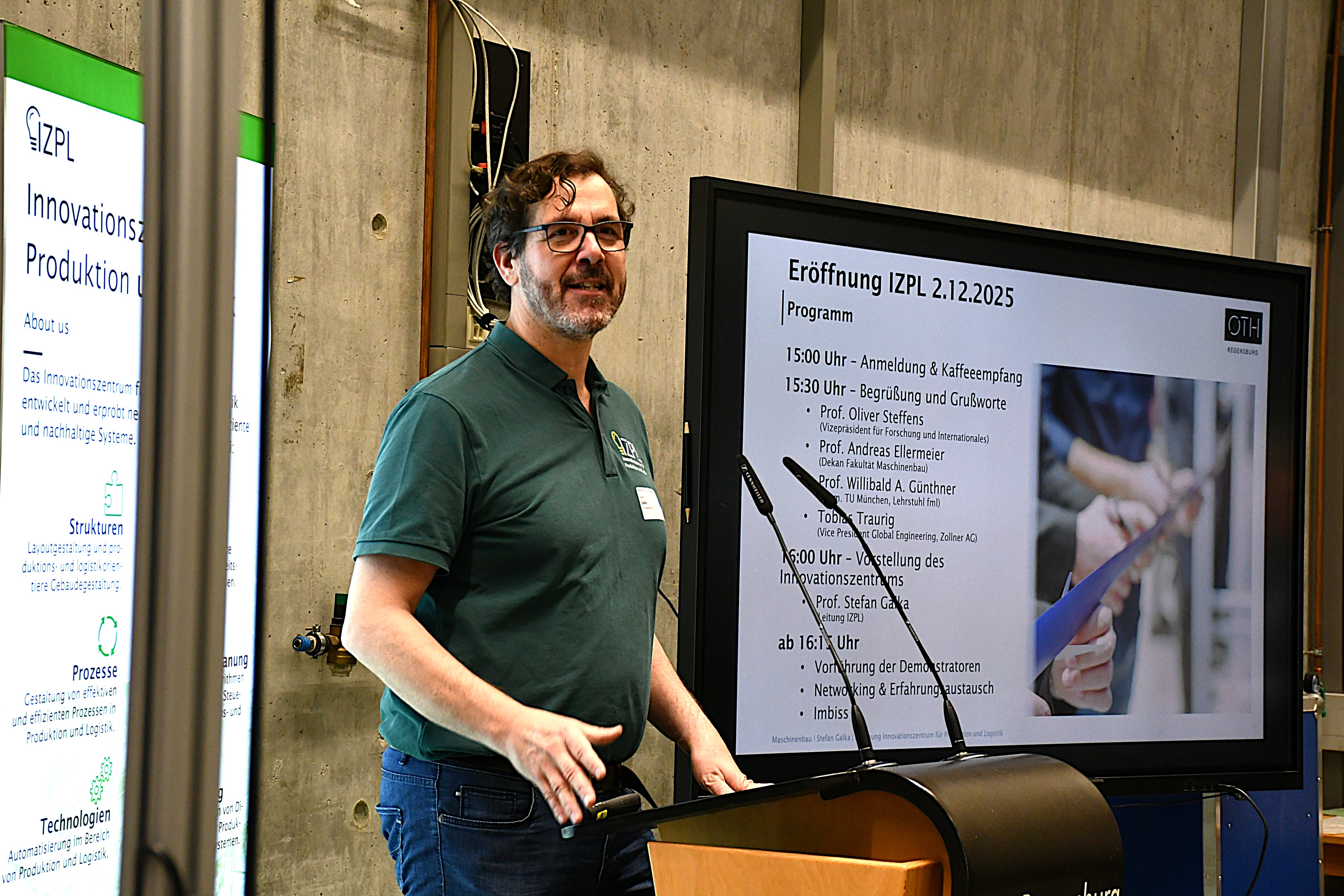
The IZPL opened in 2025 and brings together academia, industry and application-oriented teaching. Its work centres on research and development in the fields of robotics, digital twins, modern production and logistics systems, and simulation-based planning.
Why AI does not replace the digital twin
Digital twins and artificial intelligence (AI) are often mentioned in the same breath. In fact, the two technologies have different strengths. AI can analyse large volumes of data, identify patterns within them and, for example, use these to make predictions. With many AI processes, however, it is only to a limited extent possible to understand why the system arrives at a particular result. The user must trust that the model has learnt the correct correlations from the available data.
In a simulation, this relationship is more transparent. The model replicates the key processes and rules of the real-world system. This makes it possible not only to see what result is produced, but also to understand why it is produced. If, for example, a backlog forms at a particular point in the warehouse, the simulation model can be used to investigate which processes and interactions led to this.
This is precisely why Prof. Galka sees great potential in combining both approaches. AI can help to identify patterns in data, make predictions or automatically adjust models. Simulation then makes the effects of different decisions visible in a comprehensible model of the real-world system. The two approaches can thus complement each other effectively.
Decisions with an eye to the future
One thing is certain: many decisions within companies are based on experience. However, when experienced staff retire, valuable knowledge is often lost. Digital twins cannot replace this knowledge, but they can help to visualise decisions and their consequences.
At the same time, as is the case everywhere else, the economy is becoming increasingly data-driven. Companies are already using more process data to analyse and optimise their operations. The ability to evaluate different courses of action in advance could therefore become an important competitive factor in the future.