When Prof. Dr Annette Meussling-Sentpali talks about the healthcare system, she rarely starts by talking about doctors or hospitals. She talks about what lies in between. About people who do not know where to turn. About those with chronic illnesses who find themselves going through the same stages time and time again. About nursing staff whose expertise often goes unused in day-to-day practice. It’s about who provides support, offers advice, carries out preventive care and takes responsibility. Nursing could play a much greater role in this than it is currently allowed to – if the system is prepared to rethink its approach.
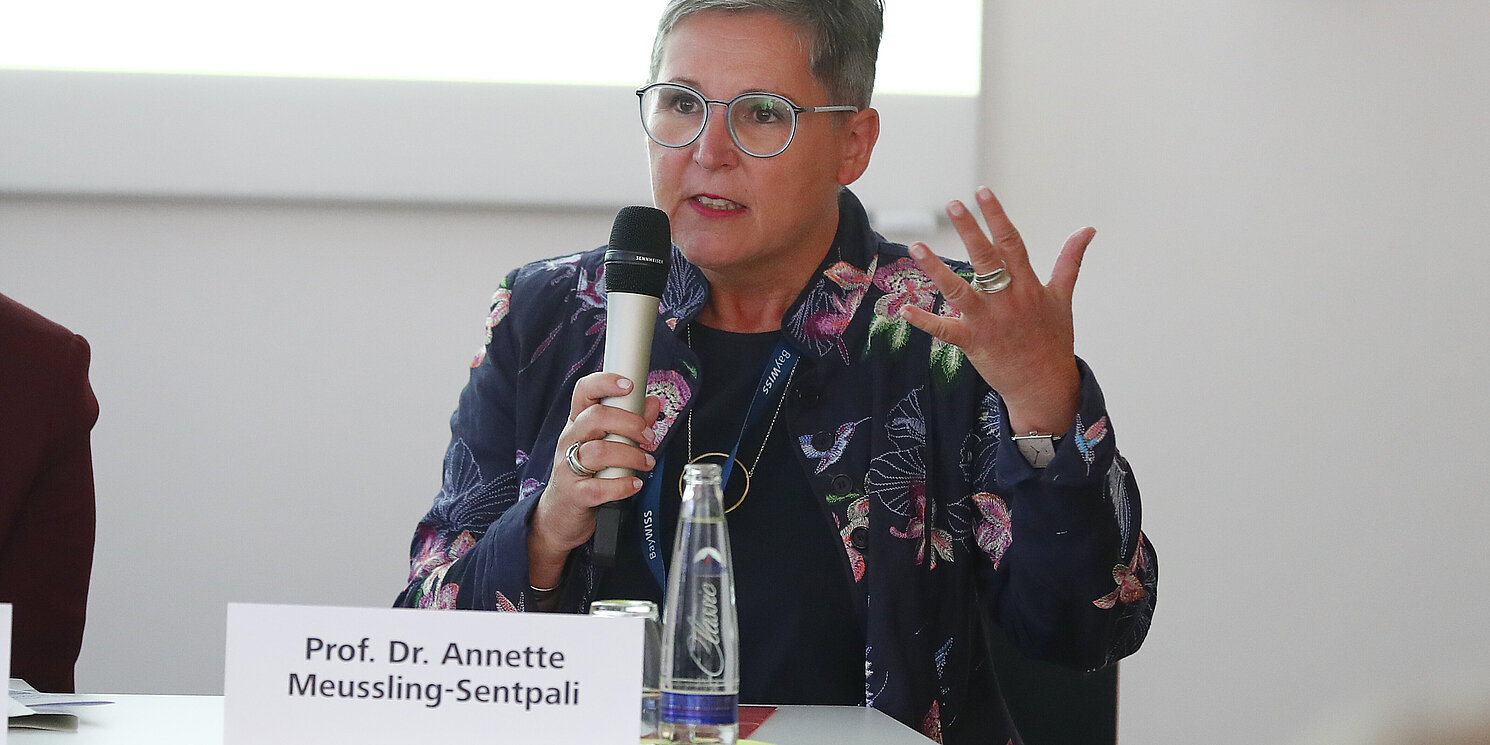
The professor at OTH Regensburg has now brought this perspective into a nationwide debate on reform. Together with other experts, she contributed to the publication “The Need for Reform in Primary Care. Towards a Future-Proof Health and Care System’, published by the Friedrich Ebert Foundation. The publication, which appeared in April 2026, examines the question of what primary care might look like if it were more closely aligned with people’s needs and regional circumstances.
At first glance, ‘primary care’ sounds like a technical term. In fact, it boils down to a rather everyday question: who is actually the first person to help me? The GP’s surgery is part of this. So too do community care, counselling services, prevention and support for people with chronic conditions. It is often at this very stage that it is decided whether treatment begins early or whether symptoms are simply put up with until, ultimately, hospitalisation becomes the only option.
Lack of coordination
“In some areas, the system is on the verge of collapsing,” says Prof. Dr Meussling-Sentpali. She is not referring to any one specific area. GP practices, care, prevention, counselling – much of this already exists. It’s just that it often doesn’t work together as it should. Responsibilities shift. Information gets lost. Patients often have to navigate the system on their own.
This can also be observed in Eastern Bavaria. Some GP practices are struggling to find successors, whilst outpatient services have been operating at full capacity for years. At the same time, the number of older people requiring long-term medical and care support is rising. The question is therefore no longer simply how to attract more doctors, but who will take on which tasks in future. In this context, it is worth considering a point that is often overlooked in the debate on healthcare: care is far more than just practical support in everyday life. Professional care is a highly complex profession that combines specialist knowledge, scientific insights, clinical judgement and responsibility.
A second misconception concerns the family. It is still frequently assumed that family members could take on additional care responsibilities under today’s living conditions – provided there is the will to do so. Yet the realities of life have changed. People work and often no longer live in the same place as their parents and grandparents, whilst at the same time looking after children and other relatives. Care within the family is therefore not simply a free fallback for the healthcare system. It has social and also significant economic consequences.
Greater responsibility for nursing staff
This is where nursing science comes in. Academically qualified nurses could take on significantly more responsibility – for example, by providing long-term support to people with chronic illnesses, identifying risks at an early stage, improving health literacy or preventing unnecessary hospital admissions.
Internationally, this has long been part of healthcare provision in many places. In Germany, too, the first concrete models are now emerging. One example is the community health nurse. They work close to where people live, combining nursing expertise with prevention, health promotion, counselling and coordination, and can thus fill a gap precisely where medical, nursing and social issues intersect. The German Professional Association for Nursing Professions (DBfK) explicitly describes community health nursing as part of modern primary care and refers to international experience from countries including England, Finland and Spain.
Luckau in Brandenburg, for example, illustrates how this might work. Tahnee Leyh has been working there since 2024 as the state’s first community health nurse in a project run by the German Red Cross. Her duties include, amongst other things, health counselling, blood pressure measurements and coordination with care services. The aim is to reach people locally and relieve the pressure on primary care.
The PORT Health Centre in the Swabian Alb also demonstrates that such structures are not merely a theoretical concept. In the municipality of Hohenstein, despite a shortage of doctors and nursing staff, an interprofessional health centre has been established which reorganises local care provision and brings together various healthcare professions. PORT stands for patient-oriented centres for primary and long-term care. The principle behind it is simple: not every enquiry necessarily has to start at a doctor’s surgery. And not every health issue ultimately requires a hospital.
What is already possible today
The potential is even more evident in clinical care. Advanced Practice Nurses – that is, nursing professionals with academic qualifications at Master’s level and additional specialisation – can take on independent responsibilities in complex care situations and coordinate treatment.
This highlights what the academisation of nursing is actually about: not turning nurses into doctors, but rather deploying nursing expertise where it is needed – and combining different areas of expertise in a meaningful way. At Regensburg University Hospital (UKR), this development has been evident for several years now. The hospital describes Advanced Nursing Practice as an approach in which nursing experts with a research-based Master’s degree work in specialised fields of practice and further develop care provision on an evidence-based basis.
Not doing away with something – but making something possible
The crucial question, therefore, is not so much which existing regulations should be abolished. Rather, it is a matter of determining what conditions need to be put in place to ensure that new care models function sustainably. According to Prof. Dr Meussling-Sentpali, this primarily involves professional regulations for nursing staff with a Master’s degree. Possible options include, for example, the right to practise or the right to prescribe certain services. The delegation of medical tasks to appropriately qualified nursing professionals is also among the issues currently under discussion.
The German Professional Association for Nursing Professions sees this as a key obstacle: the rigid division of tasks between healthcare professions must be overcome so that community health nurses and other advanced practice nurses can work with greater autonomy.
This is not about reversing the professionalisation of nursing and instead employing as many unskilled or semi-skilled staff as possible. On the contrary: Prof. Dr Meussling-Sentpali advocates further professionalisation and academicisation, particularly in elderly care. In her view, this also involves permanently integrating new roles such as community health nurses or school nurses into standard care provision and clarifying their funding on a binding basis. Similarly, staff deployment must be based more on actual care needs and not on how many staff members are currently available. This would represent a fundamental shift in perspective: it is not the available resources that determine what care is possible; rather, actual needs determine which resources are necessary.
Why Germany is so behind
If such models have long been working internationally, the question inevitably arises: why is Germany finding this so difficult? According to Prof. Dr Meussling-Sentpali, one reason lies in the history of nursing itself. Although Germany has long had comparatively good vocational nursing training, development at an academic level began very late. For decades, nursing was viewed primarily as a practical discipline rather than as an independent scientific profession. Nursing science, nursing research and doctoral degrees in nursing science consequently developed late.
Added to this is the historical structure of the German healthcare system. It is heavily doctor-centred. Consequently, when people talk about primary care, it is often simplistically understood as a matter of GP care. Yet primary care is more than just GP practice. It also encompasses nursing, prevention, health promotion, counselling and the coordination of various services. The Friedrich Ebert Foundation describes it as the first, comprehensively accessible level of the healthcare system, geared towards the basic needs of the population.
A third factor is the comparatively weak professional standing of the nursing profession. The profession is large, but for a long time its interests have only been reflected to a limited extent in political decision-making processes. In Germany, there are only a few nursing chambers; there is no strong, independent professional self-governance covering the whole country; and, traditionally, there has been less professional organisation than, for example, amongst the medical profession.
The historical separation of nursing and care for the elderly also has consequences. It has contributed to care for the elderly receiving less recognition, both socially and professionally, for a long time. Consequently, it is precisely in those areas where the need for support is growing particularly rapidly in the face of demographic change that particularly severe care provision problems are now evident.
Who will be responsible for which tasks in future?
More staff alone will do little to solve the problems. The real question for the future is therefore: Who will take on which tasks in future? And how can the various professional groups work together in such a way that patients do not have to start from scratch time and time again?
A system organised along more multi-professional lines could bring about significant change. Community health nurses could provide ongoing support to people with chronic conditions, identify health risks at an early stage and bridge the gap between medical treatment, nursing care and social support services. Advanced practice nurses could take on responsibility in specialised areas and coordinate complex care pathways.
Digital systems can also help to share information and direct patients more quickly to the right place. However, it is crucial to note that digitalisation is no substitute for a professional relationship. It can support collaboration – not the people who carry it out.
German projects are now also demonstrating that such models can work. In the NAVIGATION project, funded by the Innovation Fund, for example, specially trained community health nurses take on tasks relating to care planning, health advice and coordination following an individual needs assessment. Medical and nursing support are integrated as required.
Care needs to change – and the system with it
The debate on the future of care will therefore not be decided solely by the question of how many people will work in care professions in future. It will also be crucial to consider what qualifications these people have, what responsibilities they are allowed to take on, and how their work is integrated into the healthcare system.
This development is already underway. In July 2026, following an international symposium, the DBfK reported that community health nursing is integrated into primary care in various forms in countries such as Australia, the UK, Estonia and Spain. At the same time, it became clear that in Germany, such approaches must not remain permanently at the stage of pilot projects.
For Prof. Dr Meussling-Sentpali, this does not mean that doctors will become less important in future. On the contrary. It is about a different form of collaboration. Healthcare could then be organised more around what people actually need and less around which professional group a particular task has traditionally been assigned to.
The ideas are on the table. So are the scientific concepts. Initial models show that it can work. The main question is how quickly this can become the norm – in doctors’ surgeries, care homes, schools and the regions where good care is already no longer a given. Perhaps that is why the necessary reform begins with a relatively simple realisation: nursing is not what is left over once medicine has done its job. Nursing is an independent part of healthcare. And perhaps that is precisely the point at which a healthcare system can begin to rethink itself.