The air was stifling on 24 June 2026. The thermometer read around 32 degrees, and despite the heat, the function room at the ‘Degginger’ was packed to the rafters. The guests had a good reason to persevere in such temperatures: the heatwave outside was alarmingly fitting for the topic of the evening. For its Sustainability Week in the summer of 2026, OTH Regensburg had invited the nationally renowned meteorologist Karsten Schwanke to Regensburg as the highlight of the programme; in his keynote speech, ‘Understanding Climate Change – Shaping Prosperity’, he examined the topic from the perspective of a weather expert.
The idea for a Sustainability Week (NaWo) first emerged back in 2019. Since then, this event has become firmly established far beyond the city limits and offers an exciting and varied programme each year centred on the themes of sustainability, social cohesion and the implementation of the 17 goals of Agenda 2023. Alongside OTH Regensburg, the University of Regensburg and the City of Regensburg’s Energy Agency are also on board as partners; each year, they contribute their own programme items, some of which feature high-profile speakers.
How extreme weather is linked to climate change
When meteorologist Karsten Schwanke spoke at length about the weather during his keynote address, it was anything but mere small talk. The focus was on extreme weather events, which were once again appearing on meteorologists’ weather maps in 2026 and which Schwanke used as the starting point for his talk.
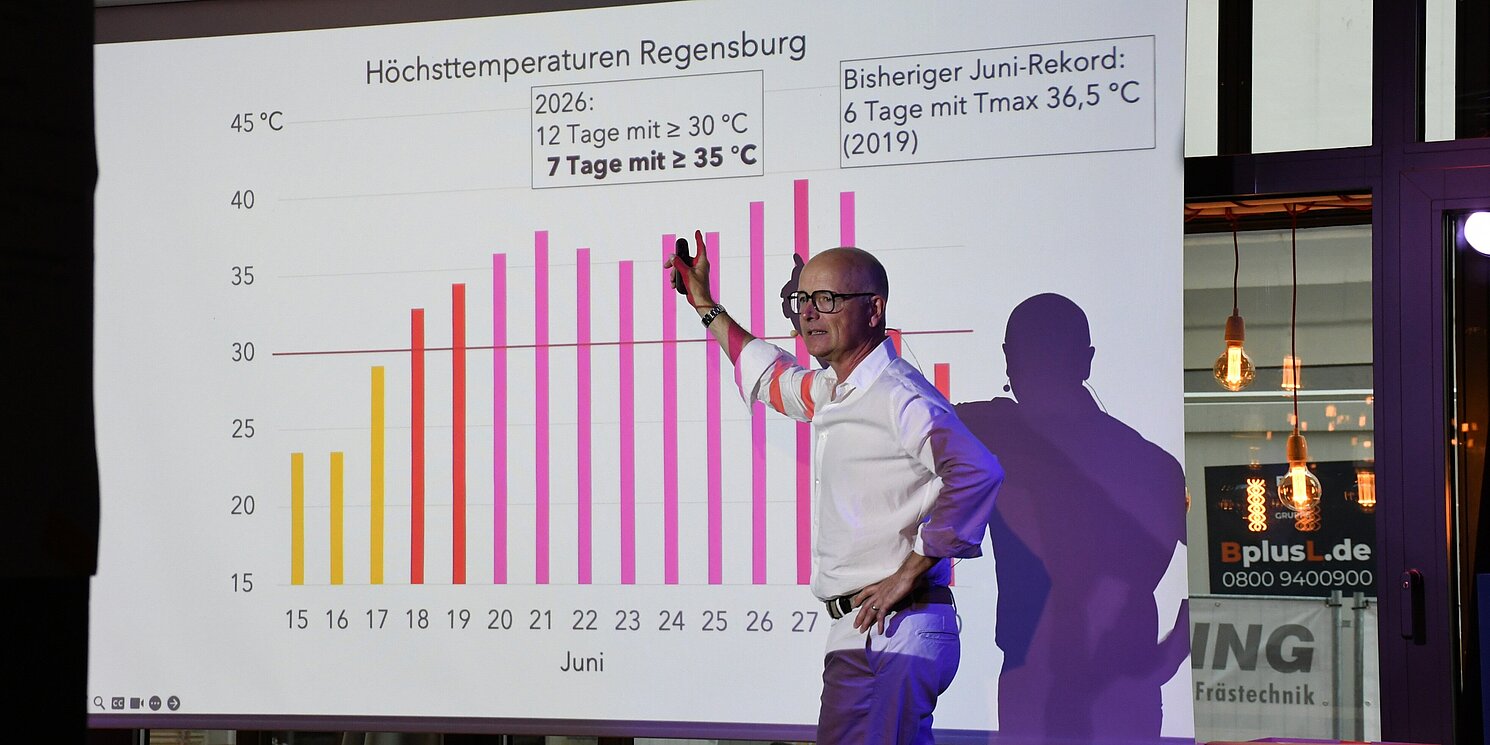
Schwanke spoke not only about climate change and extreme weather, but also specifically about how rapidly the climate is changing and why this dynamic is often difficult for us to grasp. The fact is: this development is not linear, but exponential. His analyses, backed up by specific data from the region, were particularly compelling. Twelve consecutive days above 30 degrees, seven of which were above 35 degrees: Regensburg has never before experienced a heatwave quite like the one in June. According to Schwanke, however, this is only the beginning.
To provide a better understanding, the weather expert looked not only at the region but also at the global context. He explained in clear terms how extreme weather arises and why it is becoming increasingly frequent. It also became clear that simply looking the other way or waiting it out won’t work. However, rather than concluding with a pessimistic outlook on the future, the science journalist Schwanke also spoke about possible solutions and the scope for action available in the face of climate change.
Resignation is not an option
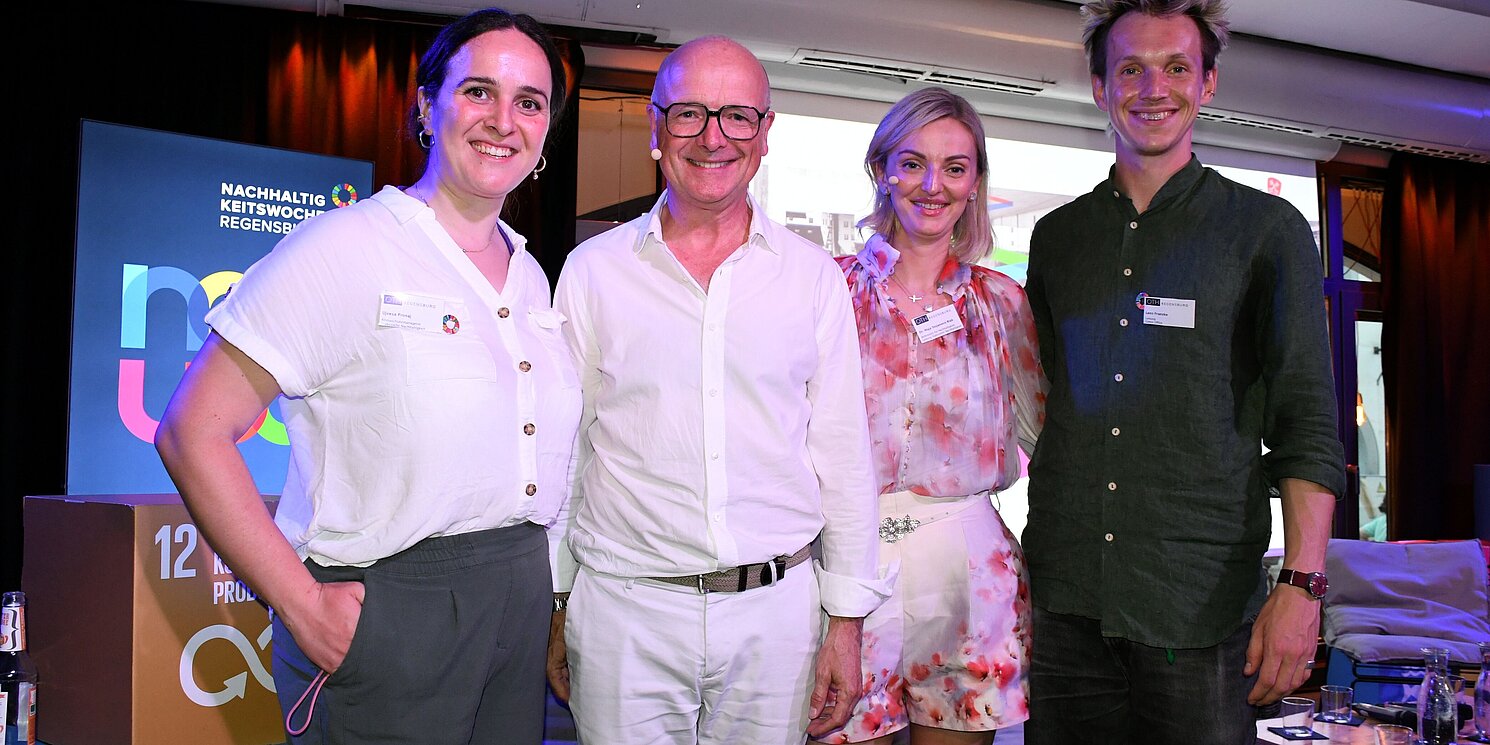
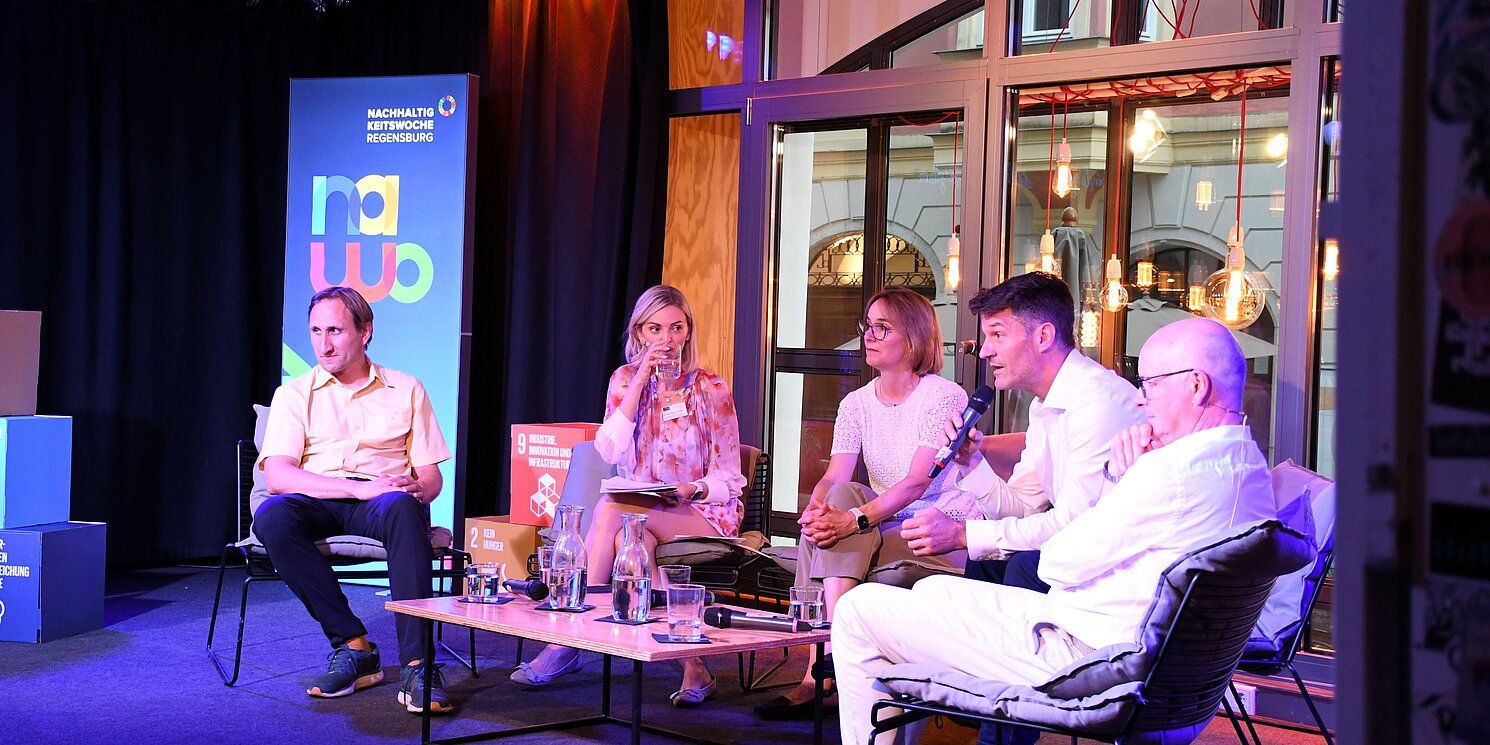
The subsequent panel discussion also demonstrated that resignation is not an option. Together with meteorologist Karsten Schwanke, Prof. Dr Georg Stephan Barfuß, Head of Economic, Scientific and Financial Affairs for the City of Regensburg, Prof. Dr Michael Sterner, Professor of Energy Storage and Energy Economics at OTH Regensburg, and Martina Birk, Head of Sustainability at Krones AG. The discussion centred on the interplay between climate change and prosperity, the social consequences for different sections of the population, and the concrete scope for action available to business, politics and society in times of profound transformation. Many questions also came directly from the audience, highlighting just how much this issue is on people’s minds.
A climate scale on the ‘Campus of the Future’
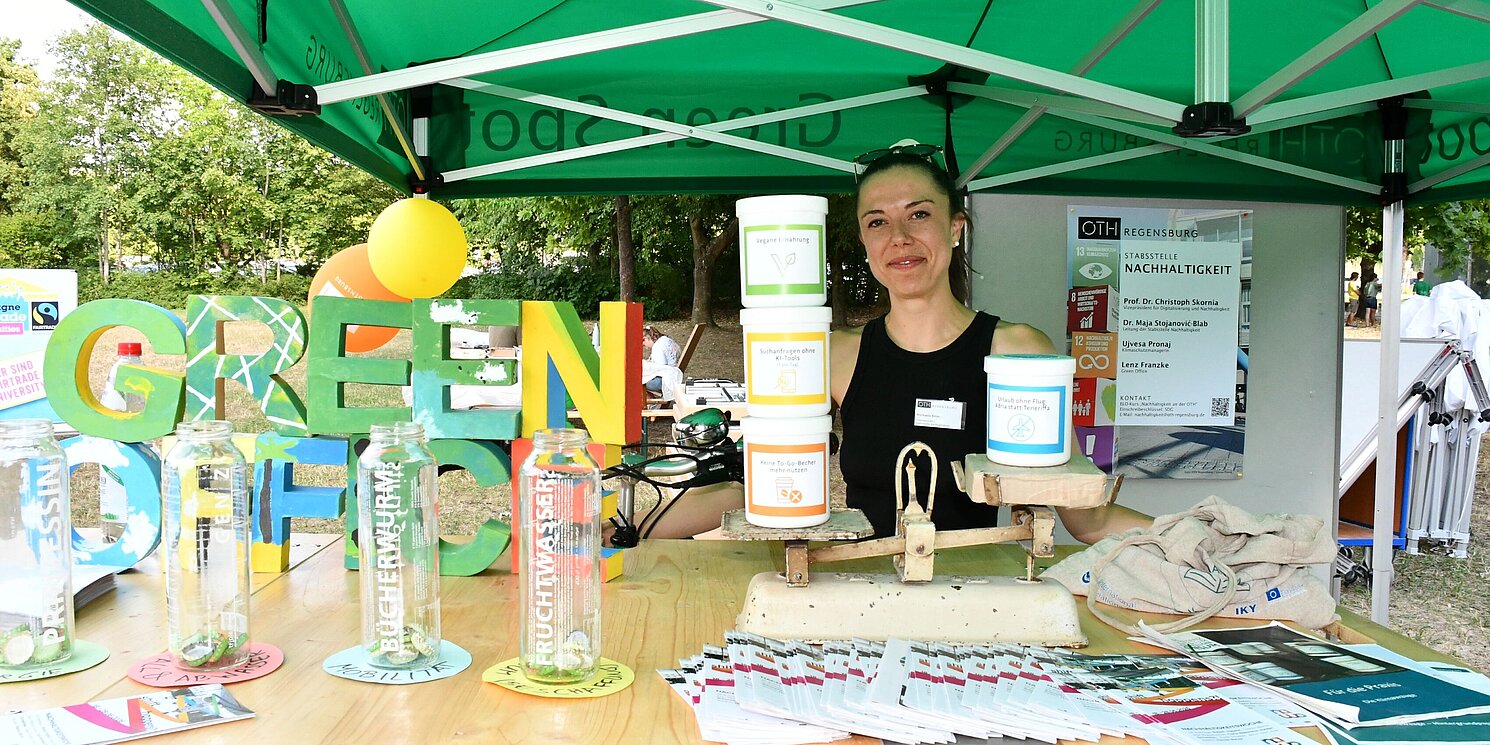
As well as the keynote speech and panel discussion at the Degginger, OTH Regensburg also hosted a Campus Day. Under the theme ‘Campus of the Future’, visitors were able to find out more about biodiversity and climate protection, recycling, equality and much more. The ‘Green Office’ stand also provided plenty to talk about; here, a ‘climate scale’ offered a fun way to discover just how much certain behaviours (and combinations thereof) affect climate change. How much of an impact does a vegan diet have on the climate compared to a holiday without flying? The answer: roughly the same. What is the impact of avoiding takeaway cups compared to AI-powered search queries? – The results prompted many to rethink their own behaviour.
Stronger together: partners and prominent figures
Regensburg Sustainability Week (NaWo) is organised by the City of Regensburg in close collaboration with the University of Regensburg, OTH Regensburg and the Regensburg Energy Agency. The City of Regensburg takes the lead in organising the themed week, whilst the partner organisations contribute to the varied supporting programme with events they organise independently. In recent years, numerous prominent figures have also appeared as guest speakers, including names such as Dr Eckart von Hirschhausen, Prof. Dr Harald Lesch, the conservation ecologist and activist Carola Rackete, Bernd Ulrich from the weekly newspaper *DIE ZEIT*, and the former German Minister for Economic Affairs, Dr Robert Habeck.