Milena Stürenburg is a professional handball player, a member of the national team and a student. The 20-year-old is studying Business Management at OTH Regensburg and played for Germany at the 2026 FISU World University Championships. Between lectures, her part-time student job and training, her daily routine is tightly scheduled.
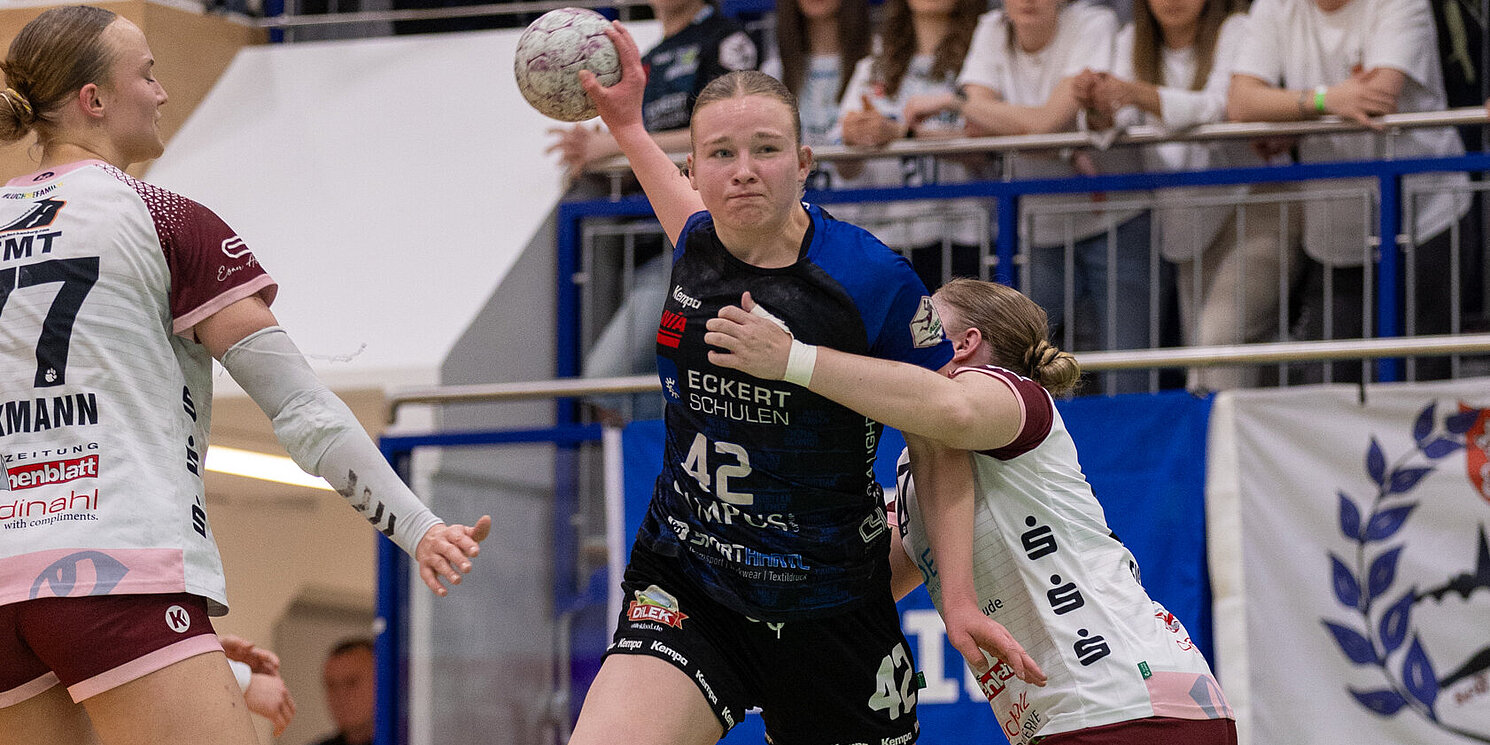
Training finishes just before 10 pm. Then it’s a quick dash home. Sometimes there’s still work to do for university; sometimes she’s just about got enough energy left to grab something to eat. The next morning, Milena Stürenburg is back in the lecture theatre at OTH Regensburg. That’s what many of her days are like. The 20-year-old is in her third semester studying Business Management, works part-time as a student trainee and plays handball for the Bunkerladies of ESV 1927 Regensburg. At the end of June 2026, she took on yet another commitment: she travelled with the German national student team to the FISU World University Handball Championship in Pessac, France. It was the first time Germany had been represented at the official World University Championships.
The fact that Milena now combines her studies and competitive sport so naturally is also down to a decision she made whilst still a teenager. At the age of 15, during the Covid-19 pandemic, she moved from her home between Bremen and Oldenburg to the handball boarding school at the Blomberg Academy. A new environment, a structured daily training routine – and, for the first time, far away from home.
At boarding school, it wasn’t just about playing better handball. She also had to organise her daily life herself: laundry, school, training, appointments. Many things that others only learn after finishing school. Perhaps that’s why she finds it easier today to keep track of several things at once. After lectures, she usually heads straight to work. Then it’s off to training. When she leaves the hall in the evening, the day is often not over yet. Of course, there are moments when she wonders what it would be like to just do something spontaneous with friends.
Choosing Regensburg was a conscious decision on her part. The decisive factor was the combination of the range of courses on offer at OTH Regensburg and the opportunity to play competitive handball for ESV 1927 Regensburg. The fact that the university and the club work together made the move even more appealing. From the outside, it sometimes seems as though she has to choose between her studies and sport. For her, however, this isn’t even a question. “You know that a career in competitive sport doesn’t last forever. The body can’t cope with such constant strain. It usually comes to an end in your early 30s.”
Her studies are therefore not a safety net just in case. They have been part of her plan from the very beginning. The reality of women’s handball also plays a part in this. Whilst many men in the professional game can earn a living from the sport, the income for female players is often insufficient. “Yes, it’s unequal treatment. But this forces us to build up a second source of income alongside handball. And in the end, that’s a good thing, even if it’s more stressful.”
OTH Regensburg supports students involved in competitive sport through partnerships with several regional clubs. As well as ESV 1927 Regensburg, these include the Eisbären Regensburg, the Guggenberger Legionäre, SSV Jahn Regensburg and NawaRo Straubing. Flexible study arrangements make it easier to balance training, competitions and exams. Even so, there was little time to focus on the tournament in the run-up to the trip to France. “As this is Germany’s first time taking part, we can’t yet gauge the standard of the other nations,” she said before departure. On their debut, the German team reached the quarter-finals, where they faced hosts France, who went on to win the tournament.
Milena Stürenburg already knew many of the players from the 2nd Bundesliga, where they had previously faced each other as opponents. After the World Cup, everyday life carried on as normal: lectures, work and training. For the time being, nothing will change about this routine.