A notice on the noticeboard, a spontaneous application, and before long they were heading across the Atlantic to Clemson University in South Carolina. Amidst college football, campus life and exciting research projects, Philipp Baumann and Johannes Weidner experienced a semester abroad that went far beyond their studies and continues to shape them to this day.
Philipp Baumann is sitting at his laptop, about to apply for a work placement semester. As a Bachelor’s student of Biomedical Engineering at OTH Regensburg, he is fine-tuning the final details of his CV when a notice from the university’s noticeboard pops up on his screen. It offered the opportunity to study as an undergraduate at Clemson University in South Carolina, USA. “Up until then, the idea of a semester abroad hadn’t even crossed my mind. But the notice piqued my curiosity, and I immediately started doing some research,” says Philipp, describing his first encounter with Clemson University. And then things moved very quickly: just a few hours later, he applied not for the work placement semester, but for the semester abroad. And he was accepted.
Johannes Weidner, a Bachelor’s student in General Computer Science, also took the plunge across the Atlantic and into the unknown. For him, however, it had long been clear that he wanted to spend a semester in an English-speaking country. Due to the high tuition fees, the dream initially seemed difficult to realise, until a stroke of luck turned the tide: Based on the partnership between OTH Regensburg and Clemson University, an agreement was negotiated whereby twelve students from Clemson came to Regensburg for a three-month work placement. This, in turn, made three places available for OTH students at Clemson University, free of tuition fees. Johannes didn’t hesitate; he seized the opportunity straight away and packed his bags for an intense and formative semester.
The campus as a world of experiences
“At first, we were what are known as ‘freshmen’ and lived on campus. Essentially, studying there means immersing yourself completely in the campus world, as the university also plays a major part in your private life,” says Philipp. There were large induction and social events for all new students, such as the Silent Disco, where Philipp and Johannes danced with others and made their first friends. The huge range of activities accompanied the students throughout their studies, from fishing to getting a pilot’s licence: it felt as though anything was possible.
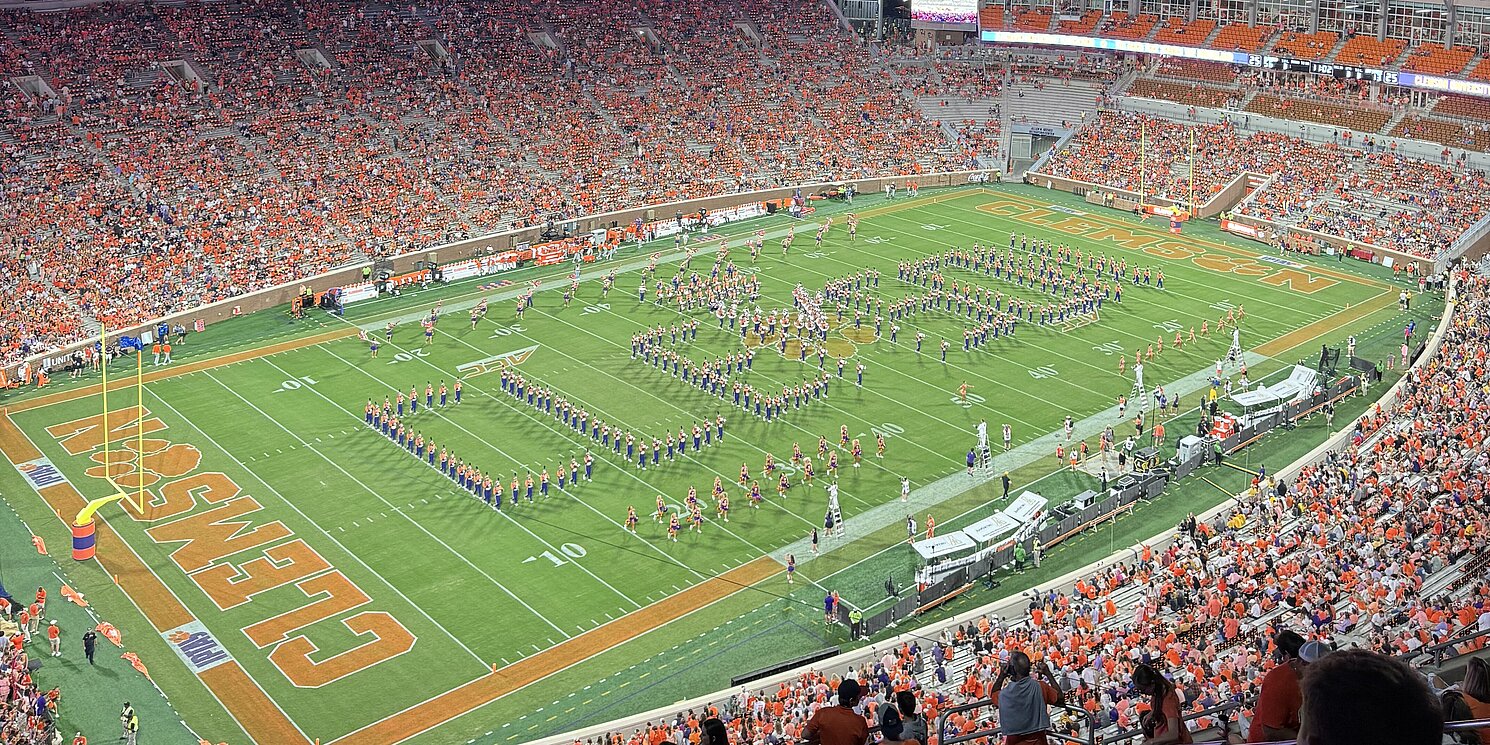
And then there’s college football, which particularly fascinated both of them: “I have particularly vivid memories of the first college football match, especially the – by our standards – enormous scale and thrilling atmosphere. A stadium with over 80,000 seats in a town with just 18,000 inhabitants – that makes a statement. I mean: it’s bigger than the Allianz Arena. It really highlights just how closely sport and the university are linked, and how important sport is to the local community,” says Johannes, describing one of many unforgettable moments.
Whilst in the USA there are several gyms on campus, along with numerous student societies and clubs in which students can get involved, studying in Germany is primarily geared towards providing everyone with a good academic education. Leisure and other activities are very much in the hands of the students themselves.
A semester abroad leads to genuine expertise
In addition, Philipp and Johannes were also able to experience a different approach to studying and learning. Philipp talks about his ‘Cardiovascular Biomechanics’ course. “Because I asked so many questions, the professor realised that I was showing great interest and initiative. Then something happened that I hadn’t expected at all: I was allowed to work on a project,” said Philipp. The project focused on people who had undergone emergency stenting due to a tear in the aorta (aortic dissection). The researchers used computer simulations to investigate how blood flows through the aorta following the procedure. Their aim was to determine whether this would provide any indications of potential long-term consequences, an increased risk of blood clots or the need for further surgery. Philipp’s task was to create precise three-dimensional models of the aorta and adjacent vessels from the patients’ CT scans. Whilst the highly complex calculations themselves were left to the professor, Philipp gained fascinating insights into this cutting-edge field at the intersection of medicine and technology through his involvement in the project.
Johannes also describes a strong practical focus: “Instead of pure theory, the focus was on specific projects, which count towards the overall mark in every subject.” A particularly formative moment for Johannes was meeting a German professor on his IT security course. This led to the opportunity to work on a project in the Automotive Security Laboratory. In addition, he was also able to gain experience of projects such as the development of a virtual reality training simulator, training a remote-control car using reinforcement learning, and the practical analysis of cyber-attacks.
“This vivid link between the course material and a real-world example was extremely beneficial to me. I certainly took that back with me to Germany. We also learnt a great deal about how to organise ourselves and function as part of a project team. That still helps me in the world of work today,” says Philipp. However, he also explains that, thanks to his studies at OTH Regensburg, he had already had plenty of exposure to practical projects. Yet such a hands-on education is by no means a given in the German higher education system.
The Challenge of Language
Alongside the many exhilarating experiences, the stay initially presented a few challenges as well. Philipp had had no trouble communicating during a previous trip to Washington and New York. However, during his first lecture, he quickly realised that everyday student life presented a whole new set of challenges: the course was attended almost exclusively by native speakers and was not specifically designed for international students.
“The English used was very subject-specific, and I first had to get used to the many technical terms. At first I was taken aback and thought: ‘Oh God, what have I done?’ But I soon realised that you improve your English very quickly through daily use. Day by day, I found it easier to follow the lectures, until understanding them was no longer a problem at all,” says Philipp.
The semester abroad doesn’t end with the return flight
For Philipp and Johannes, a semester abroad in the USA was made possible largely thanks to the existing partnership between OTH Regensburg and Clemson University. “What I particularly like about the partnership is that the exchange doesn’t end when the semester abroad finishes. There continue to be many points of contact between the two universities even afterwards,” Johannes sums up. Lecturers and groups of students from Clemson visit Regensburg regularly. “As former exchange students, we’re invited to official events at OTH Regensburg and show the American students around the university and the city,” says Johannes. The opportunity to network remains even after the semester abroad, and the connection to Clemson can – if you wish – continue throughout your degree and beyond.
Johannes and Philipp can only advise everyone to spend a semester abroad. “For me, it was the best decision of my entire degree, and I’d do it again in a heartbeat,” says Johannes. Whilst no one denies the organisational effort involved, they agree it’s absolutely worth the experience. “I can only advise anyone thinking about a semester abroad: don’t think about it for too long – just go for it,” says Philipp.
Partnership with Clemson University
OTH Regensburg and Clemson University in the US state of South Carolina have been linked by a close academic partnership for around ten years. The focus is on student exchanges: under the existing Student Exchange Agreement, students from both universities can study for a semester at their respective partner university. In addition, the collaboration now also encompasses other exchange and cooperation formats, including joint projects, short-term programmes and research activities.