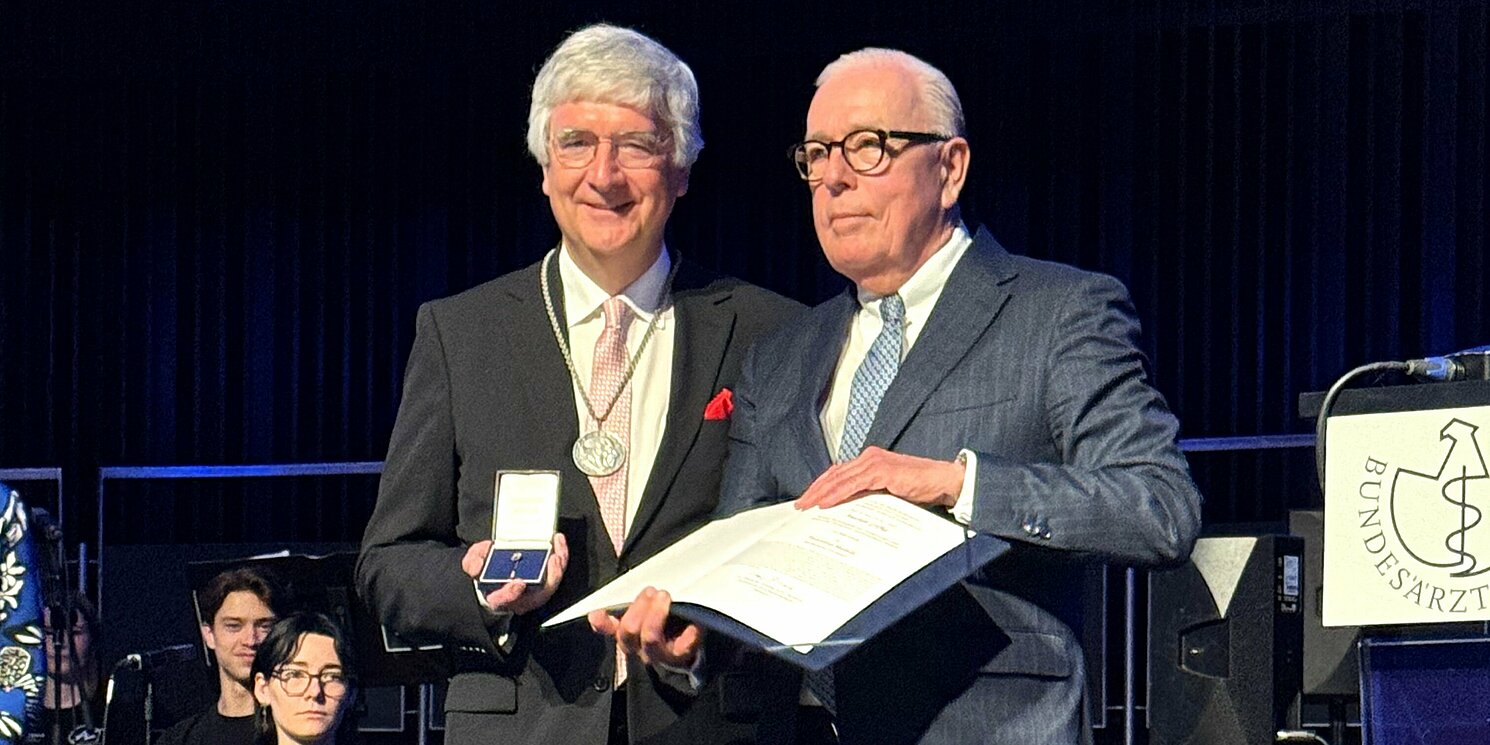
This recognition honours a medical professional who has helped shape the development of orthopaedics in Germany over several decades. In addition to his contributions to minimally invasive surgical techniques, he is distinguished by a consistently patient-centred treatment approach. The award specifically honours a medical practice that consistently prioritises the well-being of patients and rejects the pursuit of profit, even in the face of considerable resistance.
The award also holds regional significance: after more than 70 years, Prof. Grifka is the first doctor from Regensburg and the surrounding area to receive this honour. The medal has been awarded since 1952 and follows in the tradition of outstanding medical figures such as Albert Schweitzer. It honours members of the medical profession who have rendered outstanding services to medicine and medical ethics.
A pioneer in orthopaedics
The German Medical Association honours Prof. Grifka as one of the defining figures of modern orthopaedics. He played a key role in the merger of the specialities of orthopaedics and trauma surgery and was the founding president of the German Society for Orthopaedics and Trauma Surgery (DGOU). His textbooks and scientific papers are an integral part of the training of many doctors.
Innovation for the patient: saving time and speeding up recovery
For Prof. Grifka, an artificial joint is always a “last resort”. Through innovative cartilage treatments and spinal therapies, he often enables patients to delay or even avoid surgery altogether.
If surgery is unavoidable, Prof. Grifka relies on targeted preparation and particularly gentle surgical procedures. As a pioneer of so-called prehabilitation, he has developed concepts that prepare people physically and mentally for surgery.
Research and future projects at OTH Regensburg
Even after his retirement, Prof. Grifka remains active in research. Since 2024, he has headed the Orthopaedics and Ergonomics Research Centre at OTH Regensburg. Together with sports scientists and bioengineers, he is developing new concepts there for the prevention and treatment of orthopaedic conditions.
One focus is on the conservative treatment of herniated discs, with the aim of avoiding spinal surgery wherever possible. Other projects focus on ergonomic working practices in home offices, as well as programmes for the back health of children and young people.
In addition to his academic work, Prof. Grifka has also been involved in medical self-governance and health policy for decades. His work has been recognised, among other honours, with the Federal Cross of Merit on Ribbon and his election to the Leopoldina.