OTH Regensburg is part of the new Bavarian initiative for artificial intelligence ‘made in Bavaria’. Bavaria’s Minister for Science, Markus Blume, describes the project as a ‘unique approach’: the aim is to establish a trustworthy AI platform with key areas of application such as healthcare and robotics.
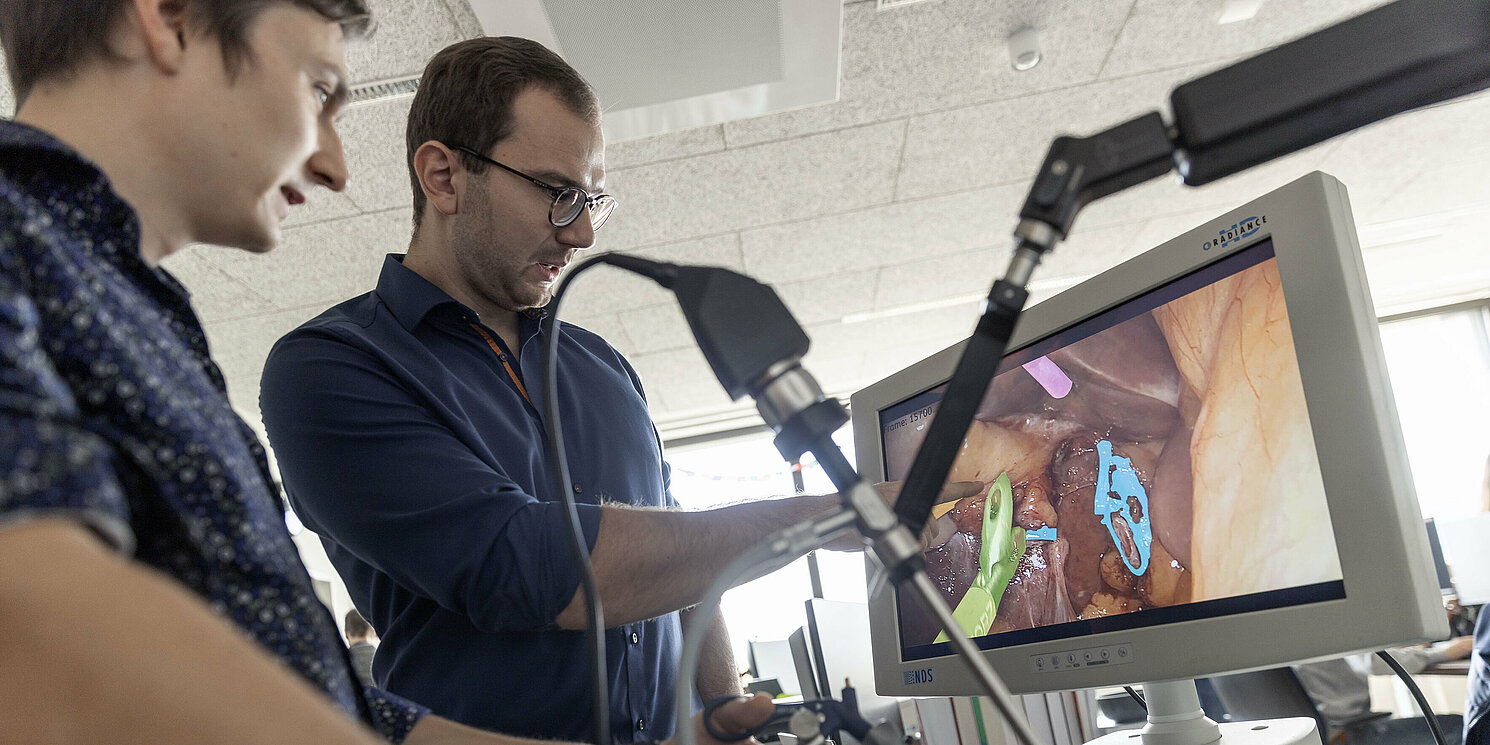
At the heart of the university’s contribution is the “MusteR-FM” research project, led by Prof. Dr Christoph Palm from the Faculty of Computer Science and Mathematics. Together with his partners, Prof. Dr Dirk Wilhelm from the Technical University of Munich and Prof. Dr Helmut Messmann from Augsburg University Hospital, he is working to further develop artificial intelligence for use in the operating theatre.
Artificial intelligence that ‘understands’ operations
What exactly is it about? 48 scientists from across Bavaria are developing a so-called AI base model. This can best be compared to ‘basic knowledge’ for artificial intelligence: instead of learning just a single task, the system is trained using a vast amount of different data, such as texts, images and videos. This creates a kind of foundation on which many specialised applications can later be built.
OTH Regensburg is focusing on a particularly challenging area: minimally invasive and endoscopic procedures. These include operations in which doctors work with small instruments and cameras, as well as procedures carried out via natural body orifices using an endoscope, such as gallbladder removal or treatment of the oesophagus. The AI model is trained using video data from such operations. The aim is for the artificial intelligence to recognise and ‘understand’ the sequence of an operation. For example, it should be able to distinguish which phase a procedure is currently in, such as cutting, suturing or preparation.
“We are teaching the AI how operations typically proceed. In the long term, it can then provide support by predicting the next step or supplying doctors with information at the right moment,” explains Prof. Dr Palm.
Bridge between medicine and robotics
A distinctive feature of the project is that it bridges the two research fields of healthcare and robotics. The AI being developed is designed not only to analyse images but also to understand processes over time. This lays the foundation for intelligent assistance systems in the operating theatre that will be able to work even more precisely and safely in the future.
Enormous computing power is required to develop such an AI model. This infrastructure is currently being set up at the Erlangen Regional Computing Centre. Around 400 high-performance processors (GPUs) are already in place, and this figure is set to rise to around 1,400 by autumn 2026. As part of the project, OTH Regensburg will be granted access to this infrastructure.
In addition, a research post will be created to drive the research forward. The project will officially launch in May 2026 and is initially scheduled to run for 15 months, with the option of extension.
Open research for widespread use
A key principle of the initiative is openness. The technologies developed will follow the open-source philosophy. This means that research institutions can access them freely and companies can also build on them to develop their own applications.
“This is a major advantage for Bavaria as a hub of innovation. We are not only creating new knowledge, but also making it available to others,” said Prof. Dr Palm.