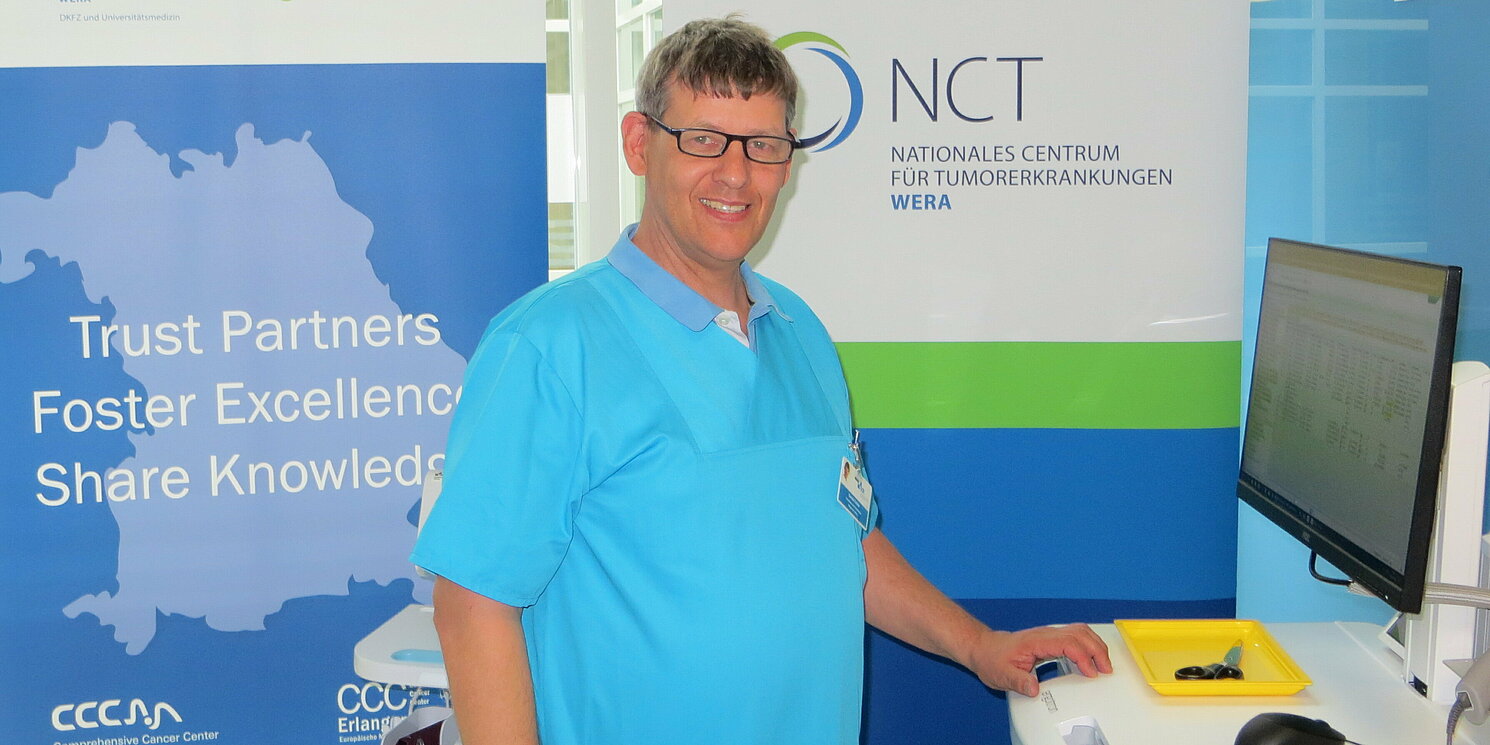
Is the patient stable enough for treatment today? Gerald Collier has been making decisions like this for many years, drawing on his experience. Yet he finds himself asking more and more often: Can this be scientifically substantiated? “Much of it is based on routine and consultation within the team, but we need to work in a more evidence-based way,” says the 53-year-old nurse from Regensburg University Hospital (UKR).
This is precisely where the new Bachelor’s degree programme at OTH Regensburg comes in, which launched for the first time in the 2025/2026 winter semester. The aim is to provide nursing staff with scientific qualifications and to improve the quality of patient care in the long term.
From experience to evidence
Collier brings decades of professional experience in oncology to the table, including in a managerial role at a day clinic. However, whilst working in national working groups, he became increasingly aware that scientific methodology was lacking for many nursing issues. “When it comes to developing new care models, experience alone is no longer enough,” he explains.
The degree programme teaches precisely these skills: nursing professionals learn to evaluate scientific findings, apply them in practice and implement their own projects.
Academisation as the key to the future of nursing
“The demands placed on nursing are constantly increasing, whilst at the same time there is a growing need for scientifically informed decisions in day-to-day care,” explains Prof. Dr Annette Meussling-Sentpali, programme director and representative for the Health Development Focus at OTH Regensburg. “With the Evidence-Based Practice in Nursing degree programme, we are creating a programme that specifically supports experienced nursing staff in expanding their expertise to include scientific skills and actively contributing to the further development of nursing.”
This development is also regarded as crucial at Regensburg University Hospital. “Evidence-based nursing not only enhances the quality of care but also strengthens the position of nursing within the interprofessional team,” emphasises Sabine Gutsche, Head of Nursing Services at UKR. “We need nursing professionals who understand research, question it critically and put innovations into practice – building on their specialist expertise.”
The degree programme offers further academic qualifications that are closely linked to professional nursing practice. Nursing professionals can choose between different specialisations depending on their area of work, such as intensive care and anaesthesia nursing, oncology or psychiatric nursing.
The programme thus also fits strategically into the university’s further development: with a focus on health in its development plan, OTH Regensburg is specifically strengthening academic qualifications in the healthcare professions and making an important contribution to sustainable care provision in the region.
Studying alongside work
The part-time degree programme is specifically designed for experienced nursing staff. Lectures are scheduled in blocks, making it easier to balance with the demands of daily work. For Collier, this is a challenge, but also a great opportunity: “Studying alongside work requires discipline. But it’s incredibly rewarding to gain new perspectives.”
Stefanie Lenz, an intensive care nurse at St. Marien Hospital in Amberg, also sees the course primarily as an opportunity to strengthen her own profession: “We are the ones who work closest to the patients. Through the course, you question things much more critically and further develop your own professional expertise.” The 42-year-old made a conscious decision to take this step after starting a family: “I really enjoy the course; the interaction with fellow students in particular is incredibly enriching. I hope that nursing will gain greater recognition overall as a result of this growing professional competence.”
The degree programme exemplifies the shift in nursing: away from purely experience-based practice towards a scientifically grounded, reflective approach. For Gerald Collier, it is clear: “Nursing can do more, and this degree programme shows how.”
Invitation to an information evening
Anyone interested can find out more at the information evening for the Evidence-Based Practice in Nursing degree programme on 5 May at 6 pm. You can register online via the website for the part-time Bachelor’s degree programme in Evidence-Based Practice in Nursing.