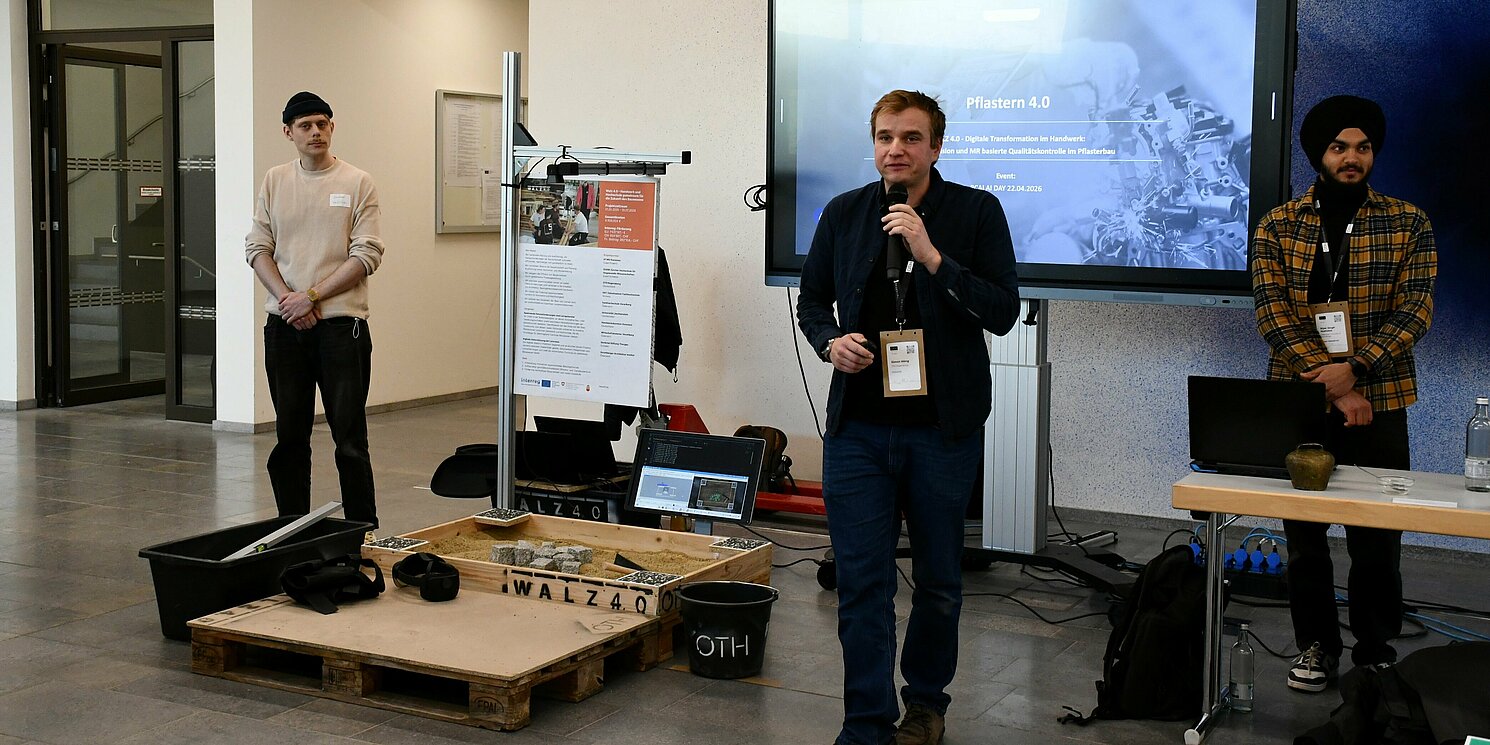
How do you lay a perfect paving pattern without years of experience in the trade? At AI Day at OTH Regensburg, all it took was a glance through a pair of glasses: an AI system, developed by the Building Lab team, showed in real time where the next paving stone should go. The aim is not to replace skilled craftsmanship, but to provide targeted support. What may sound like a distant dream to some, visitors were able to experience for themselves at the university on Wednesday, 22 April 2026.
“An exciting day awaits you, filled with fresh ideas, discussions and hands-on experiences,” announced Prof. Dr Christoph Skornia, Vice-President for Digital and Sustainability at OTH Regensburg, at the opening. A promise that was kept: from medical fact-checking and smart industrial processes to self-learning vehicles, artificial intelligence was presented in a way that was more tangible than ever before.
At the same time, Skornia made clear the role the university plays in this: “At OTH Regensburg, we see ourselves not only as a place for imparting knowledge, but as active shapers of AI development, working in close collaboration between research, practice and social responsibility.”
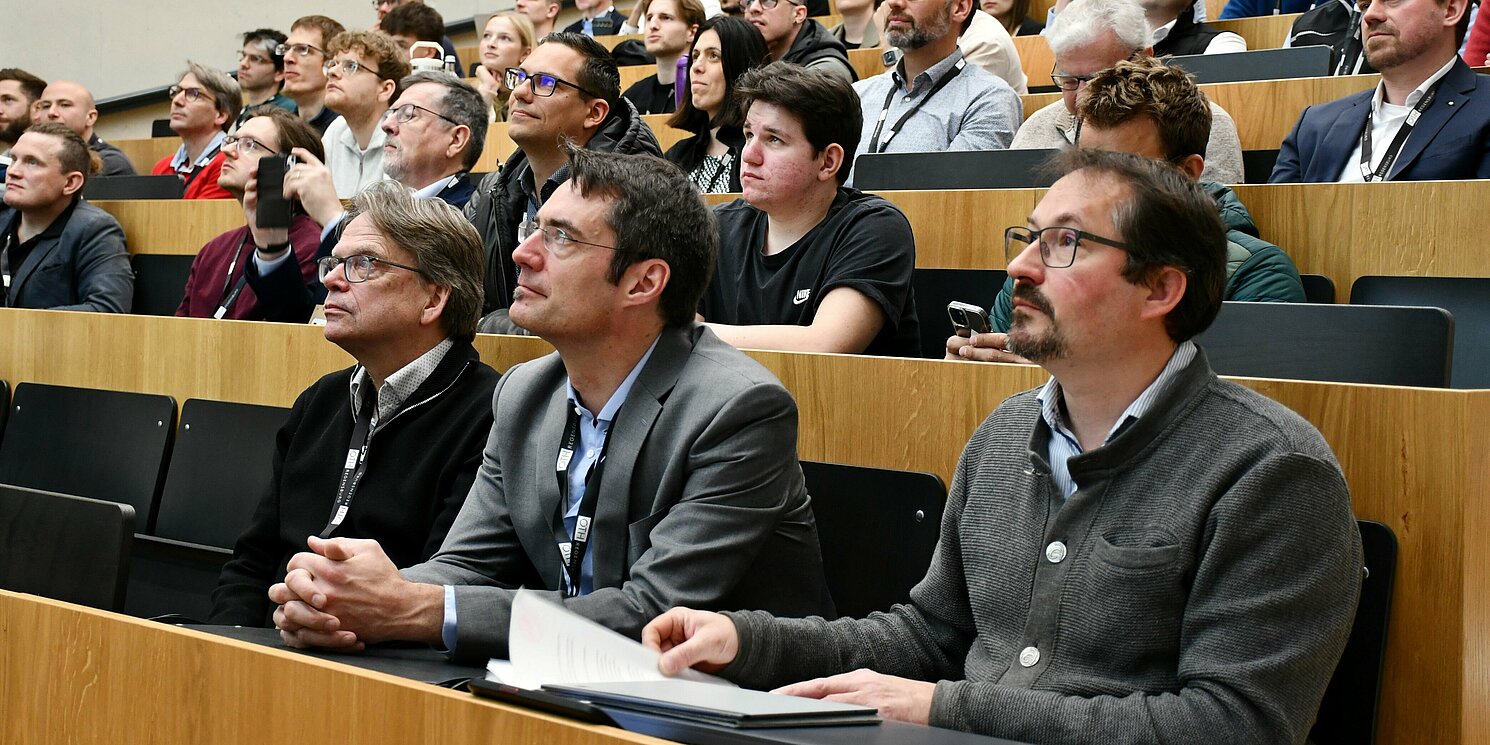
Interest was enormous: as the lecture theatre was packed to capacity, the presentations were also streamed to another room. AI Day was organised by the Research Centre for Artificial Intelligence (RCAI) under the leadership of Prof. Dr Wolfgang Mauerer. Since 2020, OTH Regensburg has been coordinating its AI activities here, ranging from basic research to practical applications. Nicole Höß, Scientific Coordinator at the RCAI, ensured the event ran smoothly.
Student competition: AI demonstrators with practical relevance
A highlight of the day was a competition in which students presented their own AI projects. The entries demonstrated the thematic breadth and high practical relevance of current AI research. Benjamin Zec took the prize and the prize money of 1,000 euros.
Benjamin Zec (OTH Regensburg, Laboratory for Digitalisation) demonstrated the already impressive capabilities of quantum computers in optimisation tasks and reinforcement learning using the scenario of an autonomous vehicle on a racetrack. Equipped with communication technology and a limited set of selectable actions (e.g. accelerating, changing to the right lane), the vehicle learns from its accumulated experience with every lap and continuously improves its driving behaviour. What makes this special is that the quantum computer reaches the optimal result faster than a classical computer.
Jonas Boerschmann and Rijak Singh Malhotra (Chemnitz University of Technology) presented an AI-supported system for fact-checking medical content in Instagram videos. The tool runs in parallel with the platform’s use and detects content with a medical context. Individual statements in the videos are identified and their accuracy is verified against freely accessible specialist medical publications. Users receive an assessment directly within the application as to whether statements are correct or misleading. This is intended to counteract misinformation on the internet.
Dominik Köster and Denis Bucher (OTH Regensburg, Digitalisation Lab) presented an AI-based knowledge assistant that can contribute to sustainable knowledge management for both businesses and OTH Regensburg. Among other things, the system analyses existing online information and answers questions about degree programmes, campuses and services. Prospective students can thus quickly and effectively find out about the content and general conditions of their degree programme.
Leon Dresel (OTH Regensburg, Building Lab) demonstrated with his ‘Koda’ project how natural language and AI can improve collaboration between architects and clients. Whilst clients usually describe their ideas verbally and emotionally, architectural firms work with complex three-dimensional models. The system translates verbal input into 3D models, thereby facilitating communication and a shared understanding of planned construction projects.
The team led by Noah Meißner and Samuel Bullard (University of Regensburg) presented an AI tool designed to track the activities of AI agents by analysing the structure of files and folders on computers. Their programme, ScopeWeaver, analyses chaotic desktop structures, sorts content and suggests clear labels. Humans remain involved at all times: every action requires explicit approval to ensure transparency and control.
Insights from research and industry
Prof. Dr Volker Tresp from LMU Munich provided the scientific impetus at the start. In his keynote speech, he covered a wide range of topics, from modern machine learning methods to fundamental questions: How does AI actually ‘understand’ language? And what distinguishes machine learning from human thinking?
In the afternoon, the focus shifted to the infrastructure requirements of modern AI. Prof. Dr Dieter Kranzlmüller (Leibniz Supercomputing Centre) presented the vision of a Bavarian AI gigafactory: high-performance data centres capable of processing enormous volumes of data. Together with Daniel Hofmann (T-Systems), it became clear how such structures accelerate innovation: from predictive maintenance in industry to intelligent mobility solutions.
AI as a strategic field for the future
AI Day also highlighted the strategic importance of artificial intelligence at OTH Regensburg. With the Research Centre for Artificial Intelligence (RCAI), additional funding for the expansion of high-performance computers and, most recently, around 40 million euros in third-party funding secured, the university is specifically strengthening its AI expertise.
Above all, however, the event demonstrated one thing: artificial intelligence has long been part of our everyday lives, and its development thrives on the exchange between science, industry and society. AI Day at OTH Regensburg provided the ideal platform for this.
AI Day at OTH Regensburg was supported by the sponsors ams-Osram International GmbH, Infineon Technologies AG and knowis AG.