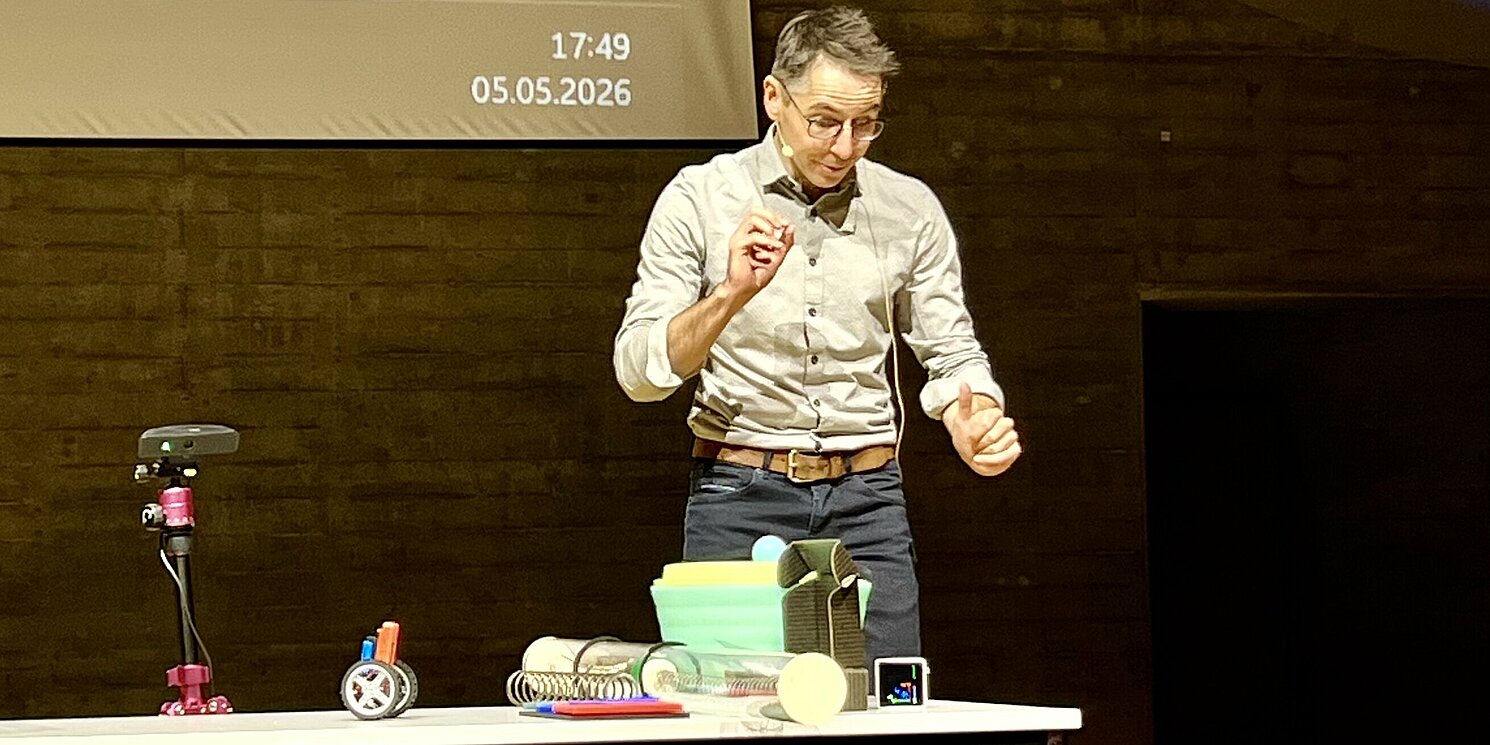
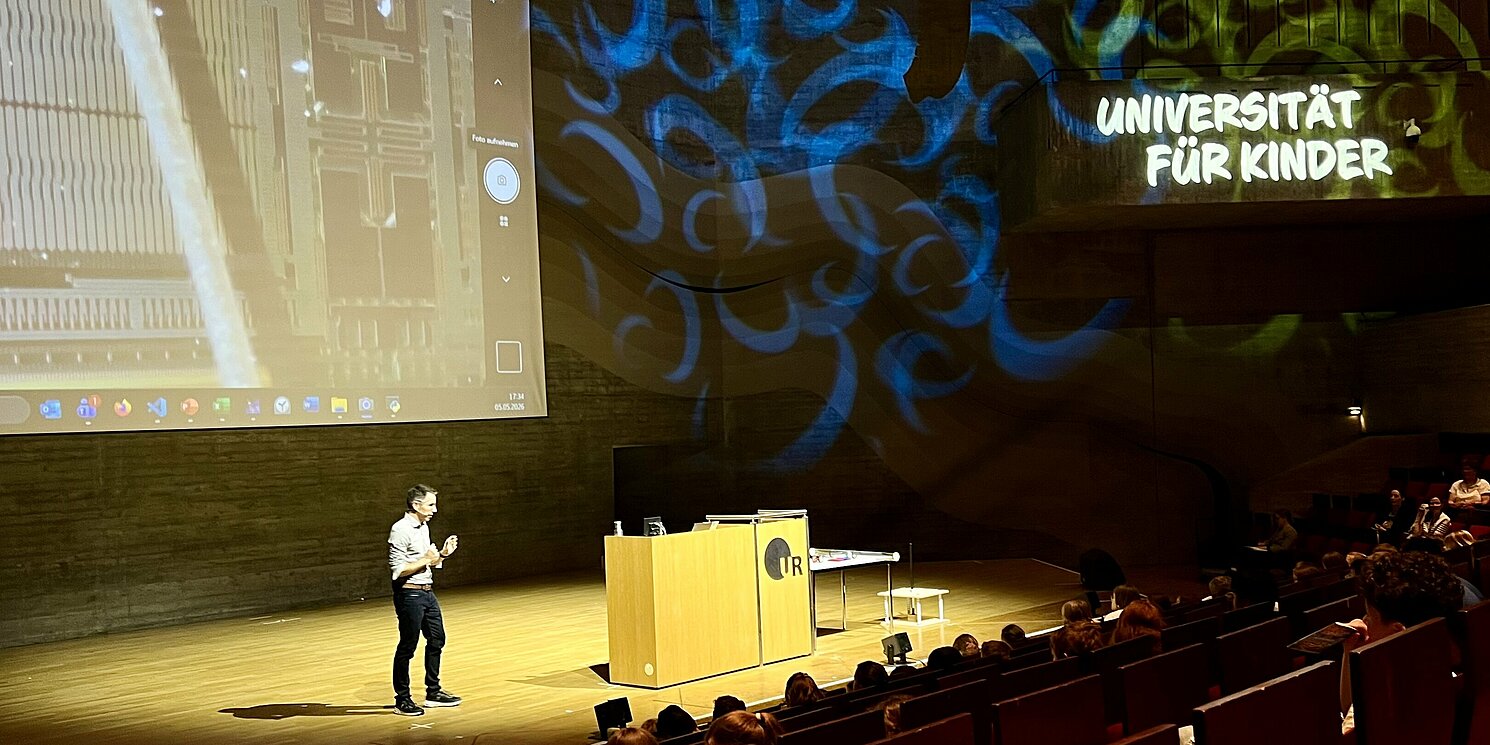
Prof. Dr Johannes Wild usually teaches physics and semiconductor physics at the Faculty of Applied Natural and Cultural Sciences at OTH Regensburg. In the main lecture theatre, his topic for the youngest students was: ‘Everything in balance: how springs in sensors can help maintain equilibrium’.
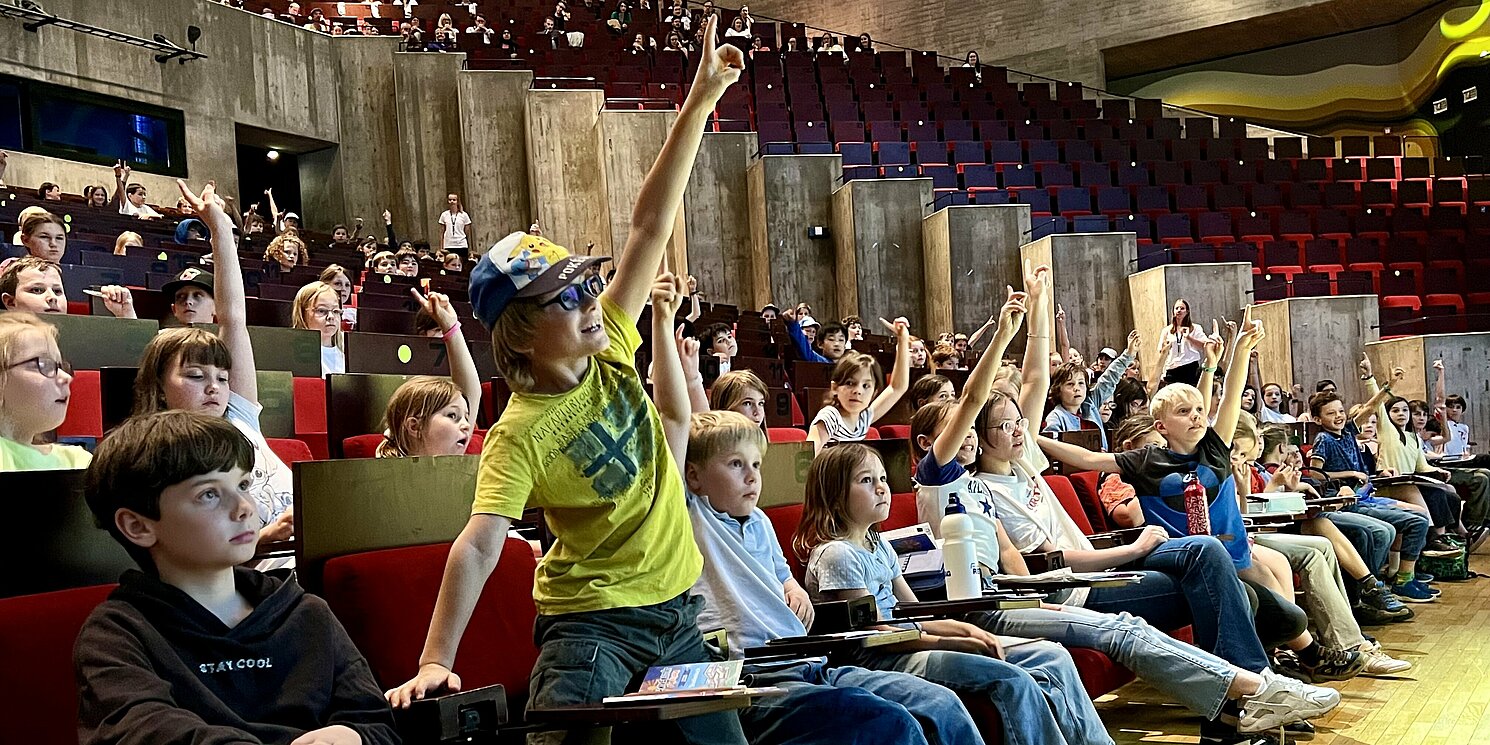
From the very first minute, physics became a hands-on experience. Through experiments on stage, Prof. Dr. Wild demonstrated how tiny weights on springs inside the chips reveal whether a device is tilted, moved or accelerated at lightning speed. Just how extreme these forces can be was shown by a test using a salad spinner: a sensor inside it measured eight times the acceleration due to gravity. These are forces usually only encountered on a rollercoaster. But the children were also allowed to get hands-on: acting as “human weights” on stage, they demonstrated the physical law of springs live: double the force results in double the deflection.
The invisible becomes visible: young researchers are amazed
The biggest ‘aha’ moment of the evening came when looking through the microscope. Suddenly it became clear: the structures inside a sensor are so tiny that a human hair looks like a tree trunk in comparison. Young visitor Henry was also amazed by this, and for him this enormous difference in size was the absolute highlight. Lilli was also fascinated, particularly by the professor balancing on his hoverboard, which reacted at lightning speed to every shift in weight thanks to its built-in sensors. Her conclusion: “I’ve learnt that sensors can be big, medium-sized and super-tiny.”
Behind these playful experiments lies genuine cutting-edge research. At the Sensor Technology Application Centre (SappZ) at OTH Regensburg, Prof. Dr Wild is researching the future of technology alongside industry partners. “Sensors are evolving from measuring devices into AI-capable platforms,” says the professor. In future, data could be analysed directly within the sensor in real time via neural networks. The professor is currently even receiving funding for teaching innovation to develop new and exciting educational concepts.
Prof. Dr Wild wants to impart one thing above all to the children: “Stay curious and develop your own interests, even if they might not be particularly popular in your circle at the moment.” The launch of the Children’s University shows that science can not only be explained, but also experienced.