The cement industry supplies an indispensable building material, but it is also one of the largest industrial sources of CO₂. In Germany alone, cement production generates around 20 million tonnes of CO₂ per year; globally, the sector is responsible for around seven per cent of global CO₂ emissions. At the same time, this industry is considered particularly difficult to decarbonise.
A key reason for this lies in the manufacturing process itself: cement is produced from limestone, which is fired at high temperatures. This releases the CO₂ chemically bound in the limestone – a process that is technically unavoidable. For every tonne of cement, this generates around 400 kilograms of CO₂ from the raw material alone, accounting for about two-thirds of total emissions. The remaining emissions result from energy consumption.
To produce cement in a climate-neutral way nonetheless, technologies are needed that capture the resulting CO₂ directly from the flue gas. This is precisely where the DECIDE research project comes in.
The collaborative project, funded by the BMWE, began in January 2026 and is scheduled to run for three years. DECIDE is researching various methods of CO₂ separation, including absorption, adsorption and so-called OxyFuel processes. In all cases, the aim is to provide clean CO₂ that can either be further utilised (Carbon Capture Usage, CCU) or stored (Carbon Capture Storage, CCS). Alongside OTH Regensburg and Linde GmbH, the Technical University of Munich is also involved in the project.
A field of research that has received little attention to date
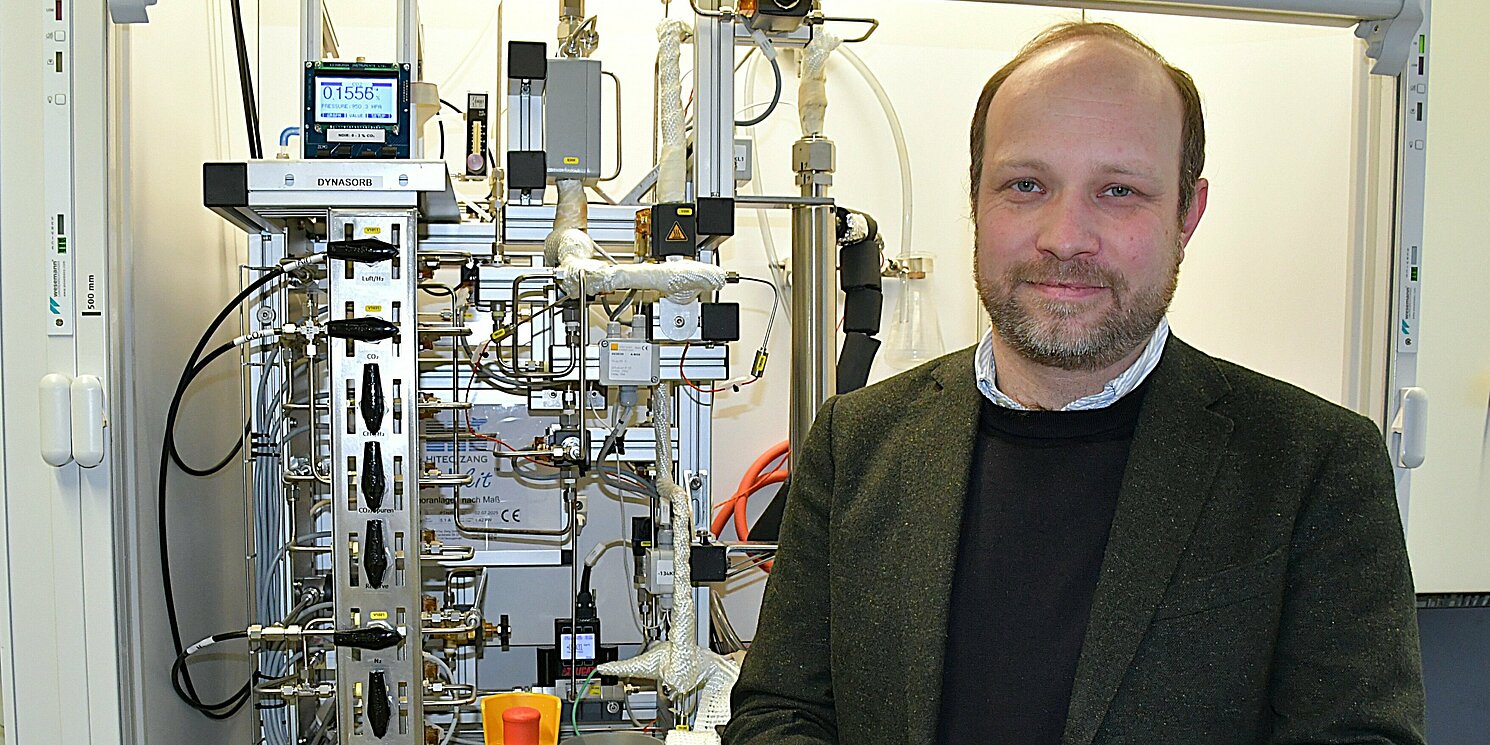
The sub-project at OTH Regensburg focuses on adsorptive CO₂ capture. OTH Regensburg is receiving approximately three million euros in funding from the BMWE for this project. The project is led by Prof. Dr Philipp Keil from the Faculty of Applied Natural and Cultural Sciences (ANK) at OTH Regensburg.
In adsorptive CO₂ capture, carbon dioxide is bound to the surface of special materials known as adsorbents. The numerous trace substances in the flue gas from cement plants, including sulphur and nitrogen oxides, heavy metals and organic compounds, present a particular challenge. How these substances affect the performance and long-term stability of the adsorbents has hardly been investigated to date.
“For CO₂ capture to work reliably in the cement industry, the materials used must remain stable even under the highly demanding and fluctuating conditions,” explains Prof. Dr. Philipp Keil, project leader on behalf of OTH Regensburg. “In the DECIDE project, we are systematically investigating for the first time how real flue gases from the cement industry affect adsorbents, thereby laying the foundation for robust industrial processes that make a rapid contribution to climate protection through efficient decarbonisation.”
Test under real-world conditions in a pilot plant
Together with its project partner Linde GmbH, the OTH team has designed and is operating a mobile container-based pilot plant that is being deployed directly at a cement plant. There, commercially available adsorbents are being tested under real-world conditions in long-term operation. In addition, extensive laboratory investigations are underway to analyse in detail the interactions between gas composition, process parameters and material properties. The aim is to derive criteria for particularly robust and efficient adsorbents and to identify potential for optimised, application-specific materials. Ultimately, the aim is to demonstrate how CO₂ capture technologies can be deployed on an industrial scale in the future, thereby providing a solution for sectors that are difficult to decarbonise.
DECIDE thus makes an important contribution to the implementation of industrial policy climate targets in Germany and Europe. With this project, OTH Regensburg underscores its role as a strong research partner for sustainable industrial transformation. The alliance of science and industry within DECIDE will develop solutions that work not only in the laboratory but also in practice, thereby opening up concrete prospects for more climate-friendly cement production.