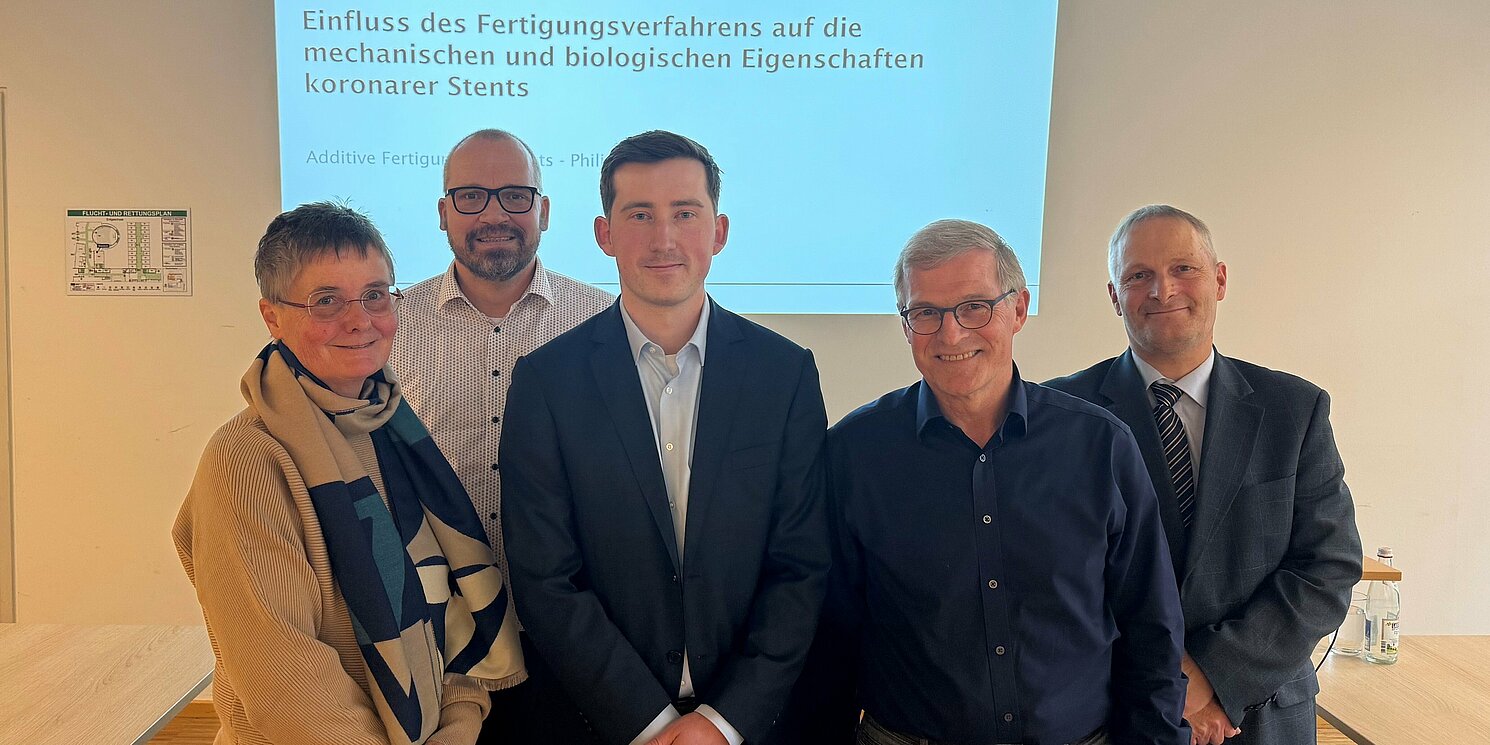
1. you have completed your doctorate - what does that mean for you personally?
Completing my doctorate marks an important personal and professional milestone for me. It stands for perseverance, independence and the ability to work on complex issues independently and bring them to a successful conclusion.
2 What is your dissertation about?
This dissertation investigates the influence of different manufacturing processes on the mechanical and biological properties of vascular stents, with a particular focus on additive manufacturing using LPBF in comparison to conventional methods. To this end, suitable manufacturing parameters were developed, a standardised stent design was implemented and samples were manufactured and post-processed both additively and conventionally. Extensive material science and standardised medical technology tests formed the basis of the evaluation.
The results show that additive manufacturing is fundamentally suitable and offers particular advantages in terms of customisation and material control, but is limited by restrictions in resolution and design freedom. Overall, the work contributes to a better understanding of the potential and limitations of additive manufacturing in medical technology and shows approaches for future optimisation.
3. what was a highlight or special experience in connection with your doctorate?
A particular highlight was the moment when I removed the first additively manufactured stents from the powder bed. This exposure of the structures showed very impressively that additive manufacturing really can be a promising way of producing such delicate components. It was a motivating moment in which the previous development work was confirmed for the first time.
4. what plans do you have for your professional future?
For my professional future, I plan to further expand my scientific and technical expertise in a targeted manner and to contribute to an innovative environment. I am currently working in development in the field of additive manufacturing, where I can directly apply and deepen the knowledge I acquired during my doctorate. I am particularly interested in the further development and industrial implementation of modern manufacturing technologies. In the long term, I would like to take on more responsibility in projects and actively contribute to the development of future-oriented solutions.
5. what tips can you give future doctoral students?
Stay patient and structured, even if progress seems slow at times, and keep the overarching goal in mind. Regular exchanges with others and obtaining feedback help to recognise and overcome challenges at an early stage.
6 Why did you choose OTH Regensburg for your doctorate?
I chose OTH Regensburg because it offers a practice-orientated research environment and good opportunities to combine science and application. I was particularly impressed by the close cooperation with industry and the excellent supervision in my chosen subject area with a lot of interdisciplinary expertise.
LINKS
- https://maschinenbau.oth-regensburg.de/labore/medizinprodukte
- Report on the doctorate: https: //maschinenbau.oth-regensburg.de/news/detailansicht-1/doktorand-entwickelt-neuartig-gefertigte-stents-zur-behandlung-der-koronaren-herzkrankheit