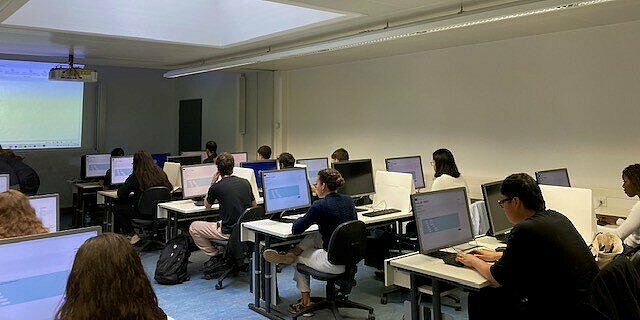
The language courses prepare international students for their studies at OTH Regensburg and are in high demand every year. A total of five courses at levels A0/A1 to B2/C1 started in September with 80 students. This provided an opportunity to test digital exam formats and evaluate their potential for teaching German as a foreign language.
Use of the Safe Exam Browser for fair examination conditions
To ensure a controlled and fair examination environment, the Safe Exam Browser (SEB) was used for the electronic examinations. The system was used in the CIP pools on campus and prevents access to unauthorised aids during the examination. At level A1, a scenario was also tested in which the SEB specifically allowed access to a certain website – for example, for the use of tasks with web-based content. A preparatory mock exam during the course helped to clarify technical issues in advance and familiarise students with the format.
Efficiency and quality in assessment
The use of electronic tests offers several advantages: many question types, such as matching tasks, multiple true/false (MTF) questions and cloze tests, are assessed automatically, which significantly reduces the amount of marking required and speeds up the delivery of results. Open-ended tasks, especially those involving written language production, continue to be assessed manually, allowing for a differentiated assessment of individual language competence.
The implementation also went smoothly from an organisational point of view. The technical infrastructure proved to be stable and the SEB was easy to use.
Digital testing as a contribution to internationalisation
Positive experiences show that digital examination formats not only offer organisational advantages, but also contribute to the internationalisation of teaching. Electronic examinations promote the digital literacy of international students and facilitate their structured entry into studies at OTH Regensburg.
Based on these findings, electronic examinations will be used regularly in language courses at levels A1 to B2 in the future. In this way, the DaF department is strengthening its role as a pioneer for digitally supported, competence-oriented examination formats and at the same time contributing to the further development of internationally oriented teaching practice at OTH Regensburg.
Overall, conducting the examinations was a very positive experience. I would like to express my sincere thanks to the Teaching and Didactics Service Centre – in particular Dr Irina Augustin and Anna Simon – for their excellent support in implementing this project.
More information is available at Assessment OTH Regensburg.