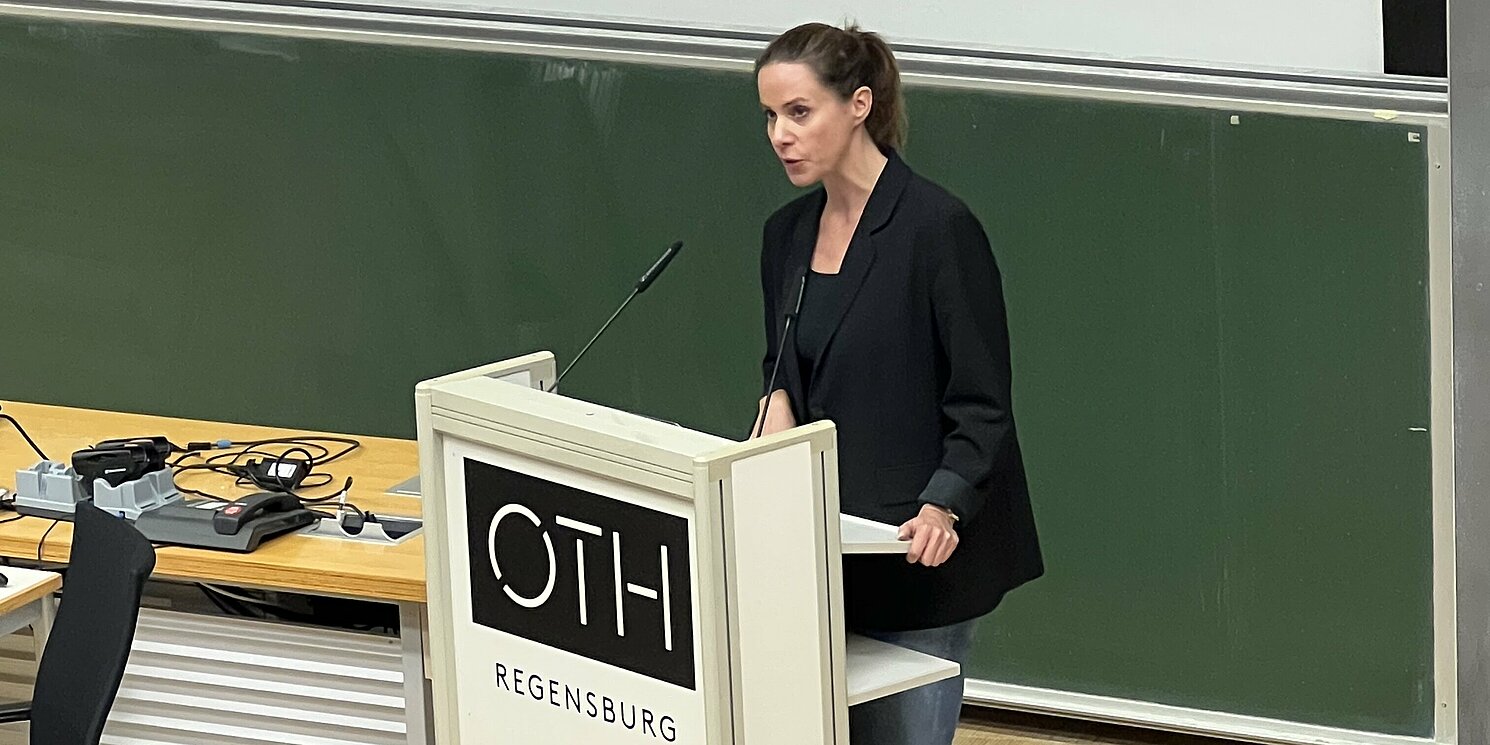
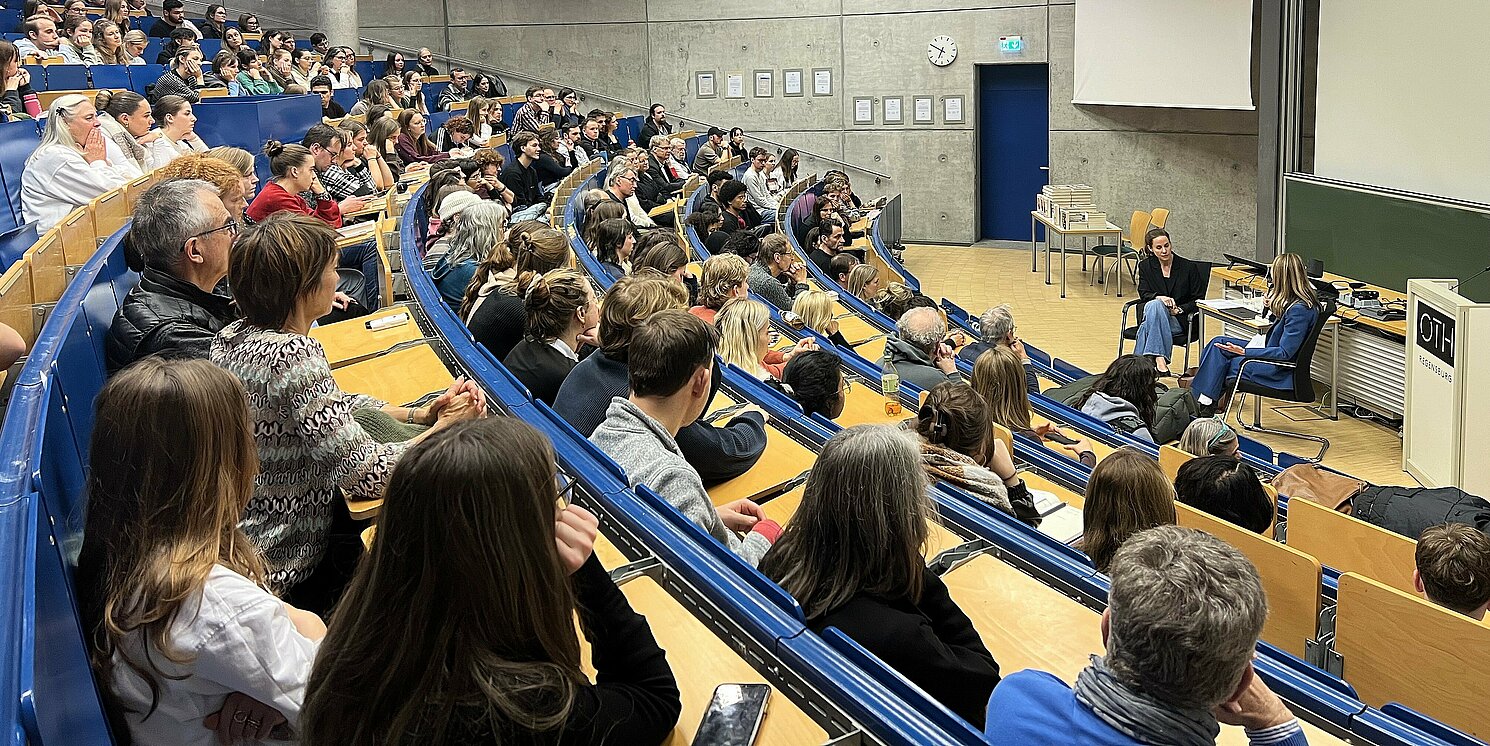
The lecture hall was completely full – students, lecturers, members of the university management and numerous interested members of the city's community took the opportunity to experience the award-winning journalist Natalie Amiri live. The evening was introduced by Prof. Dr. Nina Leffers, Deputy Commissioner for the Equality of Women in Science and Art at OTH Regensburg, followed by an introduction by Berenike Beschle from Bayerischer Rundfunk.
Behind every geopolitical headline are human destinies
In her lecture, Natalie Amiri spoke about her personal experiences from numerous stays in the Middle East and assessed the political developments in Syria, Lebanon, Israel, Gaza and Iran. She emphatically stressed that behind every geopolitical headline are human destinies. She impressively focused on these individual realities of life, especially those of local women.
The subsequent discussion with moderator Berenike Beschle focused on the challenges of journalistic work in crisis regions, the role of women in authoritarian regimes, and the question of how differentiated reporting can succeed even in polarised debates. Her plea: to also listen to the quiet voices that are working towards understanding and solutions.
The event was part of the RegensburgEXZELLENZ programme, which is supported by OTH Regensburg, the University of Regensburg and the College of Catholic Church Music and Music Education. The aim of the programme is to connect particularly talented female students and encourage them to pursue ambitious career paths. Natalie Amiri's professional career exemplifies this aspiration, characterised by journalistic courage and the balancing act between career and family.
Natalie Amiri's perspective is empathetic, humane and conciliatory
‘Natalie Amiri's view of the Middle East is empathetic, humane and conciliatory. She strives to do justice to all those involved without dividing them – rather, she builds bridges. Her reporting weaves a dense tapestry of information and personal destinies, always with a very human approach,’ said Prof. Dr. Nina Leffers in her welcome address to the speaker.
The event ended with an open question and answer session, during which the audience had the opportunity to ask their own questions and engage in conversation with the speaker. The evening was characterised by a respectful and profound exchange, in keeping with the university's mission to assume social responsibility and create spaces for dialogue.